Freelancers lose contracts over this. Students get called into academic integrity hearings. Job applicants get rejected before a human ever reads their cover letter. All because a detector said their writing was AI-generated, and someone believed it.
The detectors are wrong. Not sometimes. Often. And the people paying the price are the ones who can least afford it: writers whose English is their second language, neurodivergent professionals whose communication style reads as 'too structured,' and students who learned to write clearly and got punished for it.
This is not a hypothetical problem. It is happening right now, across every platform that sells AI detection as a service. Here is how the detectors actually work, why they fail, and what you can do if your writing gets caught in the crossfire.
How AI detectors actually work
AI detectors do not scan for watermarks. They do not look up your text in a database of known AI outputs. They do not have a secret signature that ChatGPT hides in every response. What they actually do is simpler and much less reliable.
Detectors measure two main statistical properties of text.
The first is perplexity. This is a measure of how 'surprising' each word is given the words that came before it. If I write 'The cat sat on the,' the next word 'mat' has low perplexity because it is highly predictable. If I write 'The cat sat on the chandelier,' that is higher perplexity. Language models like ChatGPT generate text with characteristically low perplexity. They pick the most probable next word, then the most probable word after that, and so on. The result is text that flows predictably, with few genuinely surprising word choices. Detectors look for that smooth predictability and flag it as AI-generated.
The second is burstiness. Human writing tends to be 'bursty.' A person might write a long, complex sentence, then follow it with a three-word fragment. Then another long sentence. Then two short ones. The rhythm is uneven. AI writing tends to be more uniform. Sentences cluster around similar lengths. The vocabulary stays in a consistent register. Detectors flag text with low burstiness as AI-generated because it lacks the unpredictable rhythm of human prose.
That is it. Perplexity and burstiness. Two statistical signals, neither of which has anything to do with actual authorship. The detector is not asking 'did an AI write this?' It is asking 'does this look like things AI usually writes?' Those are wildly different questions.
Why false positives are inevitable
The core problem is simple: clean human writing and AI writing are statistically similar. If you write clearly, with good grammar, in a formal or professional register, your text will show low perplexity and low burstiness, the same signals detectors use to flag AI output.
Think about who gets hurt by this. A non-native English speaker who learned the language through textbooks and grammar drills is going to write with lower perplexity than a native speaker who breaks rules freely. The non-native writer has fewer vocabulary options to draw from and sticks closer to standard constructions. The detector reads that as 'AI-like.' It is penalizing someone for having learned English the hard way.
Neurodivergent writers face a similar problem. An autistic professional who communicates with structured clarity, avoids ambiguous phrasing, and maintains a consistent tone throughout a document is going to produce text that looks statistically 'flat' to a detector. The very traits that make their writing clear and professional are the traits the detector was trained to flag.
Even native speakers with no particular communication style get caught. A legal brief, a grant proposal, a technical whitepaper. These genres demand formal, precise language with limited vocabulary variation. They look like AI output because the genre constraints force the same statistical profile. A detector cannot tell the difference between 'this is a legal document' and 'this is AI slop.' It just sees the numbers.
The detector companies know this. They publish disclaimers buried in their terms of service. Turnitin, one of the largest academic detection platforms, acknowledges that its AI detection tool produces false positives and should not be used as the sole basis for an academic integrity decision. But that disclaimer does not show up in the report a professor sees. It does not stop a client from firing a freelancer over a flagged deliverable. The gap between what the detector actually measures and how its results get used is the entire crisis.
Who is getting hurt
The people flagging text with AI detectors rarely understand what the score means. They treat it like a drug test: positive means guilty. But an AI detection score is not a binary test. It is a probability estimate, and a noisy one. A score of 80 percent does not mean '80 percent of this text was written by AI.' It means 'this text has an 80 percent statistical similarity to our model's training examples of AI writing.' Those are completely different statements, and the distinction gets lost every time someone opens a detector tool and sees a big red number.
The most common casualties I hear about fall into three groups.
Freelance writers get hit hardest. A client runs a delivered article through a free detector. The score comes back high. The client withholds payment, terminates the contract, or demands a rewrite with no additional budget. The writer has no recourse because platforms like Upwork and Fiverr do not have policies for disputing detector results. The detector's output gets treated as fact, and the burden of proof falls entirely on the writer.
Students are next. Universities that adopted AI detection tools after ChatGPT launched in late 2022 built their academic integrity workflows around detector scores. A flagged essay triggers an automatic review. The student has to prove they wrote their own work, often without access to the evidence they need. Google Docs version history, timestamps on drafts, notes from the research process. Most students do not preserve this material because nobody told them they would need to defend their authorship in a tribunal.
Job applicants round out the list. Companies are running cover letters and writing samples through detectors as part of the screening process. A candidate whose writing reads as too polished, too structured, or too consistent gets filtered out before a recruiter ever sees their application. The applicant never finds out why. There is no rejection email that says 'our AI detector flagged your cover letter.' You just never hear back.
What to do if you get falsely flagged
If someone runs your writing through a detector and the score comes back high, you have options. They are not great options. But they are better than nothing.
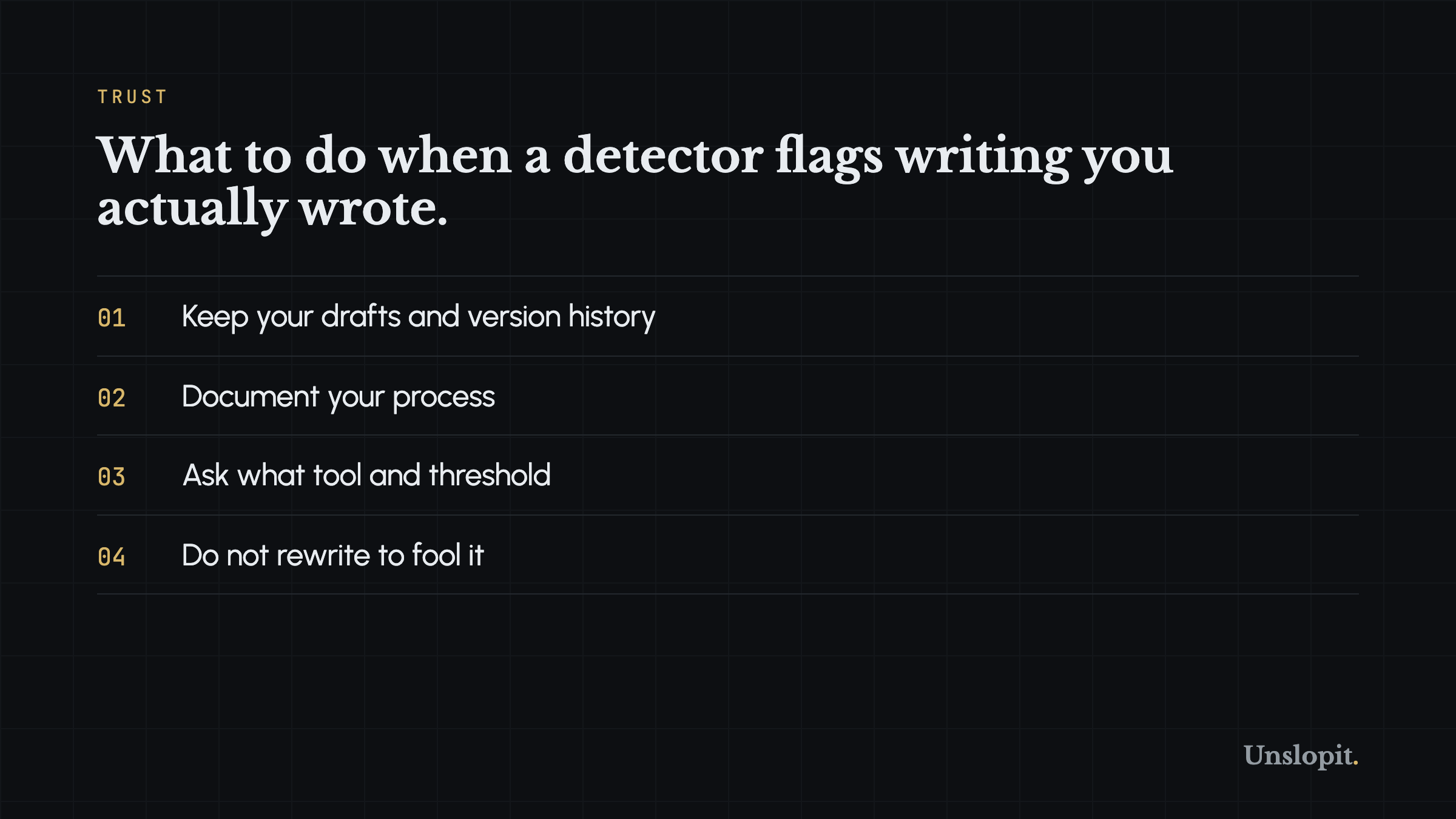
1. Keep your drafts. Always.
The single best defense against a false positive is a trail of version history. If you write in Google Docs, that history is automatic. If you write in Word, turn on Track Changes or save incremental versions. If you write in a plain text editor, commit to Git. The timestamps on your revisions prove the writing process happened over time, with edits, restructurings, and false starts. That is the profile of a human writer. AI outputs arrive fully formed.
2. Document your research process
Keep your source notes. Save the URLs you referenced. If you did an interview, keep the recording or the transcript. The more evidence you have that the content came from specific research activities, the harder it is for someone to claim an AI invented it. AI slop is notoriously bad with facts and attribution. A trail of real sources is a strong counter to a detector score.
3. Run your work through multiple detectors
Different detectors use different models trained on different data. The same text can score 95 percent on one detector and 12 percent on another. If you can demonstrate that the results are inconsistent across tools, you undermine the authority of any single score. Screenshot everything. The inconsistency itself is evidence that the technology is unreliable.
4. Ask the accuser to prove it
Detector companies rarely publish their methodology in detail. They do not disclose their training data, their false positive rates across different demographic groups, or the confidence intervals on their scores. If someone is using a detector score to take action against you, ask them: what is this tool's false positive rate for non-native English speakers? What is the confidence interval on this specific score? Can the vendor provide documentation? Most cannot. Pointing at the black box is sometimes enough to weaken the case.
5. Write with deliberate irregularity
This is a defensive tactic, not a permanent solution, but it works. AI detectors flag uniform rhythm and low perplexity. If you are writing something that is likely to get checked (a freelance deliverable, an academic essay, a job application), vary your sentence length aggressively. Throw in a fragment. Use a colloquial word where a formal one would fit. Break a grammar rule on purpose. These choices increase burstiness and perplexity, which lowers the detector score without meaningfully damaging your writing quality. It is absurd that anyone has to do this. But until detection technology improves, it is a practical hedge.
Why Unslopit is not a detector evasion tool
This is where I need to be direct. Some products in this space promise to 'beat AI detectors' or 'humanize your AI text so it passes detection.' We do not do that. We will never do that.
The reason is not moral posturing. It is practical. If detection technology is unreliable (and it is), then optimizing text to beat detection is optimizing for the wrong target. You end up chasing a moving statistical threshold set by black-box models whose training data and false positive rates are unpublished. That is not quality improvement. That is an arms race against a broken measuring stick.
Unslopit takes a different approach. We rewrite AI drafts in your actual voice. You give us a writing sample (500-plus characters), we build a voiceprint, and we rewrite any text to match how you actually write. We also run a deterministic auditor that scores the output on anti-slop dimensions: em dashes, buzzwords, scaffold phrases, copula inflation, sentence rhythm, and specificity. The score is transparent. It is not a black box. It tells you exactly what it found and where.
If your writing gets flagged by a detector, running it through Unslopit will probably not fix the flag. We are not tuning for detector scores. We are tuning for your voice and for clean, specific, human-sounding prose. Those goals overlap with 'not looking like AI' in the same way that healthy eating overlaps with weight loss. The mechanism matters.
Where we go from here
The AI detection industry is not going away. Too many institutions have already wired detection into their workflows. But the conversation needs to shift from 'did AI write this?' to 'is this good writing?' A detector score tells you nothing about accuracy, originality, voice, or usefulness. It tells you about statistical patterns in word choice and sentence structure. Those patterns correlate with AI output. They do not prove it.
If you are a freelancer, protect yourself with version history and source documentation. If you are an educator, treat detector scores as one data point among many, never as a verdict. If you are a hiring manager, read the cover letter before you run it through a tool. And if you want to check whether your writing carries the tells that make it look like AI slop (regardless of who wrote it), the free Slop Score grader at unslopit.io/score will flag the specific patterns for you. No signup. No detector. Just a breakdown of what makes your text read the way it reads.