Yes, students have been expelled because an AI detector was wrong. In May 2026, a Palo Alto high school student was kicked out after Turnitin flagged his essay on "The Crucible" as 76 percent AI-generated. His family sued the school district in federal court, alleging the detector is biased, the process was broken, and the expulsion put the student's visa at risk. That case is pending. It is not the first. There have been at least six US lawsuits over AI detection false positives, and the number of unreported cases (students who accepted the accusation, dropped out, or just took the F) is anyone's guess.
What happened in the Palo Alto AI detector expulsion case?
The case is Kato v. Palo Alto Unified School District, filed May 2026 in the Northern District of California. A parent, Takashi Kato, sued after his son's English essay was flagged 76 percent AI by Turnitin. The essay was on Arthur Miller's "The Crucible." The complaint says the school disciplined the student without a meaningful hearing, re-ran his handwritten rewrite through Turnitin without the family's consent, and ignored evidence that the student wrote the paper himself.
The case is unusual for two reasons. First, it is a K-12 case, not a college case. Most AI detection lawsuits involve universities. Second, the complaint raises Title IX and Title VI discrimination claims, alleging male students in the class were flagged far more often than female students. That statistical argument has not been tested in court before. Whether it holds up is unclear. But the fact that a parent is now alleging discrimination-by-detector tells you how far the stakes have risen.
The student also faced visa implications. International students on education visas can lose their legal status if they are expelled for academic misconduct. A false AI flag threatens more than a grade. It can threaten a family's right to stay in the country.
How often do AI detectors falsely accuse students?
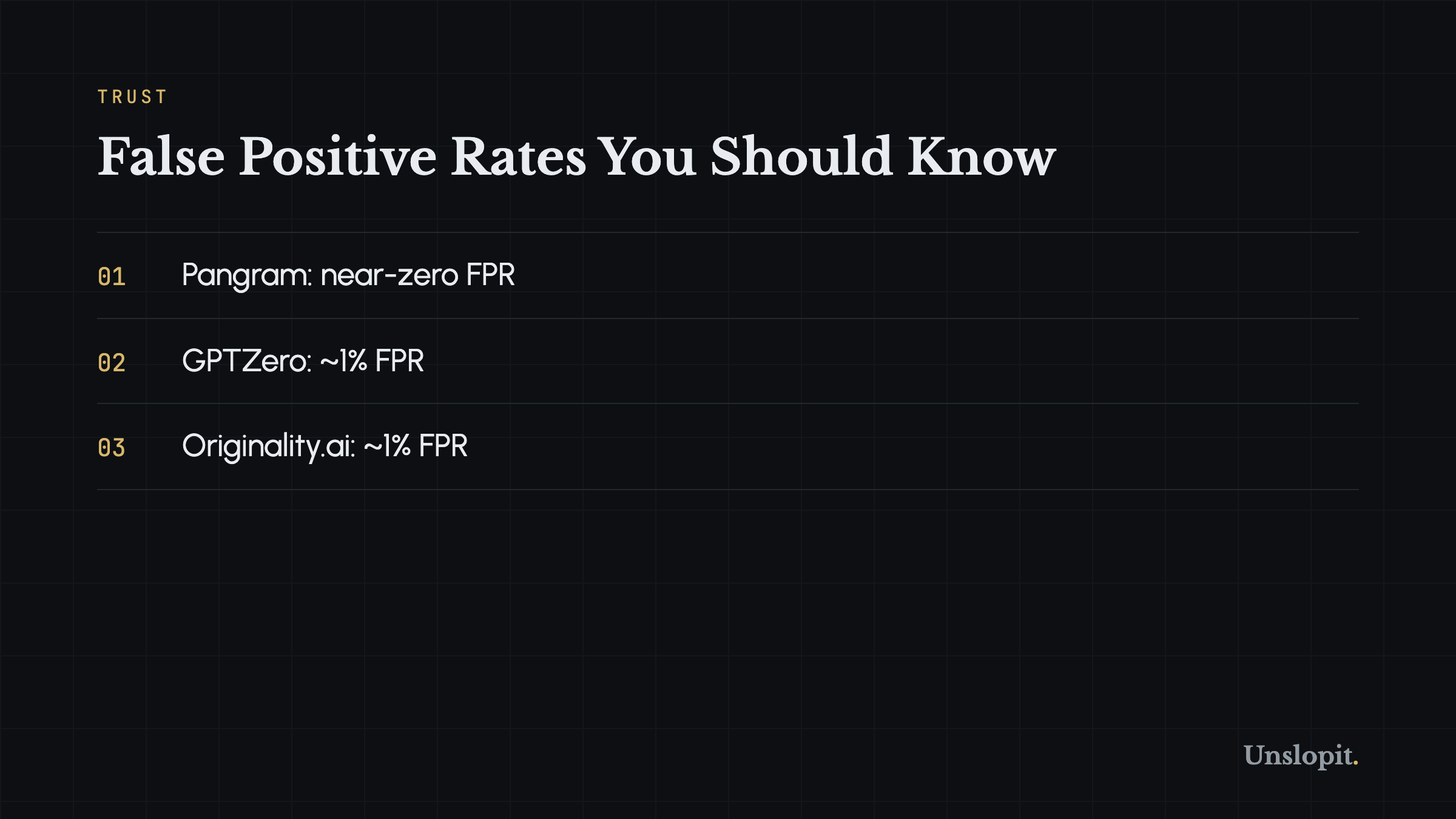
More often than the companies selling them will admit. Turnitin, the dominant player on US campuses, claims a false positive rate below 1 percent. Independent research paints a very different picture.
The Stanford study that broke this open came from James Zou's lab in 2023. They tested seven commercial AI detectors against essays written by native English-speaking eighth graders and essays from the TOEFL exam (Test of English as a Foreign Language). The results were stark. For native speakers, detectors were near-perfect. For non-native speakers, the detectors flagged 61.3 percent of human-written essays as AI-generated. All seven detectors unanimously labeled 19 percent of TOEFL essays as AI-written. And 97 percent of the non-native essays, 89 out of 91, were flagged by at least one detector.
Think about that. If seven different detectors all agreed that 18 essays were AI-written, and those essays were all written by real humans, what confidence does a single detector score give you? None.
Then there is the regulator side. In August 2025, the Federal Trade Commission finalized an order against a company called Workado, which had advertised its AI detector as 98 percent accurate. The FTC found the real accuracy was about 53 percent. "Essentially a coin toss," the commission said. OpenAI pulled its own AI detector in July 2023 after finding it correctly identified only 26 percent of AI-written text while falsely flagging 9 percent of human writing as AI. Even the people who build the language models cannot build a detector that works.
Why do universities keep using detectors that everyone knows are flawed?
Some are stopping. Vanderbilt disabled Turnitin's AI detection in 2023. The University of Waterloo did the same in 2025. Michigan State told faculty that detector outputs are "potential indicators, not conclusive evidence" and should "never serve as the sole basis" for a misconduct finding. Yale has deprioritized detection. The University of Cape Town discontinued all AI detection tools in October 2025.
But many institutions keep the tools running. The reason is not ignorance. It is institutional math. A university that gets caught missing AI cheaters faces reputational damage, angry parents, and accreditation pressure. A university that falsely accuses a handful of students faces, at most, a few angry phone calls and maybe a lawsuit. The incentives are lopsided. Over-enforcement is the safer play for the institution even when it destroys individual students.
The detector outputs are potential indicators, not conclusive evidence. They should never serve as the sole basis for a misconduct finding.
— Michigan State University faculty guidance on AI detection
Can AI-generated content actually be detected?
The strongest answer from computer science is: probably not, at least not reliably. Soheil Feizi, an assistant professor at the University of Maryland, published research in 2023 showing that even the best AI detectors fail when the AI text is run through a basic paraphraser. Accuracy drops from near-perfect to coin-flip levels. His team's conclusion was blunt: "Current detectors of AI are not reliable in practical scenarios."
Feizi went further on the theory side. Because the distribution of human-written and AI-written text is so close, especially as models improve, he argues there is a fundamental upper bound on detection accuracy. Paraphrase the AI text, change a few words, mix in some human edits, and the signal disappears. He put it plainly: "Theoretically, you can never reliably say that this sentence was written by a human or some kind of AI."
Other researchers, like Furong Huang at UMD, think better detectors are possible with more training data and larger text samples. But even Huang's team agrees that detection is an arms race. Every improvement in detection gets met with an improvement in generation. The gap never closes.
Who is most at risk from a false AI accusation?
Three groups face the highest risk, and the risk is systematic, not random.
Non-native English speakers are the most vulnerable by a wide margin. The Stanford data is unambiguous: 61 percent false positive rate versus near-zero for native speakers. The reason is how detectors work. They measure "perplexity," which correlates with vocabulary range and syntactic complexity. Non-native writers tend to use simpler, more predictable sentence structures. So does ChatGPT. The detector cannot tell the difference between "writes simply because English is a second language" and "writes simply because the text was generated by a language model." The detector sees the pattern. It does not see the person.
Neurodivergent students are the second high-risk group. Orion Newby, the student who won his case against Adelphi University in January 2026, is autistic and was enrolled in Adelphi's Bridges support program. His Turnitin score came back as 100 percent AI-generated. Two other tools, Grammarly and ZeroGPT, said the essay was human-written. The judge annulled Adelphi's misconduct finding and ordered Newby's record expunged, describing the university's determination as "without valid basis and devoid of reason." Newby won. Most students in his position do not have a lawyer.
The third group gets less attention but might be the largest: students who simply write well. Clean prose. Consistent structure. Formal tone. These are the same features that detectors associate with AI output. A student who learned to write structured essays in high school, who avoids fragments and uses transitions, is more likely to get flagged than a student who writes messier, more idiosyncratic prose. The incentive is perverse. Students on Reddit threads about getting flagged have started asking each other whether they should "write worse" to avoid the accusation. That is not a joke. It is happening.
What other AI detection lawsuits have been filed?
Kato v. Palo Alto is the newest case, but it follows a growing docket. The tracker on GradPilot counts six US lawsuits where a student was accused of AI misconduct based on a detector. Two have been decided. Three are pending. One student has won.
- Newby v. Adelphi University (decided Jan 2026). Autistic student Orion Newby's essay was flagged 100 percent AI by Turnitin. A New York state judge annulled the finding and ordered his record expunged. The student won, but on due process grounds: the university ignored exculpatory evidence.
- Harris v. Hingham (decided 2024). A Massachusetts high school student was disciplined for using AI on an AP US History project. A federal court denied the family's request to raise the grade. The school won.
- Yang v. University of Minnesota (decided 2025-2026). PhD student Haishan Yang, a Chinese national, was expelled after GPTZero flagged a preliminary exam. He lost on both state appeal and federal court. The school followed its process, and the court deferred to it.
- Rignol v. Yale (pending). French MBA student Thierry Rignol was suspended after GPTZero flagged a final exam. He alleges national-origin bias. A preliminary injunction was denied. The case continues.
- Doe v. University of Michigan (pending). A student with documented anxiety and OCD says her meticulous writing style was misread as AI. No detector score was named; the accusation rested on instructor judgment. A preliminary injunction was denied in May 2026.
- Kato v. Palo Alto USD (pending). The Crucible essay case. Newly filed May 2026. Title IX and Title VI discrimination claims.
The pattern across these cases is clear and a little depressing. Students who win, win on due process: the school ignored evidence, denied a fair hearing, or failed to accommodate a disability. Students who lose, lose because the school followed its own procedures, and courts are reluctant to second-guess academic judgments. No court has yet ruled that an AI detector is itself unlawful or unreliable as a matter of law. The technology gets a pass while the process around it takes the scrutiny.
How do students actually fight back against a false AI accusation?
The most effective defense is also the simplest: version history. William Quarterman, a UC Davis student flagged by GPTZero in 2023, cleared his name by showing his Google Docs edit history. Every draft, every revision, every timestamp. The professor dropped the case. Quarterman also ran the Declaration of Independence and the Bible through GPTZero. Both came back flagged as AI-generated. That comparison has since become the go-to demonstration for students fighting an accusation.
If version history is not enough, the next step is procedural. Most universities have an academic integrity appeals process. The key is to make the school follow its own rules. Ask what evidence was considered beyond the detector score. Ask whether the professor reviewed the score in context or treated it as dispositive. Ask for a hearing. Newby v. Adelphi proves that when a school ignores exculpatory evidence, courts will intervene. But the student has to document everything.
Litigation is the last resort and the most expensive. A student plaintiff needs to show more than "the detector was wrong." Courts have not accepted that argument yet. What works instead: showing the school denied due process, discriminated on the basis of national origin or disability, or breached its own published policies. The Rignol v. Yale case tests the national-origin theory. The Doe v. Michigan case tests disability discrimination. The Kato v. Palo Alto case tests both discrimination and process claims. These are the legal frontiers.
There is also a quieter form of recourse: universities turning the detectors off. An 1,100-plus signature petition at the University at Buffalo in 2025 demanded that Turnitin's AI detector be disabled. Vanderbilt, Waterloo, Michigan State, and Yale have all pulled back. Faculty pressure matters. When enough professors report false positives in their own classes, IT departments listen.
What should students do right now to protect themselves?
- Write in Google Docs with edit history turned on. Every revision gets timestamped. If you get flagged, you can show the whole process from blank page to final draft.
- Save your notes, outlines, and research materials. The more evidence you have of how you built the paper, the harder it is for a single detector score to stand alone.
- Know your school's AI policy before you submit anything. Some schools ban detection evidence entirely. Others allow it but require human review. If your school's policy says detectors are "indicators, not proof," quote that language back in your defense.
- Check your own writing before submitting. Run a paragraph through a free detector. If it flags clean human writing, you know the tool is unreliable for your style. Screenshot that result.
- If you use Grammarly or any AI-assisted editing tool, check your school's policy. Some schools treat AI-assisted editing the same as AI generation. Others draw a line. Know which side your school is on.
Where does this leave us?
The detectors are not going away. Turnitin has a lucrative institutional market. GPTZero is raising venture money. The fear of AI cheating is real, and schools want a tool that gives them answers. But the tool does not work. It is biased against non-native speakers, unreliable on short passages, and trivially defeated by paraphrasing. And yet students are being expelled on the basis of its output.
The lawsuits and overturned expulsions are only the visible cost. The real damage is the chilling effect. Students who write formally or simply are now afraid their own voice will get them accused. International students are terrified that a false flag will cost them their visa. Neurodivergent students are getting flagged for writing patterns they cannot change. And every student who takes the F rather than fight is a data point that will never appear in a court docket.
The fix is not a better detector. The UMD research suggests a better detector may not be possible. The fix is to stop treating AI detection scores as evidence at all until the tools can be independently validated by the accused. A student should have the same right to challenge a detector score that they have to challenge any other piece of evidence used against them. Right now, they do not. The machine says 76. The student says "I wrote it." And the machine usually wins.
If you are worried about your own writing getting flagged, the clearest defense is to write in your actual voice. Not a flattened, generic tone that a detector might confuse with AI output. Real voice, with its quirks and rhythms and uneven sentence lengths, is harder for a perplexity-based detector to misclassify. You can get a free Slop Score at unslopit.io/score to see how your writing reads. No signup, no card. It will not tell you whether a detector will flag you. But it will tell you whether your writing sounds like you or like a language model trying to sound like everyone else. That distinction matters more than any detector score.