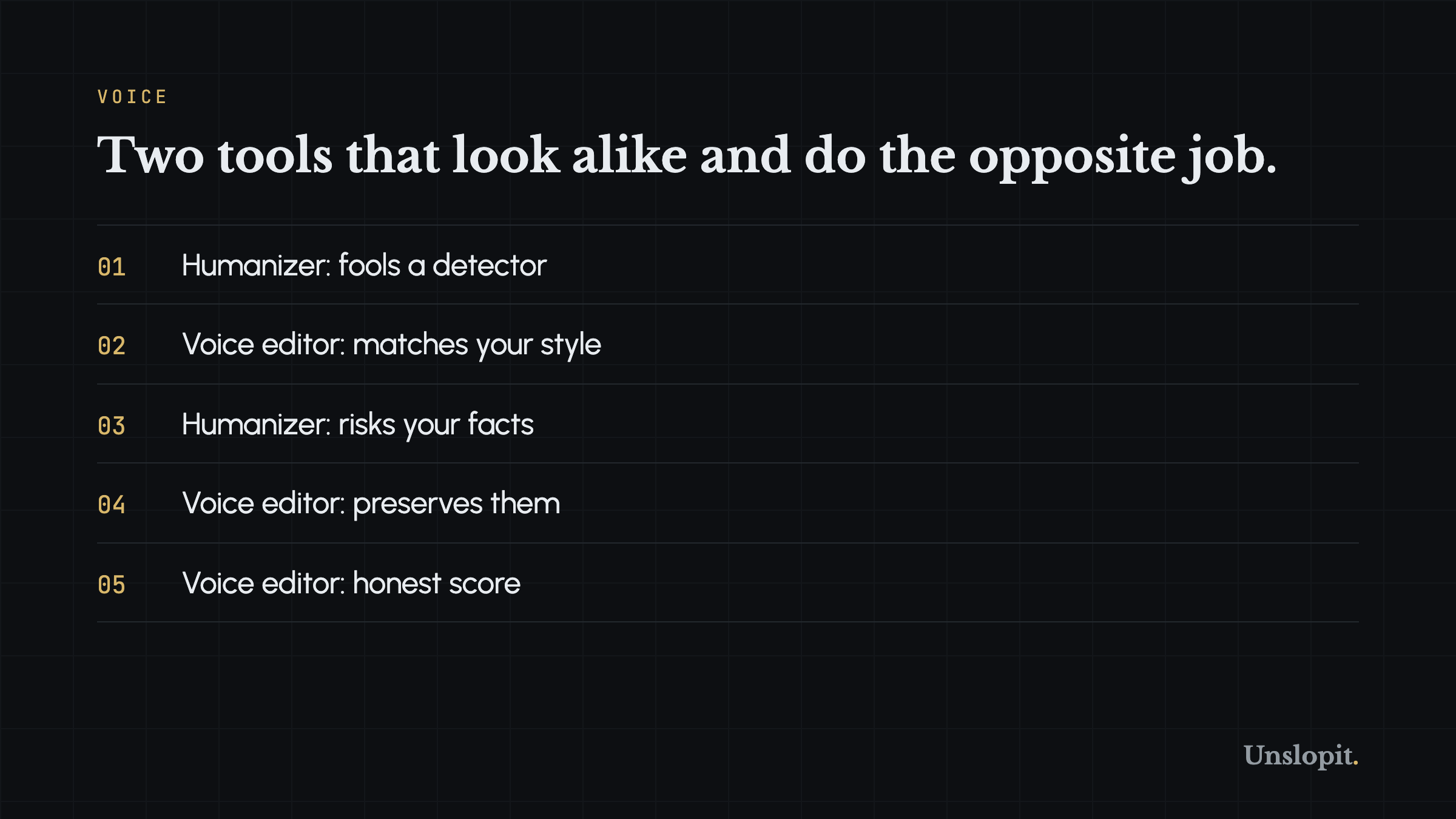
They solve opposite problems. An AI humanizer exists to fool detectors. Its job is to scramble your text enough that an algorithm cannot tell a machine wrote it. A voice editor exists to make your text sound like you. Its job is to learn your patterns and apply them to whatever you write, while keeping your facts intact and your meaning honest.
The two tools get lumped together because they both rewrite text. That is like lumping together a forgery and a portrait because they both involve paint. The intent, the mechanism, and the outcome are completely different. If you pick the wrong one, you get the wrong result. And most people are picking wrong.
What is an AI humanizer actually doing?
An AI humanizer takes AI-generated text and mutates it until AI detectors stop flagging it. That is the entire job description. Quality, accuracy, and voice are not objectives. They are collateral.
The techniques vary by tool but share a common logic. Add unpredictability. Break the statistical patterns that detectors look for. Common approaches include:
- Humanizers deliberately insert typos or minor grammatical errors because detectors associate perfect spelling with AI output.
- Humanizers swap common AI vocabulary for less common synonyms, regardless of whether those synonyms fit the context.
- Humanizers vary sentence length artificially. Some sentences become fragment-short. Others get run-on long. The goal is disrupting the rhythm patterns detectors recognize.
- Humanizers remove or replace transition words that models overuse: "furthermore," "however," "additionally."
- Humanizers sometimes add personal anecdotes or emotional language that was not in the original, because detectors associate objective tone with AI.
Notice what is missing from that list. Preservation of meaning. Consistency of voice. Factual accuracy. These are not in the brief because the brief is simple: do not get caught.
I tested several popular humanizers with a paragraph containing five specific claims and three named entities. The results were consistent across tools. The output passed AI detection. It also mangled two of the five claims, dropped one named entity entirely, and introduced a new claim the original never made. The prose sounded more "human" in the sense that it read less like a model and more like a first draft written at 2 a.m. That is not a compliment.
Why humanizers make your writing worse
The core problem is structural. Detection evasion and writing quality are competing goals. Every change you make to fool a classifier takes you further from clear, accurate communication. You are not editing. You are adding noise.
Here is what the noise costs you:
- Precision goes first. The humanizer replaces "implemented a new inventory management system" with "set up a way to track stuff." The detector is happy. Your reader now thinks you run a lemonade stand.
- Voice evaporates. The humanizer does not know your style and does not care. It applies generic "human-like" patterns that belong to no one. Your writing stops sounding like you and starts sounding like everyone else who used the same humanizer.
- Facts degrade. Any rewrite that does not anchor and verify facts will drift them. Humanizers are aggressive rewriters by design. The drift is worse than with standard AI rewriting because the changes are less predictable.
- Credibility cracks. A reader who spots a deliberate typo does not think "ah, a human wrote this." They think "this writer cannot spell." A reader who spots an out-of-place synonym does not think "clever evasion." They think "this person does not know what that word means."
That last point matters more than it seems. Humanizers are designed to fool machines, but humans read the output too. When your client, professor, or editor sees writing that is slightly off in ways they cannot articulate, they do not diagnose it as humanized AI. They diagnose it as bad writing. You traded detection risk for credibility risk. That is a bad trade.
What a voice editor does differently
A voice editor starts from the opposite premise. The goal is not to hide that AI was involved. The goal is to produce writing that represents you accurately, whether or not AI assisted. The AI part is a tool, not a secret. The output should sound like you wrote it on your best day.
Here is how voice editing works, step by step:
- You provide a writing sample. Ideally 500 characters or more of your natural writing. Emails, blog posts, reports. Anything you actually wrote.
- The editor analyzes your patterns. Sentence length distribution. Vocabulary range and preferences. How you open paragraphs. How you transition. Whether you write in fragments or full clauses. Your punctuation habits. Your structural tics.
- The editor builds a voiceprint. This is not a generic "casual" or "professional" setting. It is a fingerprint of your specific writing behaviors.
- When you submit a draft, the editor rewrites it through your voiceprint. Same facts. Same structure. Your cadence, your word choices, your rhythms.
- The editor scores the result on two honest dimensions: how closely it matches your voice, and how free it is of AI slop markers. You see both scores. No gameable "human score" that hits 100% because it sprinkled in some typos.
The distinction from a humanizer is fundamental. A humanizer asks "does this sound like a human wrote it?" A voice editor asks "does this sound like YOU wrote it?" The first question has a thousand answers. The second has one.
Humanizer vs voice editor: the comparison
If you are choosing between these tools, here is what you are actually choosing between:
- Goal: Humanizers aim to bypass AI detection. Voice editors aim to produce writing that sounds like a specific person.
- Mechanism: Humanizers add noise: typos, synonym swaps, rhythm scrambling. Voice editors apply a learned style profile: your vocabulary, your cadence, your sentence structures.
- Fact handling: Humanizers change words aggressively and often drift or drop facts. Voice editors anchor every name, number, and claim before rewriting, then verify they survived after.
- Quality: Humanizer output often reads as worse than the original. Deliberate errors and awkward synonyms degrade readability and credibility. Voice editor output should read as better. The goal is your best writing voice, applied consistently.
- Scoring: Humanizers give you a detection-evasion score. High score means the detector was fooled. It says nothing about quality or accuracy. Voice editors give you an anti-slop score and a voice match score. High scores mean the writing is clean and sounds like you.
- Accountability: Humanizers succeed when no one notices the machine. Voice editors succeed when readers think you wrote it, because it genuinely reflects how you write.
- Use case: Humanizers are for people who want to hide AI use. Voice editors are for people who use AI as a drafting tool and want to make the output their own.
The tradeoff is honest. Voice editors require setup. You need to provide a writing sample. You need to think about what your voice sounds like. Humanizers are instant. Paste, click, get output. But the convenience costs you in quality, accuracy, and the slow erosion of whatever made your writing yours in the first place.
Why the distinction matters for professional writing
If you write for work, you already know the anxiety. Your industry is flooding with AI-generated content. LinkedIn reads like a bot convention. Client emails all hit the same three tone registers. Proposals, reports, and analyses blur into a single generic hum. Standing out is hard. Sounding like yourself is harder when every tool encourages you to sound like everyone else.
The humanizer approach makes this worse. It layers a second generic filter over already-generic AI output. The result is writing that belongs to no one. It passes detection but fails the only test that matters: does anyone want to read this?
I have watched this play out in freelancer communities. Writers who rely on humanizers report a pattern: their work gets accepted faster because no detector flags it, but their repeat client rate drops. The clients cannot explain why they stopped hiring the writer. They just know the writing feels... off. Flat. Like it was written by someone who was not really thinking about the topic. The humanizer solved the detection problem and created a quality problem the client felt but could not name.
Voice editing takes the other path. It acknowledges that AI drafting is useful and probably here to stay. The problem is not that AI helped write something. The problem is that AI writing sounds like AI writing. The fix is to make it sound like the person whose name is on it. Your clients hired you, not a weighted average of internet text. Your readers follow you, not a language model.
When should you use which one?
If your primary concern is getting past an AI detector, and you are willing to accept worse writing in exchange, a humanizer does that job. I do not recommend it. The cost in quality and credibility is high, and the detectors keep getting better. You are playing whack-a-mole with your own reputation.
I get why people reach for humanizers. The fear of being flagged is real. Students get accused of cheating. Freelancers lose clients. Job applicants get filtered out before a human reads their cover letter. A tool that promises to make the problem go away is tempting. The tragedy is that the tool often makes the writing worse than if you had just left the AI draft alone and edited it yourself. The cure is more damaging than the condition.
If your concern is that your writing does not sound like you, or that AI-assisted drafts feel generic and bloodless, you want a voice editor. Build your voiceprint once. Use it on every draft. The output carries your patterns, your word choices, your rhythm. Readers notice the difference even if they cannot name it.
There is a middle ground worth mentioning. Some writers use a voice editor for the final polish but still draft with AI. The AI handles structure and research synthesis. The voice editor handles the rewrite into their specific style. This is not cheating. It is the same division of labor that has always existed between writers and editors, except the editor is now a tool that learned your voice from samples you provided. The output is yours. The process is efficient. Nobody got fooled.
If your concern is factual accuracy, neither category is automatically safe. Most voice editors do not anchor facts the way Unslopit does. Ask the tool what it does to prevent drift. If the answer is vague ("our model understands context"), assume facts will drift. If the answer is deterministic ("we extract every fact, anchor it, and verify it after rewriting"), you can trust the output.
No card. No signup. Just an honest score.