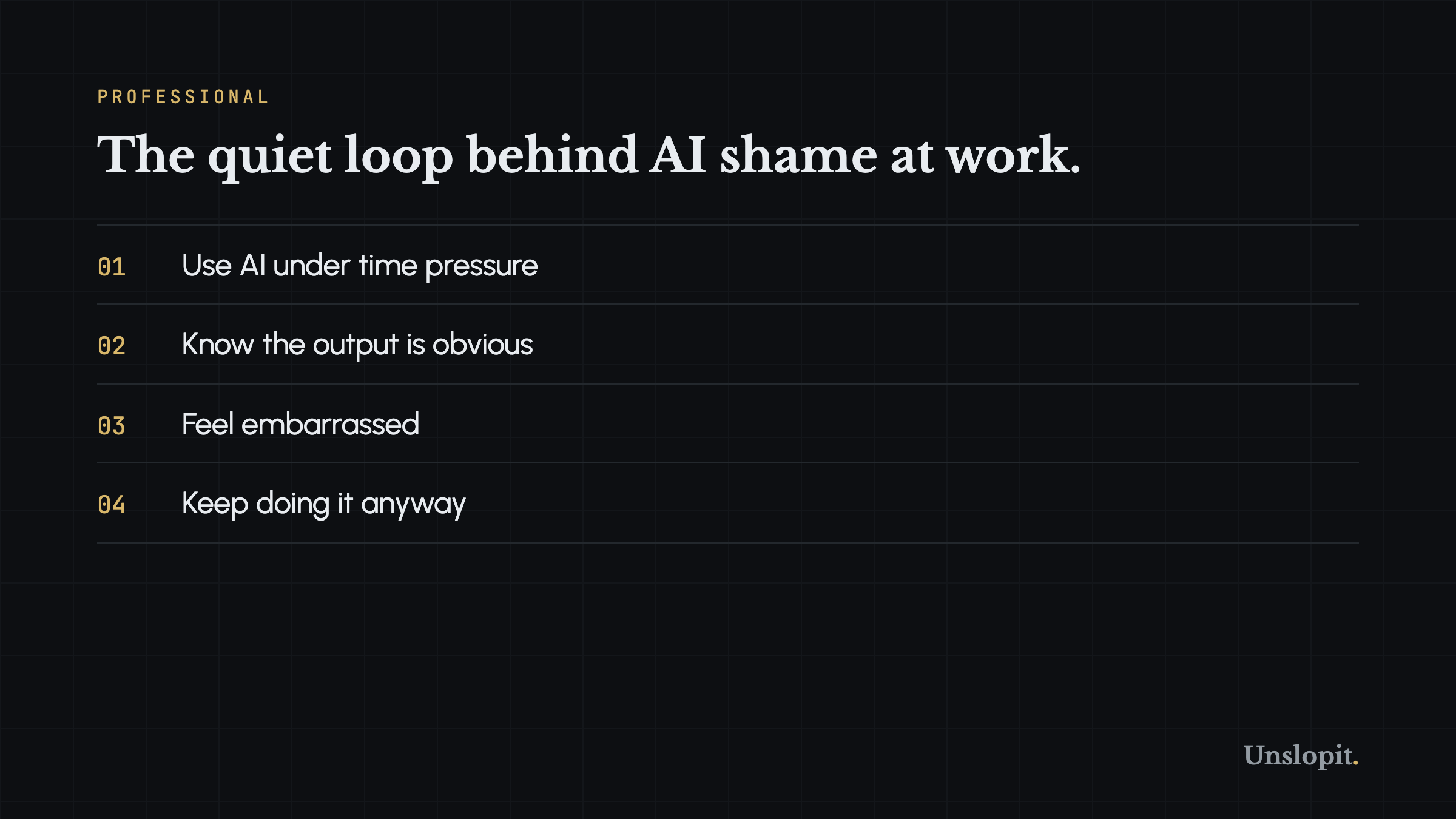
AI shame is the quiet embarrassment of posting something you know reads like a machine wrote it. It is the pause before you hit send on a Slack message. The hesitation before publishing a LinkedIn post. The hope that your boss skims instead of reads. A Reddit thread about this exact feeling hit 1,600 upvotes and hundreds of comments because the experience is nearly universal among people who use AI at work. The dynamic is not complicated: people use AI because time pressure demands it, they know the output is painfully obvious, they feel a small sting of shame, and they post it anyway. The shame does not come from using the tool. It comes from producing work that screams AI while pretending it does not.
What AI shame actually looks like
It starts small. You ask ChatGPT to draft an email. The output is grammatically correct and tonally wrong. It uses words you have never typed in your life. "I hope this message finds you well." You have never written that sentence. But you are behind on replies and the alternative is leaving someone waiting until tomorrow. So you change two words and send it. You feel a small wince as your finger lifts from the enter key.
Over time the volume grows. You are generating Slack updates, client emails, performance reviews, project summaries. Every piece of output carries the same flat, frictionless rhythm. Your coworkers do not say anything. But you notice their replies do not reference anything specific you wrote. They skimmed it. They knew.
AI shame is not about getting caught by a detector. Most people never run their colleagues' writing through GPTZero or Originality.ai. They do not need to. The tells are obvious to anyone who has used ChatGPT more than twice. The em dashes. The word "delve" appearing in a sentence about quarterly targets. The paragraph that opens with "In today's fast-paced business environment." The uniform sentence rhythm that reads like a metronome. These are not subtle signals. They are neon signs, and everyone in the room can see them.
Why we keep using AI writing we are embarrassed by
Time pressure is the main driver. A manager needs to send five client updates before a 3 p.m. meeting. Writing each from scratch takes twenty minutes. AI takes two. The quality gap is real, but the time gap is larger, and time wins. Every single time.
Volume demands make it worse. Content marketers who used to write two blog posts per week are now expected to produce five. Social media managers juggle four platforms instead of two. Internal comms teams that sent one company update per month now push weekly newsletters. The only way to hit the numbers is to draft with AI. Everyone in these roles knows this. Nobody talks about it openly. The quiet agreement is: we all do it, we all see it in each other's work, and we all pretend not to notice.
There is also a weird normalization happening. When everyone's LinkedIn feed fills with posts that share the same cadence and vocabulary, the bar drops. "Good enough" becomes the standard, not because anyone likes it, but because it is what everyone else is doing. The shame dulls into resignation. This is just how things sound now. You stop cringing at your own posts because every other post in the feed reads the same way.
But the shame does not fully go away. It sits in the background, a low-grade awareness that the work you are putting your name on does not carry your voice. For people who take pride in their writing, this is corrosive. It turns a craft into a copy-paste operation. You start to wonder whether any of your colleagues can still tell the difference between something you actually wrote and something you generated and lightly edited. You start to wonder whether you can tell the difference yourself.
The tells that make AI writing embarrassing
Some AI tells are subtle. Most are not. Here are the ones people notice immediately, whether they can name them or not.
The em dash is the number one dead giveaway. Most humans type a hyphen and call it done. AI floods text with em dashes, sometimes three or four per paragraph. Once you notice this, you cannot unsee it. A paragraph with five em dashes is not a paragraph a human wrote. It is a paragraph a model generated, and everyone reading it knows.
Banned word clusters are the second tell. "Delve." "Tapestry." "A testament to." "In the realm of." These words appear in AI output constantly because they appeared constantly in the training data. No human writes "let us delve into the quarterly metrics" in a Slack message. When these show up, the author's credibility evaporates. The reader does not think "this person has a rich vocabulary." They think "this person pressed a button."
Scaffold phrases. "It is important to note." "Furthermore." "In conclusion." "It is worth mentioning." Humans use these sometimes. AI uses them always. A paragraph that opens with three scaffold phrases in a row is a paragraph that came from a language model, not a person. The phrases serve no purpose. They are filler. They pad the word count and add nothing.
Copula inflation. "Serves as" instead of "is." "Stands as" instead of "is." "Represents a significant step" instead of "is a big deal." AI loves these constructions. Humans do not talk this way. When every other sentence inflates a simple verb into a multi-word phrase, the writing feels labored. It feels like someone trying to sound important rather than someone trying to communicate.
Uniform rhythm. AI sentences tend toward the same length, over and over. Twelve words. Eleven words. Thirteen words. Twelve words. No short punches. No long runs. Just a steady, hypnotic drone that puts readers to sleep before they finish the first paragraph. Human writing has texture. It speeds up and slows down. AI writing does not.
Negation-elevation. "Not just faster, but smarter." "Not only more efficient, but more human." "More than just a tool." This sentence structure is everywhere in AI output and almost nowhere in human writing. It is a genuine fingerprint. When you see it, you know the origin.
These tells are not hard to fix. But most people do not fix them, because they do not know what to look for, and because the AI that produced the text cannot self-diagnose. If you ask ChatGPT whether its output sounds like AI, it will tell you it sounds fine. It lacks the category to answer the question.
The consequences go beyond embarrassment
For some people, AI shame is an annoyance. For others, it is a career problem. Freelance writers have reported losing contracts because clients ran their work through detectors and terminated the relationship. Sometimes the accusation was false and the writer had not used AI at all. The accusation alone was enough. The client did not need proof. They needed a reason to cut costs, and "this reads like AI" is a convenient one.
Job applicants report being flagged by automated screening tools that classify their cover letters as machine-generated. Even when the applicant wrote every word by hand, the false positive is the only signal that matters. The resume never reaches a human reader. The decision was made by a detector that was wrong.
Teams develop a quiet mistrust of AI-assisted writing. Nobody says "I think Priya used ChatGPT for that report." They say "the report felt a little generic." The word "generic" in a workplace context now means "I suspect this is AI." It is a polite way of calling out slop without starting a fight. Priya knows what they meant. Everyone knows.
The real cost of AI shame is that it turns writing into a defensive act. People spend time manually altering AI output to hide the tells instead of spending time making the output good. They swap synonyms. They break up em dashes with find-and-replace. They inject random sentence fragments to disrupt the rhythm. They delete every "furthermore" and replace it with "also." This is not editing. This is camouflage. It does not make the writing better. It makes it harder to flag. And flagging was never the real problem. The real problem was that the writing was bad.
The way out is not hiding. It is owning.
The usual advice is to get better at prompting. Write more detailed instructions. Iterate. Edit heavily. This helps at the margins but does not solve the core problem: the AI does not know your voice and cannot produce it from a text prompt alone. A prompt is a suggestion. Your voice is a set of statistical patterns. Those two things do not map onto each other cleanly. You can tell the model to "sound conversational" or "use short sentences" and it will comply in spirit while missing the texture entirely.
The actual fix is to stop treating AI as a ghostwriter you hire and start treating it as a drafting engine you control. You need a voiceprint. A voiceprint is a statistical model of how you actually write, trained on a sample of your real writing. It captures your sentence length distribution, your vocabulary range, your punctuation habits, your transition patterns. When you run AI output through a voiceprint, the result is not "more human." It is more you.
This changes the dynamic entirely. Instead of writing with AI and then manually scrubbing the tells, you let the AI produce a first draft and let the voiceprint reshape it into your patterns. You are not hiding the AI use. You are using it properly. The output sounds like you because it was filtered through you. Or through a model of you precise enough that the difference does not matter to the reader.
The shame dissolves because there is nothing to be ashamed of. You are not passing off machine text as your own. You are using a machine to draft and a system to align that draft with your voice. The output carries your rhythm. Your vocabulary. Your stance. Nobody reads it and thinks "this sounds like ChatGPT." They read it and think "this sounds like Maria" or "this sounds like the Acme brand" or just "this reads well." The origin stops mattering because the result is good.
How a voiceprint plus an audit closes the loop
At Unslopit, the system works in two stages. First, a voiceprint built from your writing sample reshapes AI output into your patterns. Second, an anti-slop auditor scores the result on concrete dimensions: em dashes, buzzwords, scaffold phrases, copula inflation, rhythm, and specificity. The score is deterministic. It counts things. A draft that scores high has no AI tells to hide because the tells were removed by a system that knows exactly what to look for.
The effect on AI shame is real. When you know your output will be audited before it ships, you stop worrying about whether it sounds like ChatGPT. You check the score. If the score is good, you publish with confidence. If it is not, you fix the flagged items and rerun. The anxiety is replaced by a number. And numbers do not lie.
Writing you are proud to put your name on
The goal is not to hide AI use. The goal is to produce work you are not embarrassed to share. AI is a tool. The shame comes from using it badly, not from using it at all. When the output sounds like you, when it carries your rhythm and your vocabulary and your stance, nobody cares how it was made. They care whether it was worth reading.
There is a version of this where AI-assisted writing becomes a point of pride instead of a source of shame. It happens when the writer controls the output instead of the other way around. When the voiceprint does the heavy lifting of alignment, and the audit catches what the voiceprint missed. When the person hitting publish can read the final draft and think "yeah, that sounds like me" instead of "I hope nobody looks too closely."
If you want to see where your writing lands right now, run a draft through the free Slop Score grader at unslopit.io/score. No signup needed. Paste in a draft and get a number. If the number is lower than you would like, the report tells you exactly what to fix. No ambiguity. No guesswork. Just a count of what is dragging your writing down and a path to fixing it.
The point of Unslopit is not to hide that you used AI. It is to make the output good enough that you would attach your name to it. If a rewrite cannot honestly hit your voice, the score tells you. Run any draft through the free Slop Score grader at unslopit.io/score and see where it lands. Then try three free rewrites, no card, and watch your shame become a non-issue.