AI slop has a look. Once you see it, you cannot unsee it. It shows up as em dashes where commas used to live. It shows up as the word 'delve' in a cold email nobody asked for. It shows up when every sentence runs the same length, when every paragraph opens with an -ing word, when the conclusion tells you something 'is not just X, it is Y.' I run a studio and read AI drafts all day. Here are the patterns, side by side with what a person actually writes.
What makes AI writing stick out like a sore thumb?
Before we look at examples, here is the short list of tells I check for first. Every single one of these appears in the examples below. Some are obvious. Some are subtle. Together they create the unmistakable smell of AI output.
- Em dashes. ChatGPT pumps them out like a reflex. Real humans use commas, periods, and occasionally semicolons. If your paragraph has three em dashes, it screams AI.
- Uniform sentence rhythm. AI sentences tend to run 18 to 24 words, like a metronome. Human writing speeds up, slows down, throws in a fragment.
- Scaffold phrases. 'In today's rapidly evolving landscape.' 'It's important to note.' 'When it comes to.' These add zero meaning and hog word count.
- Banned vocabulary. Delve. Tapestry. Testament. Robust. Seamless. Paradigm shift. If you see these in a draft that claims to be human, someone hit the ChatGPT button.
- Negation-elevation hooks. 'It's not just about X, it's about Y.' 'More than just a tool.' 'Not only does it do A, but also B.' This is the single most reliable AI tell.
- Fake-vulnerable stories. 'I once struggled with imposter syndrome.' 'I used to think hard work was enough.' These are template-placeholder emotions, not actual memories.
- Engagement-bait questions. 'What's one thing you have overcome?' 'Share your thoughts below!' AI loves ending posts with a question posed to the void.
- -ing clause openers. 'Highlighting the importance of...' 'Reflecting on my journey...' Nobody talks like this. Nobody writes like this unless they learned it from LinkedIn gurus or GPT.
- Copula inflation. 'Serves as a reminder.' 'Stands as proof.' 'Represents a shift.' Just say 'is.'
- Vague abstraction. Real writing names things. AI writing gestures at them. 'The rapidly changing digital space' vs. 'Google changed its search algorithm three times last year.'
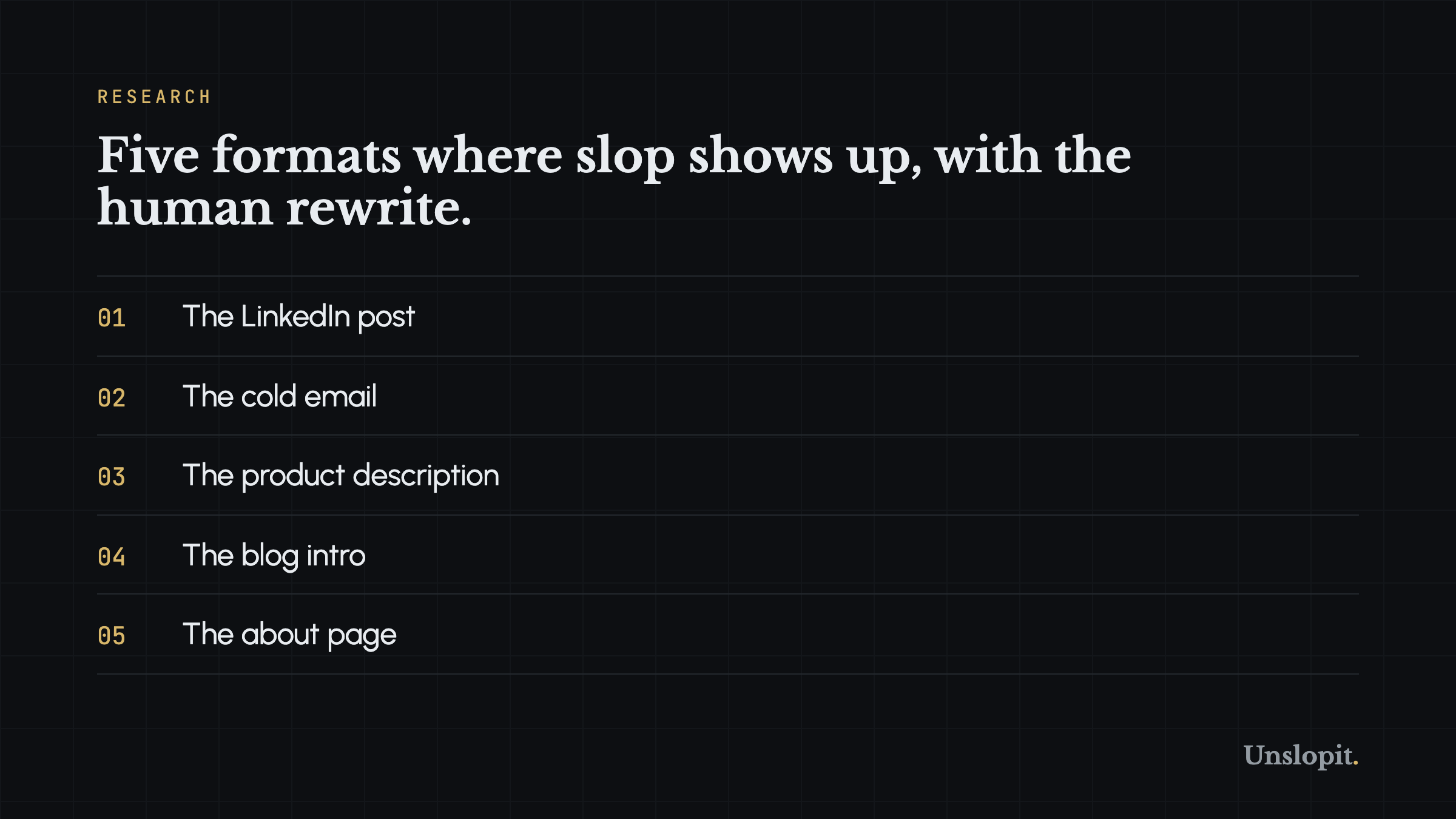
Example 1: The LinkedIn Post
LinkedIn is where AI slop went viral. The format is so recognizable that a Reddit thread cataloging it hit 170 upvotes in one afternoon. Here is what the classic template looks like, followed by what a real person wrote about the same topic.
Before: AI-generated slop
In today's rapidly evolving professional landscape, success isn't just about hard work, it's about authentic connection. 🚀 ✅ Showing up consistently ✅ Adding value before asking for anything ✅ Building a personal brand that resonates I once struggled with imposter syndrome. I felt like I didn't belong in rooms I had earned the right to be in. Then I had a realization: the only person I needed to be was myself. This mindset shift changed everything. My network grew. Opportunities appeared. And it all started when I stopped trying to fit someone else's mold. What's one challenge you've overcome that shaped who you are today? Share your story below. 👇
After: Human rewrite
I used to draft LinkedIn posts in a panic at 11:45 PM. They were bad. Real bad. What changed? I stopped trying to sound like a thought leader and started writing like I talk. Short sentences. No emoji checkmarks. Stories that actually happened to me. The post that got 10x my normal response started with 'I got fired on a Tuesday.' No hook. No framework. Just a thing that happened. People read it because it was real. Nobody needs another post about 'showing up consistently.' They need something that does not make them roll their eyes.
What changed, specifically
The AI version hits seven tells in six sentences. The opening ('In today's rapidly evolving professional landscape') is a scaffold phrase that says nothing. The negation-elevation hook ('success isn't just about hard work, it's about authentic connection') is the number one AI fingerprint. The emoji checkmarks, the fake-vulnerable imposter syndrome story, the engagement-bait question at the end, the vague 'opportunities appeared', and the generic 'being yourself' resolution. Every sentence is medium length. Nothing lands hard.
The human rewrite uses five short sentences before the first long one. It has a concrete detail ('11:45 PM'), a specific anecdote ('I got fired on a Tuesday'), and a real metric ('10x my normal response'). It ends on 'roll their eyes' instead of a question nobody will answer. It sounds like someone who has said these things out loud.
Example 2: The Cold Email
Cold emails are a slop super-spreader. The tools that promise to 'personalize at scale' mostly just insert your name into a template and call it done. The result is a format people delete on sight.
Before: AI-generated slop
Subject: Unlocking synergies: a quick intro Hi [Name], I hope this email finds you well! I've been following your company's trajectory in the [industry] space, and I'm truly impressed by the innovative approach you're taking to [vague problem area]. At [Company], we're pioneering next-gen solutions that empower organizations to streamline their workflows and achieve unprecedented efficiency. Our cutting-edge platform is designed to help teams like yours maximize output while minimizing friction. I'd love to schedule a quick 15-minute call to explore potential synergies and see how we might add value to your existing operations. Would Tuesday or Wednesday work better for you? Best, [Name]
After: Human rewrite
Subject: Your checkout flow [Name], I tried to buy something on your site yesterday. Got stuck at step 3. The shipping calculator timed out twice. I gave up. We fix that exact problem. Our client FreightRight had the same 12 percent cart abandonment at the shipping step. They are now under 3 percent. If you have 15 minutes, I can show you what we did. If not, no hard feelings. I just figured you would rather hear it from me than from your analytics dashboard six months from now. - Sam
What changed, specifically
The AI cold email is a museum of banned words: 'unlocking', 'synergies', 'next-gen', 'cutting-edge', 'unprecedented', 'streamline', 'synergies' again. It rattles off value propositions without naming a single concrete thing. The human version opens with a specific experience ('got stuck at step 3'), names a real client ('FreightRight'), uses actual numbers ('12 percent' and 'under 3 percent'), and closes with a line that acknowledges the reader might not care ('no hard feelings'). It is 88 words to the AI's 130, and every one of those 88 carries weight.
Example 3: The Product Description
Product descriptions are where AI slop does the most commercial damage. You are asking someone for money. Your copy should sound like it was written by someone who has used the product, not someone who read the spec sheet.
Before: AI-generated slop
Introducing the AeroSip Bottle, a game-changing hydration solution designed for the modern lifestyle. Crafted from premium double-wall stainless steel, this robust vessel keeps beverages cold for up to 24 hours or hot for up to 12. But the AeroSip is more than just a bottle. It's a statement. A testament to the belief that everyday objects can be both functional and beautiful. With its sleek, ergonomic design and a palette of curated colors, the AeroSip seamlessly integrates into your daily routine, whether you're at the gym, the office, or exploring the great outdoors. Experience the AeroSip difference today and elevate your hydration game.
After: Human rewrite
The AeroSip bottle keeps ice solid for a full day. I filled mine at 7 AM, left it in a hot car until 4 PM, and the water still had cubes clinking around. It holds 22 ounces. The mouth is wide enough to drop a standard ice cube tray cube straight in. The lid does not leak. I have thrown it in a backpack with a laptop twice and both times everything stayed dry. It comes in five colors. The matte black one looks fine on a conference table. The bright orange one you will not lose in a gym locker. If you want a bottle that does the thing and does not leak, this is it. If you want a lifestyle statement, buy art.
What changed, specifically
The AI product description inflates nearly every verb: 'crafted from', 'serves as', 'represents a', 'seamlessly integrates.' It leans on banned vocabulary ('game-changing', 'robust', 'testament', 'curated', 'elevate'). It makes the bottle a metaphor for a philosophy instead of telling you what it does. The human version describes three specific things the writer actually did with the bottle: filled it at 7 AM, left it in a hot car, threw it in a backpack with a laptop. The word count is similar. The information density is not.
Example 4: The Blog Intro
Blog intros are where AI padding hits hardest. The first 150 words of a ChatGPT blog post are almost always skippable. They are throat-clearing dressed up as context-setting.
Before: AI-generated slop
In the ever-evolving landscape of digital marketing, staying ahead of the curve has become more crucial than ever before. With consumer behaviors shifting at an unprecedented pace and new technologies emerging on what feels like a daily basis, marketers find themselves at a crossroads. How can brands cut through the noise and forge meaningful connections with their audiences? The answer lies in a holistic approach that marries data-driven strategy with authentic, human-centric storytelling. In this comprehensive guide, we'll explore the key pillars of modern marketing success and provide actionable insights you can implement today.
After: Human rewrite
Most marketing advice is noise. I should know. I have written some of it. Here is what actually worked for three companies I advised last year: a DTC furniture brand, a B2B API product, and a local dental practice. The tactics are different. The principle is the same: stop broadcasting and start answering the question the customer already typed into Google. This article covers the exact queries each company targeted, what they built to rank for them, and the traffic numbers six months later. No frameworks. No 'key pillars.' Just what happened.
What changed, specifically
The AI intro burns 118 words before the reader learns anything. It deploys 'in the ever-evolving landscape', 'staying ahead of the curve', 'cut through the noise', 'holistic approach', and 'actionable insights' in rapid succession. It promises a 'comprehensive guide' without stating what the guide contains. The human version gets to the point in sentence three: what worked, for whom, and what this article will tell you. It names specific company types. It previews the structure. It sets an expectation and commits to meeting it.
Example 5: The 'About' Page
About pages are where even good companies lose their nerve. They reach for AI because 'writing about yourself is hard.' The result is a page full of adjectives and zero evidence.
Before: AI-generated slop
We are a passionate team of innovators dedicated to pushing the boundaries of what's possible. Founded in 2018, our company has grown from a small startup into a thriving organization committed to delivering world-class solutions that make a real difference in people's lives. Our mission is to bridge the gap between cutting-edge technology and everyday usability. We believe that powerful tools should be accessible to everyone, regardless of technical background. This belief shapes everything we do, from product design to customer support. At our core, we are driven by a simple philosophy: do great work, treat people well, and never stop learning.
After: Human rewrite
We build billing software for companies that send invoices and hate every minute of it. I started this company in 2018 after watching my wife spend four hours on a Sunday chasing late payments. She ran a photography studio. Her clients loved the photos. Paying for them, less so. We now handle billing for about 400 small studios and agencies, most of them in the US and Canada. Our average customer gets paid six days faster after switching to us. That is the only metric we care about. If your billing workflow makes you angry, try us. If it does not, you are probably fine where you are.
What changed, specifically
The AI about page uses zero concrete nouns. 'Passionate team of innovators', 'thriving organization', 'world-class solutions', 'real difference in people's lives.' You could paste this onto a dental practice, a SaaS company, or a nonprofit and it would fit all three equally. The human version starts with an actual problem ('chasing late payments'), names a real person ('my wife'), quantifies the customer base ('about 400'), and gives a specific metric ('six days faster'). It also tells you who should not buy ('you are probably fine where you are'), which is the fastest way to earn trust.
Why these patterns keep showing up
It is not a mystery. Most people use the same handful of tools with the same default settings. ChatGPT, Claude, Jasper, Copy.ai. These models were trained on similar corpora, and their most probable completions converge on the same stylistic choices. Em dashes are mathematically convenient. Negation-elevation structures exist because the models learned them from a decade of LinkedIn thought leadership and Medium listicles.
Add prompt laziness on top of that. People type 'write a cold email about my SaaS product' and hit enter. No voice sample. No examples of good copy. No instructions on what to avoid. The model defaults to its training median, and the training median sounds like a marketing intern who just discovered Thesaurus.com.
How to spot the tells before you hit publish
You do not need a detector. You need a checklist. Here is what I run against every draft I see, whether it came from me or from a model:
- Ctrl+F for em dashes. If you find more than one in a short piece, replace them with periods or commas.
- Read the first sentence of every paragraph aloud. If three in a row start with an -ing verb, rewrite two of them.
- Check sentence length. Paste into a counter. If every sentence is between 18 and 24 words, break some up. Add a three-worder.
- Look for negation-elevation. Search for the words 'not just' and 'more than.' Delete and restate plainly.
- Scan for the banned word list: delve, tapestry, testament, robust, seamless, paradigm, holistic. Replace each one with a normal word.
- Ask: does this sentence name a specific person, place, number, or date? If the answer is no for three sentences in a row, you are drifting into abstraction.
The product that does this automatically
I built Unslopit because I got tired of doing this checklist by hand. It rewrites AI drafts in your actual voice (you give it a 500-plus character writing sample and it builds a voiceprint). It runs a deterministic auditor that scores your output 0 to 20 on exactly these dimensions: em dashes, buzzwords, scaffolds, copula inflation, sentence rhythm, and specificity. It also locks every fact, name, and number so nothing gets invented or dropped during the rewrite.
The free tier gives you three scored rewrites a month. The Slop Score grader at unslopit.io/score checks any text against the anti-slop dimensions, no signup, no credit card. Run the examples from this article through it. See what score they get. Then run your own last five posts. The number might surprise you.