Yes. Readers can tell when you use AI to write. Not some of them. Most of them. And they do not need a detector tool to do it. They feel it. The feeling arrives before the conscious verdict. A sentence lands wrong. The rhythm is off. Something about the tone makes them squint. Then the thought clicks into place: this was written by ChatGPT. I run an AI voice editor called Unslopit. I talk to readers, writers, and editors every day about this exact phenomenon. Here is what they notice first and why it matters.
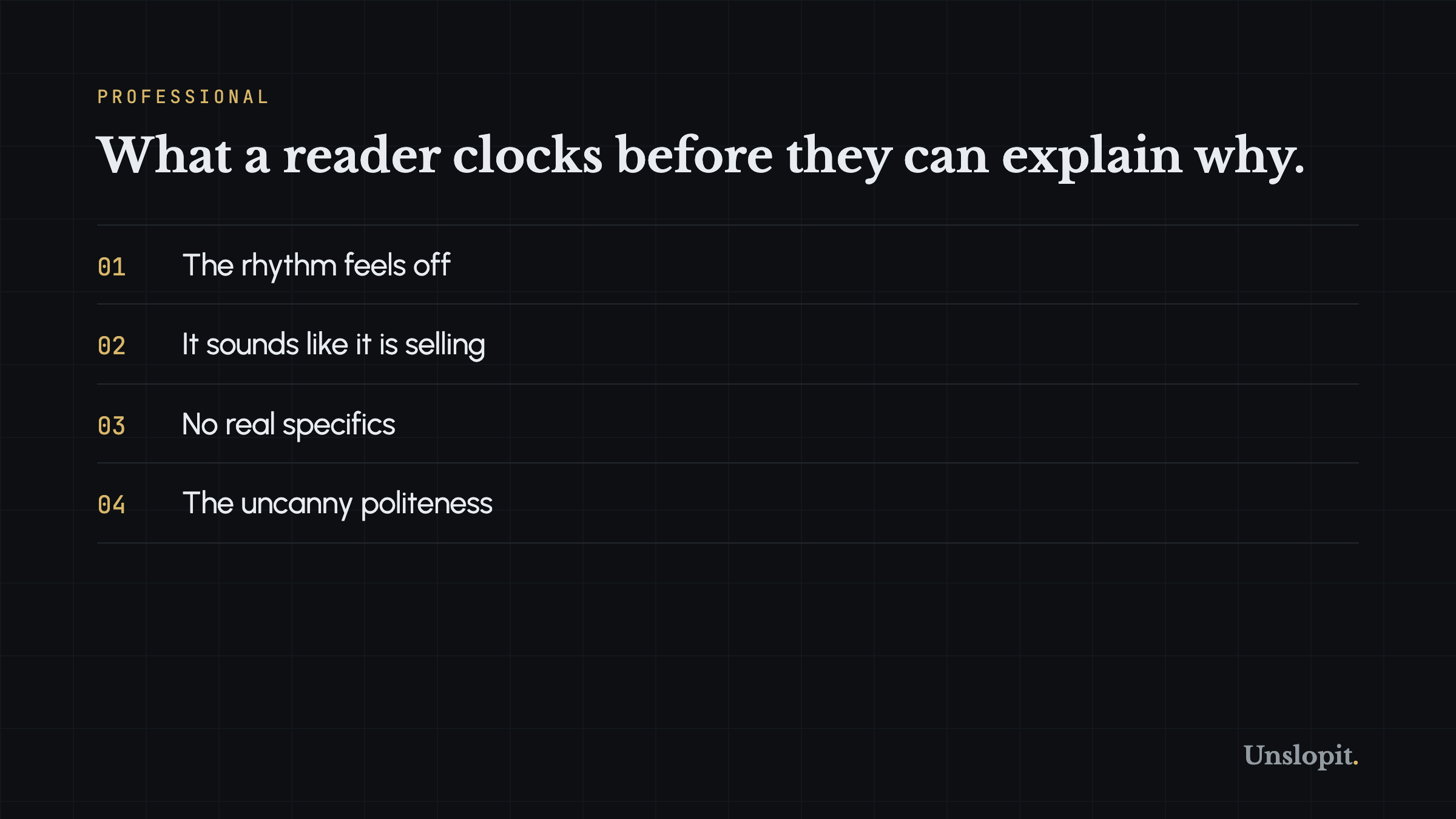
1. The Rhythm Is Wrong
This is the first thing readers clock, usually within three sentences. AI text has a flat, mechanical cadence. Every sentence runs roughly the same length. Every paragraph follows the same shape. The reader's internal voice never speeds up or slows down. There are no fragments. No one-word punches. No sentences that stretch long and then snap short. Just a steady, even drone.
Human writers vary rhythm naturally because they think in bursts. A person types a short, blunt sentence when they are certain. They write a longer, more exploratory sentence when they are working through an idea. Their sentence length maps to their thought process. AI does not have a thought process. It predicts tokens in sequence, optimizing for fluency, and fluency alone produces a flat line. Readers feel that flat line before they can name it.
One reader on a Reddit thread about AI tells put it this way: "It is like listening to someone who learned English from a textbook. The grammar is perfect but the music is missing." That is exactly right. The grammar is fine. The vocabulary is fine. But the rhythm, the thing that makes writing feel like it came from a specific person at a specific moment, is absent.
2. It Sounds Like a Sales Pitch
AI text defaults to promotional tone even when the topic is not promotional. A blog post about note-taking habits reads like ad copy for a productivity app. An internal memo about office snacks sounds like a press release. The model was trained on vast amounts of marketing content, landing pages, and corporate communications. It learned that polished writing pushes toward enthusiasm. The result is prose that feels like it is selling something even when nobody asked to be sold.
Readers notice this quickly. They have spent years developing immunity to marketing language. When a LinkedIn post opens with "I am thrilled to announce" or a newsletter uses "we are excited to share," the reader's guard goes up. When the entire piece maintains that tone without ever relaxing, the guard stays up. Then they start scanning for other signals. The promotional tone is often the gateway tell that primes readers to notice everything else.
3. Nothing Is Specific
AI models generate plausible generalities. They do not generate the exact friction of a real workflow. They do not tell you that the marketing team spent fourteen hours per blog post and still hated the result. They say "many organizations face challenges with content production." The second sentence has a number, a department, a timeframe, and an emotion. The first sentence could have been written about anything by anyone.
Specificity is the strongest human signal in writing and its absence is the fastest way readers detect AI. A human writer who knows their topic drops details without thinking about it. They mention the third button on the dashboard because they clicked it yesterday. They reference the email from a client that made them rethink the feature. AI does not have a yesterday. It does not have a client. It substitutes abstraction for experience and readers feel the gap.
I have watched readers describe this feeling in almost identical language across platforms: "It says a lot of words but nothing actually happened." "I finished the article and realized I learned zero new things." "It is all conclusions with no evidence." These are not comments about style. They are comments about substance. The reader expected to learn something specific and got a haze of well-structured generalities instead.
4. The Uncanny Politeness
AI writing is pathologically polite. It hedges. It qualifies. It never takes a sharp position without immediately softening it. "While there are compelling arguments on both sides, it is worth considering that..." No human writes like that unless they are a diplomat negotiating a treaty. Real humans have opinions. They state them. They do not wrap every claim in three layers of qualification.
This politeness is a product of RLHF. The human feedback training that made ChatGPT helpful and safe also sanded off every sharp edge. The model learned that qualification and balance were rewarded by raters. The result is text that never offends but also never connects. Readers describe it as "corporate robot voice" or "HR-speak." It sounds like a company statement that passed through legal review. Nobody trusts a company statement.
The tell is most obvious in opinion pieces and personal essays. When a human writes about something they care about, their sentence structure shows it. Anger produces short, blunt sentences. Excitement produces run-ons. Curiosity produces questions. AI produces the same measured tone about climate change that it produces about pasta recipes. The emotional flatline is what readers notice. Not the lack of emotion, but the lack of variation in intensity.
5. Real Readers, Real Reactions
The signals above are abstract. Here is what actual readers say when they encounter AI-generated text in the wild. These are real comments collected from Reddit, LinkedIn, and direct conversations with readers of AI-heavy publications.
I immediately thought this shit was written by ChatGPT. The tone was off. It was too peppy. Too polished in a way that felt plastic. I could not point to one specific sentence that gave it away, but the whole thing felt like a LinkedIn post written by someone who has never actually done the thing they are writing about.
— Reddit user, r/freelanceWriters
That comment captures the experience better than any technical breakdown. The reader did not run a detector. They did not count em dashes. They felt something was wrong and trusted that feeling. The feeling was correct. That same dynamic plays out millions of times a day across every platform where AI-generated text appears.
Another comment from a marketing director on LinkedIn: "I can tell within the first paragraph whether someone used ChatGPT. It is not the vocabulary. It is the structure. Real writers vary their structure. AI writers follow the same pattern every single time: context paragraph, three supporting points, conclusion with a call to action. After you have seen it fifty times, you can not unsee it." This pattern recognition is spreading. The more AI text floods platforms, the faster readers learn to spot it.
Why It Destroys Trust
The stakes here are not academic. When a reader detects AI writing, they make a rapid set of judgments. This person did not write this. This person is not an expert. This person is cutting corners. The content is not worth my time. None of these judgments may be fair. The writer might have used AI as a drafting engine and added substantial original thought. But the reader does not make that distinction. They bail.
Trust is a fragile asset in any relationship between a writer and an audience. It takes months to build and one AI-sounding post to damage. I have heard from freelance writers who lost long-term clients because the client ran a draft through a detector, or simply because the client's own pattern recognition kicked in and they decided the writing felt off. The accusation is rarely direct. Clients do not say "I can tell you used ChatGPT." They say the writing "is not working" or "does not match your usual quality." Then the contract ends.
The trust problem compounds. Once a reader has flagged one piece of yours as AI-sounding, they read everything you write with suspicion. Your genuine human writing gets scrutinized for tells that are not there. The false positive problem is real. Real writers who naturally use em dashes or certain vocabulary patterns get caught in the dragnet. But the broader point stands: if your writing sounds like AI, readers assume AI, and the assumption sticks.
Six Things Readers Clock Before They Finish the First Paragraph
Based on conversations with readers and analysis of community discussions, here are the six signals that produce the "something is off" reaction fastest. These rank by speed of detection, not by importance:
- Em dash density. Readers may not count them, but their eye registers the repeated long strokes. Multiple dashes in a paragraph look wrong.
- The sales-pitch tone. Enthusiastic language about mundane topics reads as inauthentic immediately.
- Sentence-length uniformity. The reader's internal rhythm never changes. The reading experience becomes monotonous within three sentences.
- Zero specifics. The text makes claims with no evidence, names, numbers, or concrete examples.
- Structural predictability. The three-paragraph intro, three-point body, single-paragraph conclusion format repeats across every piece.
- Overly balanced hedging. Every claim is immediately qualified. Nothing is stated plainly.
Keeping the Human Signal When You Use AI
None of this means you should stop using AI to write. I use AI every day. My company builds tools that help people use AI better. The question is not whether you use the model. It is whether the final text carries your voice or the model's default voice. There are concrete things you can do to keep the human signal intact.
First, treat AI output as a zero draft. It is raw material. It is not publishable. The model gives you structure and rough content. You give it rhythm, specifics, and a point of view. Do not edit lightly. Rewrite heavily. Move sentences. Break paragraphs. Add details only you could know. Delete the polite hedging. State your actual opinion without softening it.
Second, read everything aloud before you ship. This catches the flat rhythm, the unnatural phrasing, the words nobody actually says. If you can not speak a sentence comfortably, your reader can not read it comfortably. The read-aloud pass is the closest thing to a human detector you have.
Third, run your drafts through a scoring tool that measures the actual tells. The free Slop Score grader at unslopit.io/score scans for em dashes, buzzwords, scaffolds, copula inflation, rhythm problems, and specificity gaps. It gives you a number from 0 to 20. You can watch that number climb as you edit. The score does not lie. If your draft is a 12 before editing and a 17 after, you know the edit worked. If it is still a 12, you know you have more work to do. No signup. No card. Paste your text and get a number in seconds.
Readers are getting better at spotting AI every month. The model defaults are not getting harder to detect. They are getting more familiar. The writers who stand out will be the ones whose human signal survives the drafting process intact. That signal is not mysterious. It is rhythm, specificity, and an actual point of view. The tools exist to measure and improve all three. What remains is the decision to use them.
Readers can tell. But they do not have to. Run any draft through the free Slop Score grader at unslopit.io/score and see how many tells it catches. If the number is high, you know what to fix. Three free scored rewrites a month, no card. The goal is writing your reader trusts, regardless of who or what wrote the first draft.