ChatGPT's custom instructions field is the single most useful anti-slop tool most people never touch. It sits in Settings, under Personalization, and it takes about 90 seconds to configure. The default box is empty. Most people leave it that way. The ones who fill it often write something vague like "be helpful and concise," which does almost nothing.
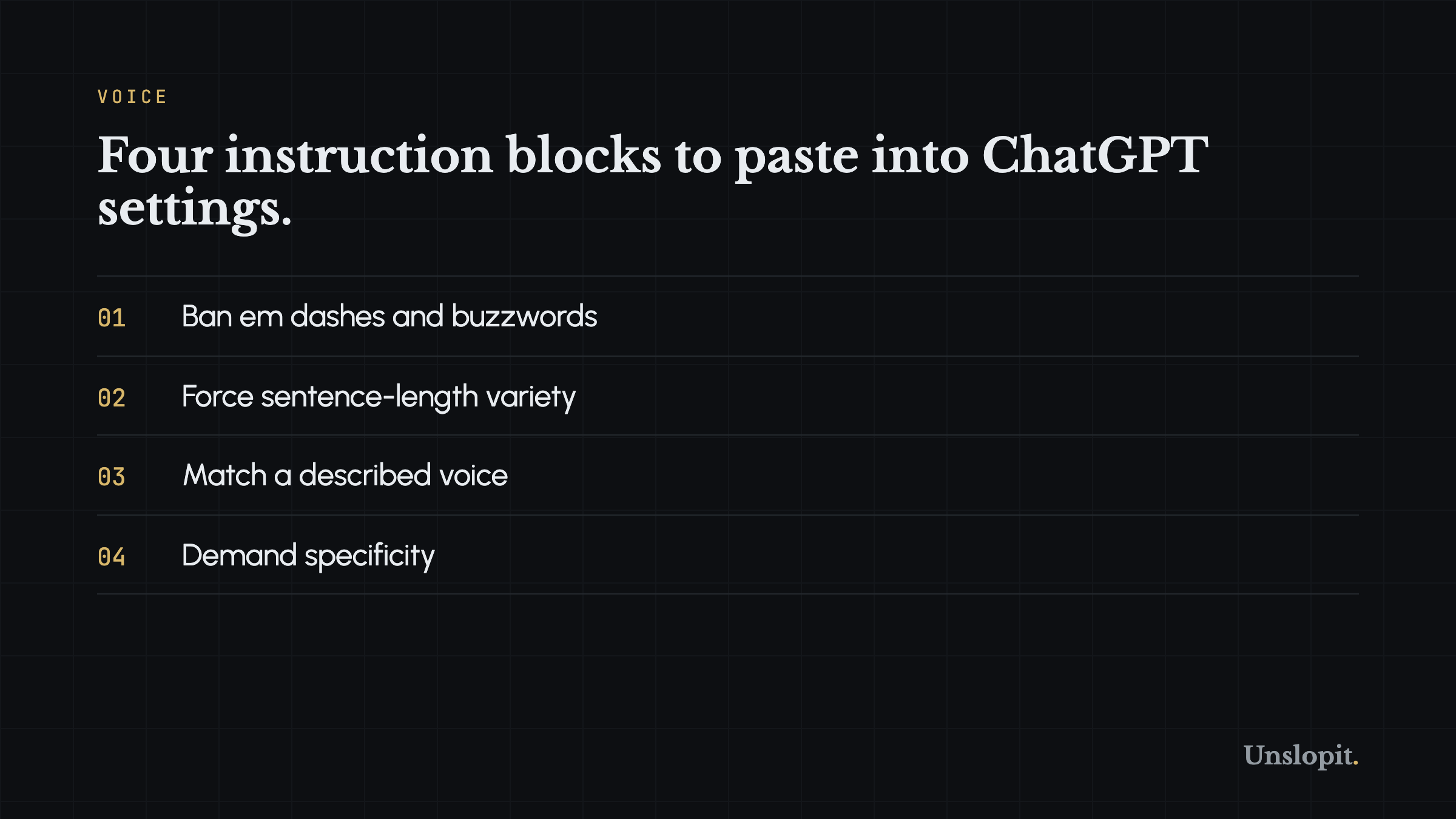
I have been refining custom instructions for writing output for months. The ones that actually work are specific, prohibitive (they ban behaviors rather than requesting them), and short. Long custom instructions get ignored. Short, sharp bans get followed. Here are four instruction blocks you can paste into your ChatGPT custom instructions right now. Each targets a different dimension of AI slop.
Block 1: Kill em dashes and buzzwords
This is the most important block. The em dash is the single most reliable signal that a human did not write the text. ChatGPT uses it constantly. Real humans barely use it at all. The same goes for a cluster of words that AI overuses: delve, tapestry, robust, seamless, transformative, and about thirty others.
Copy this into your custom instructions:
Never use em dashes. Never use the word 'delve.' Never use: tapestry, robust, seamless, transformative, groundbreaking, game-changer, holistic, multifaceted, intricate, elevate, empower, unleash, unlock (metaphorically), supercharge, cutting-edge, meticulously, underscores, paradigm shift, reimagined, purpose-built, leverage (as verb), testament to, in the realm of, in the world of. If a sentence would use any of these, rephrase it in plain English.
— Anti-slop custom instruction
What this does: It stops ChatGPT from reaching for its default vocabulary. Those words are not in your actual vocabulary. The model uses them because its training data is saturated with them. Banning them forces the model to reach for the next available word, which is usually a simpler, more human choice.
The limit: ChatGPT sometimes ignores this list on long outputs. After about 800 words, the early instructions lose weight and the model's defaults creep back in. This block works best on short to medium outputs. For long-form writing, pair it with the rhythm block below.
Block 2: Vary sentence rhythm
AI writing has flat rhythm. Every sentence lands at roughly the same length, same structure, same cadence. It reads like a metronome. Human writing has peaks and valleys. Short punchy sentences. Then a longer one that carries more weight and builds toward something. The rhythm block forces variation.
Copy this:
Vary your sentence length aggressively. Use short sentences (3-8 words) between longer ones. Never write three consecutive sentences of similar length. Include at least one sentence fragment per paragraph. Avoid starting consecutive sentences with the same word. Break up any rhythm that feels steady or predictable.
— Rhythm-breaking custom instruction
What this does: It forces the model out of its comfort zone. Default ChatGPT writes sentences between 18 and 22 words, one after another, like bricks in a wall. This instruction breaks that pattern. The output becomes unpredictable in a way that reads as human. The fragment requirement is important. Fragments are the opposite of what AI naturally does.
The limit: This can produce output that feels choppy or forced if pushed too hard. Some variation is good. Constant jumping between extremes reads as artificial in a different way. Use this block, but read the output and smooth anything that feels like it is trying too hard.
Block 3: Match a described voice
This block is for when you cannot build a proper voiceprint but you know how you want to sound. Instead of saying "write conversationally" (which gets you ChatGPT's generic version of conversational), you describe specific, measurable voice attributes. The more concrete, the better.
Copy this and edit the specifics to match your actual voice:
Write in first person. Use contractions whenever natural (I'm, can't, don't, it's). Keep your vocabulary at a high school reading level. Use concrete nouns over abstract ones. Avoid passive voice unless it serves a specific purpose. Open paragraphs with the main point, not a setup. End sentences on strong words. Do not use 'however,' 'therefore,' 'furthermore,' or 'nevertheless.' If you are not sure whether a word sounds like me, choose the simpler one.
— Voice-matching custom instruction
What this does: It gives the model specific, executable instructions instead of vague adjectives. "Use contractions" is an instruction a language model can follow. "Write conversationally" is open to interpretation. The model's interpretation of "conversational" is shaped by its training data, which skews toward a specific flavor of casual that everyone gets. Specific instructions produce specific output.
The limit: Describing your voice in words is always lossy. You cannot fully capture how you sound through a list of rules. A voiceprint built from your actual writing sample will always be more accurate. This block reduces the gap. It does not close it.
Block 4: Demand specificity
AI writing defaults to vague, general statements. It summarizes broad categories instead of naming specific things. It says "many companies" instead of naming one. It says "recent studies show" without citing anything. This block forces the model toward concrete detail.
Copy this:
Every paragraph must include at least one concrete detail: a number, a named example, a specific date, or a direct observation. Do not write 'many people' when you can write 'three of my clients.' Do not write 'recently' when you can write 'last Tuesday.' Do not write 'some studies' when you can write 'a 2024 Pew survey.' If a sentence would work without its specific details, add specific details. Vagueness is failure.
— Specificity-forcing custom instruction
What this does: It pushes the model from the abstract to the concrete. This is the single biggest quality improvement you can make through prompting alone. Concrete details make writing feel observed rather than generated. They anchor the reader in something real. The absence of concrete details is the loudest AI tell there is. Fix that and you fix most of the problem.
The limit: ChatGPT will sometimes invent details when forced to be specific. It does not actually know what happened last Tuesday, but if your instruction demands a date, it will make one up. Watch for fabricated specifics after using this block. The goal is real details you provide or the model can reason about from context, not hallucinated facts.
How to combine these blocks
Do not paste all four into the same custom instructions field. That overwhelms the model and none of them work well. Pick the one or two that match your biggest slop problem. If your output is full of em dashes and buzzwords, use Block 1. If the rhythm feels dead, use Block 2. If you sound like a generic AI instead of yourself, use Block 3. If your writing is vague and abstract, use Block 4.
I use Block 1 and Block 2 together in my own custom instructions. That covers the surface-level tells (words and punctuation) and the structural tells (rhythm). For voice matching, I rely on Unslopit's saved voiceprint instead of Block 3. It is more accurate and does not drift over long outputs.
What custom instructions cannot fix
Custom instructions have hard limits. Being honest about them is more useful than pretending they solve everything.
Decay on long outputs
The longer the output, the weaker the custom instructions become. The model's attention mechanism naturally gives less weight to instructions that appeared far back in the prompt. After roughly 1,500 words of output, most custom instructions are effectively gone. The model reverts to its defaults. This is why long articles written entirely by ChatGPT drift into slop territory no matter how good your custom instructions are.
Ignored under load
When ChatGPT is handling a complex task, reasoning steps, code, or multiple constraints, it deprioritizes stylistic instructions. Your anti-slop rules compete for attention with the actual task. The task wins. This is why asking ChatGPT to "write a detailed analysis of Q3 financials" with your custom instructions produces more slop than asking it to "write a two-paragraph note about this morning's meeting." The complexity margin is small.
No verification
Custom instructions do not verify their own output. You get what you get. The model might violate its own instructions and you will not know until you read the output carefully. A proper anti-slop auditor runs after generation and checks every dimension. Custom instructions are a best-effort request. An auditor is a measurement.
Context window amnesia
Custom instructions sit at the very beginning of the prompt. In a fresh conversation, the model sees them clearly. But if you have been chatting for 30 messages and your context window is filling up, the model's attention to those early instructions drops. This is not a bug. It is how transformer attention works. The early tokens compete with every subsequent token for the model's finite attention budget. Eventually they lose. If you are editing a long document across multiple exchanges, the anti-slop instructions from message one are ghosts by message twenty.
When should you use each block?
These blocks solve different problems. Using the wrong one wastes the limited instruction space you have. Here is a quick diagnostic.
Use Block 1 (ban em dashes and buzzwords) if your ChatGPT output contains the word 'delve,' uses multiple em dashes, or deploys 'tapestry' unironically. This is the most common problem and the easiest fix. The instruction is simple enough that the model follows it reliably for the first few hundred words.
Use Block 2 (vary rhythm) if you have already cleaned the surface tells and the output still reads flat. Rhythm problems are harder to spot than em dashes but more damaging to the reading experience. A reader might not notice a single em dash. They will notice five paragraphs of identically-paced sentences.
Use Block 3 (match a described voice) if the output is clean and varied but still sounds like nobody in particular. Clean output without a voice is the most common outcome of Blocks 1 and 2 alone. The text passes a mechanical check but has no personality. Block 3 adds personality through constraints.
Use Block 4 (demand specificity) if the output makes true statements that could apply to anyone. 'Companies benefit from clear communication' is true. 'Three of my clients cut their meeting time by 40 percent after switching to async standups' is specific. Block 4 pushes toward the second kind of sentence.
What about combining blocks?
Combining blocks works but the model's available attention per instruction shrinks with each addition. Two blocks that address different dimensions, like Block 1 (surface tells) and Block 4 (specificity), tend to play well together. They do not compete for the same linguistic resource. Three blocks starts to strain the model's ability to satisfy all constraints simultaneously. Four almost guarantees that at least one block gets ignored. Pick your biggest problem. Fix that one first. Once it is reliably solved, consider adding a second.
What about other AI writing tools?
These custom instructions are written for ChatGPT's specific implementation. Claude has a similar system called project instructions that works with the same principle. Gemini has system instructions through the API but not in the consumer interface. For any tool that accepts system-level instructions, these blocks will work. The format might differ slightly but the bans transfer.
The broader point: custom instructions are a bandage. They help. They are better than nothing. But the real fix is a tool that measures output against a standard and corrects it, rather than hoping the model follows a request. If you are writing content that matters, a request is not enough. You need verification.
Start with the free score
Before you change your custom instructions, find out what your current output actually scores. Paste something you wrote with ChatGPT into the free Slop Score grader at unslopit.io/score. It runs the same deterministic auditor that powers Unslopit's rewrite engine. No signup. No card. The score tells you exactly which dimensions need work. Then pick the custom instruction block that matches your weakest dimension. Fix the problem you actually have, not the problem you assume you have.
Custom instructions help. They are a real first line of defense. But when they drift on long outputs, which they do, a deterministic checker that catches every tell and a voiceprint that holds your style steady is the backup that makes the first draft publishable. Try the free Slop Score grader at unslopit.io/score, no signup, and see how your ChatGPT output scores right now.