ChatGPT has a vocabulary problem. Not a small one. It overuses a specific set of words and phrases so reliably that entire Reddit communities now maintain ban-lists crowdsourced from thousands of users. These are not obscure tells that only linguists notice. They are the words that make readers pause mid-sentence and think "a human did not write this."
I run Unslopit, an AI voice editor that audits writing for exactly this kind of thing. Our auditor scans for 113 flagged terms across multiple categories. The words on this list are the ones that trigger most often, ranked by frequency in real user drafts. For every offender, I will give you the plain-English replacement that keeps your meaning intact without screaming "I asked ChatGPT to write this."
Category 1: Inflated Verbs (The 'Delve' Problem)
ChatGPT loves verbs that sound intellectual but mean something simple. These words add syllables without adding meaning. The worst offenders:
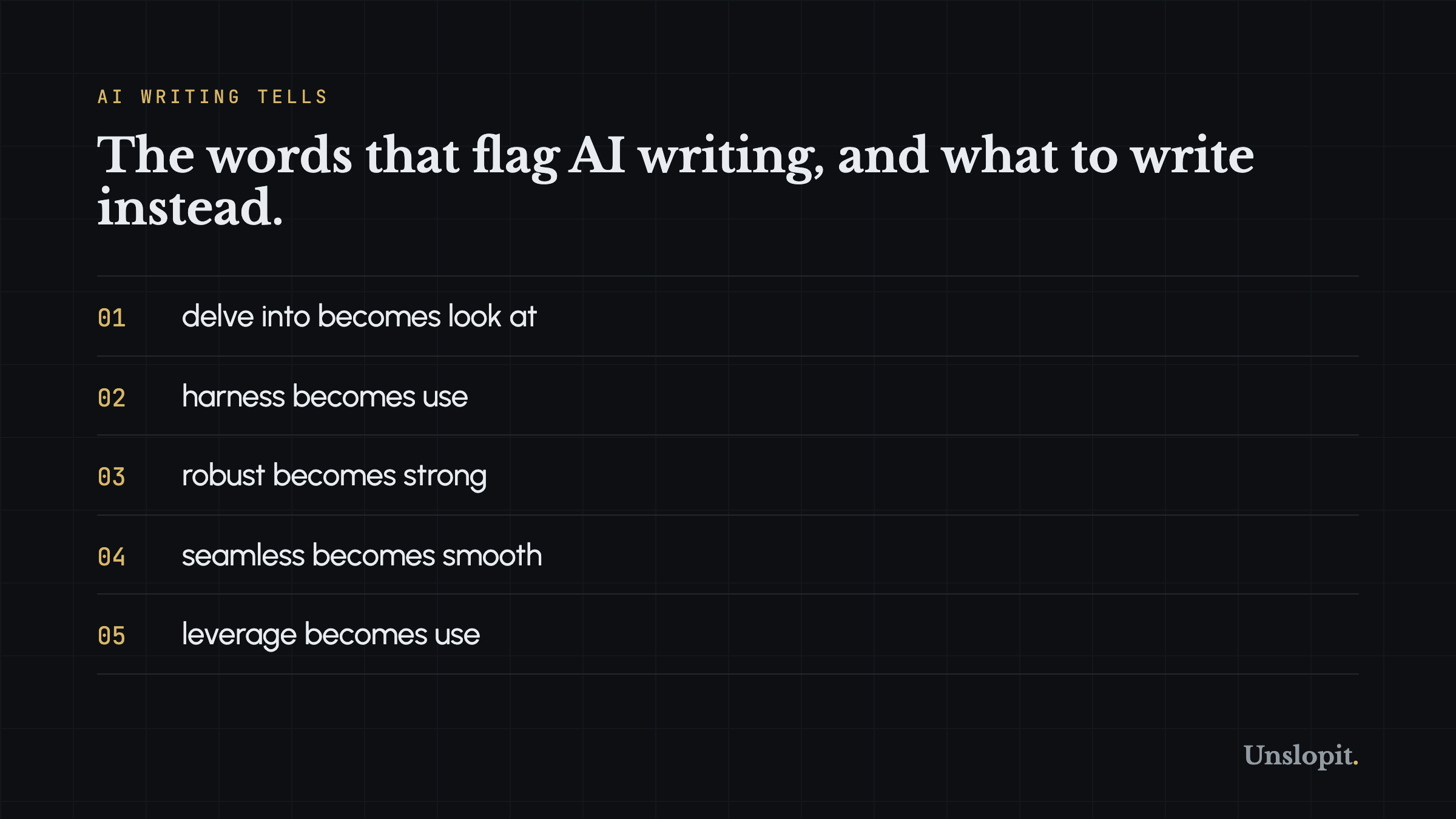
- "Delve" or "delve into" becomes "look at," "dig into," or "explore"
- "Harness" becomes "use" or "put to work"
- "Unlock" becomes "get" or "access"
- "Unleash" becomes "release" or "let loose"
- "Supercharge" becomes "speed up" or "boost"
- "Elevate" becomes "raise" or "improve"
- "Empower" becomes "let" or "give the ability to"
- "Turbocharge" becomes "speed up" (or just delete it; nobody needs this word)
- "Revolutionize" becomes "change" or "transform"
- "Reimagine" becomes "rethink" or "redesign"
- "Leverage" (as a verb) becomes "use," "borrow from," or "build on"
"Delve" is the poster child here. It appeared so often in ChatGPT outputs during 2023 and 2024 that it became a meme. People now scan for "delve" the way airport security scans for liquids. If your draft contains it, replace it. The word is not bad English. It is just a flashing neon sign that says "generated by AI."
The pattern behind all these verbs is the same. ChatGPT learned from formal writing where longer, rarer words signal expertise. In academic papers, "leverage" sounds sophisticated. In a blog post or email, it sounds like you are trying to sell enterprise software. The fix is almost always the shortest word available. "Use" beats "utilize." "Change" beats "revolutionize." Simple beats inflated.
There is a deeper reason these particular verbs stuck. During RLHF training, human raters were asked to evaluate responses on helpfulness and quality. They consistently preferred answers that sounded thorough and authoritative. A sentence like "we will leverage our existing infrastructure to unlock new efficiencies" reads as more substantive to a tired rater scanning hundreds of responses than "we will use what we have to go faster." The inflated version gets the higher score. The model logs that preference. Over millions of ratings, the feedback loop hardens into a vocabulary pattern that now defines an entire generation of AI-generated business writing.
Category 2: Abstract Nouns (The 'Tapestry' Family)
These are the nouns ChatGPT reaches for when it wants to sound profound but has nothing concrete to say. They are vague by design. They gesture at meaning without delivering it.
- "Tapestry" becomes "mix," "collection," or just delete it and describe the actual thing
- "Landscape" (as in "the digital landscape") becomes "the field," "the market," or "what is happening"
- "Realm" (as in "in the realm of") becomes "in" or "for"
- "A testament to" becomes "shows" or "proves"
- "Paradigm shift" becomes "big change" or describe the specific change
- "Game-changer" becomes "important" or explain what actually changed
- "Best-in-class" becomes "good" or "top"
- "World-class" becomes "excellent" or "top-tier"
- "Next-gen" becomes "new" or "next version"
- "Cutting-edge" becomes "new" or "advanced"
The worst of these is "tapestry." ChatGPT deploys it to describe anything that has multiple parts. A "rich tapestry of features." A "tapestry of insights." A "tapestry of experiences." No human who has touched grass in the last decade describes anything as a tapestry unless they are talking about actual woven fabric hanging on a wall. Kill it on sight.
Category 3: Scaffold Phrases (Verbal Scaffolding That Holds Up Nothing)
These are the filler phrases that pad sentences without adding content. They are the verbal equivalent of clearing your throat before speaking. ChatGPT uses them constantly because RLHF training rewarded text that sounded careful and considered. But careful writing does not need these crutches.
- "It is important to note" becomes nothing. Just say the thing. If it were not important, you would not be saying it.
- "It is worth mentioning" becomes nothing. Same logic.
- "Needless to say" becomes nothing. If it is needless, do not say it.
- "When it comes to" becomes "about" or "for" or nothing. "When it comes to pricing" becomes "On pricing."
- "In today's [anything]" becomes nothing. Just start with the point. The reader knows what year it is.
- "At the end of the day" becomes "in the end" or nothing.
- "That being said" becomes "but" or "still" or nothing.
- "In conclusion" or "to sum up" becomes nothing. Readers can see they are at the end of the article.
- "Let us dive in" becomes nothing. Just start writing.
- "Without further ado" becomes nothing. You are not hosting a wedding reception.
- "The bottom line is" becomes nothing. Just state the bottom line.
The common thread: these phrases all delay the actual point. They are warmup laps for a sentence that never needs warming up. Delete them and your writing gets shorter, clearer, and instantly more human.
Category 4: Formal Transitions (The 'Moreover' Problem)
ChatGPT learned transitions from academic papers and formal essays. It drops "moreover" and "furthermore" into casual blog posts the way a first-year college student drops them into a term paper. Real humans do not use these words outside of formal academic writing.
- "Moreover" becomes "also," "plus," or "and"
- "Furthermore" becomes "also," "and," or "what is more"
- "Consequently" becomes "so" or "as a result"
- "Nevertheless" becomes "but," "still," or "even so"
- "Thus" becomes "so" or "so that means"
- "Hence" becomes "so" or "which is why"
- "Accordingly" becomes "so" or "that is why"
- "Notably" becomes nothing or "one thing worth knowing"
The rule is straightforward. If you would not say the transition out loud to a friend over coffee, do not type it. "Moreover" fails that test for roughly everyone. "So" passes it. Use "so."
Category 5: The Negation-Elevation Pattern (The Single Biggest AI Tell)
This is not a word list. It is a sentence structure. And it is so common in AI output that it deserves its own category. The pattern: deny something ordinary, then claim something grander. "Not just X, but Y." "Not only A, but B." "More than just C." "It is not D. It is E."
Examples of what to avoid and how to fix them:
- "Not just a tool, but a complete ecosystem" becomes "It is a tool. It also connects to other tools."
- "Not only faster, but also smarter" becomes "It is faster. It also handles more complex tasks."
- "More than just analytics" becomes "It does analytics. It also does reporting."
- "It is not about speed. It is about precision." becomes "The main benefit is precision. Speed is a bonus."
- "This is not your typical CRM" becomes "This CRM works differently because [specific reason]."
The negation-elevation pattern feels persuasive to the model because it mirrors a genuine rhetorical technique. But in practice, it almost always signals that the writer is reaching for drama rather than substance. If your claim is strong, state it directly. If you need to deny something first, ask yourself whether the denial is just padding.
Where These Ban-Lists Came From: The Reddit Detective Work
The word lists in this article did not come from a linguistics department. They came from Reddit. Starting in early 2023, users on r/ChatGPT, r/Teachers, and r/freelanceWriters began noticing the same words appearing in AI-generated text and comparing notes. Someone would post a thread titled "Words ChatGPT overuses" and the comments would fill with hundreds of examples. Community members compiled these into shared Google Docs and GitHub repositories. The most famous ban-list, maintained collaboratively, grew to over 200 entries. It is still being updated today as new models and new tells emerge. This was not academic research. It was thousands of people independently noticing the same unnatural language patterns and cross-referencing their findings.
Why These Words Cluster Together in AI Output
The words on this list do not appear in isolation. ChatGPT rarely drops one "delve" into an otherwise clean paragraph. It produces clusters. A single paragraph might contain "delve," "tapestry," "moreover," and "it is important to note" all at once. That is because these words share a common source. They all come from the same formal registers in the training data. They all got reinforced by the same RLHF feedback loop. They all signal the same thing: an AI model trying to sound smart instead of being clear.
When you see one of these words in your own AI drafts, look for the rest. They travel in packs. Fixing just one or two will not solve the problem if the underlying patterns remain. You need to retrain your eye to spot the whole category, not individual words.
The stakes here are higher than most people realize. Freelance writers report losing clients who spotted "delve" or "tapestry" in their work and assumed the entire piece was AI-generated. Job applicants get their cover letters flagged by recruiters who have learned to scan for these tells. Students face academic integrity inquiries over essays that carry the vocabulary signature of ChatGPT even when the ideas are original. The words on this list are not just stylistic annoyances. They carry real professional risk for anyone whose credibility depends on sounding like themselves rather than a language model.
You Do Not Need to Memorize This List
Here is the honest take. Maintaining a personal ban-list is tedious and error-prone. People on Reddit have built massive shared lists with hundreds of entries. They update them every time a new AI tell emerges. It is a community effort that proves how real and frustrating this problem is. But you should not have to manually audit every draft you write.
The list in this article will get you 80% of the way there. The other 20% is rhythm, specificity, and voice. Those are harder to diagnose with a word list. But if you start by killing the words above, you will have already removed the most visible AI tells from your writing. Everything after that is refinement. Try the free grader at unslopit.io/score on your next draft. No signup, no card. Just a number that tells you how clean your writing actually is.