Your clients know. They may not say it in the first email. They may not bring it up on the call. But they have read enough AI-generated text by now to spot the difference between your voice and an algorithm's. When your deliverables shift from sounding like you to sounding like ChatGPT, the trust damage is already done before they articulate it.
I run a studio that builds tools for this exact problem. I talk to freelancers, ghostwriters, and agency owners regularly. The pattern is the same every time. Someone gets busy. They start using AI to handle first drafts. The output is fine for a first draft. But they do not edit it enough. Or they edit the first few and then stop. The client notices the shift. Sometimes they say something. More often they just do not renew. The freelancer never learns why.
This is not a lecture about how AI is bad. AI is a tool. I use it every day. The problem is using it in a way that erases the thing the client is paying for: your voice, your judgment, your specificity. If the deliverable sounds like it could have come from anyone, the client is overpaying.
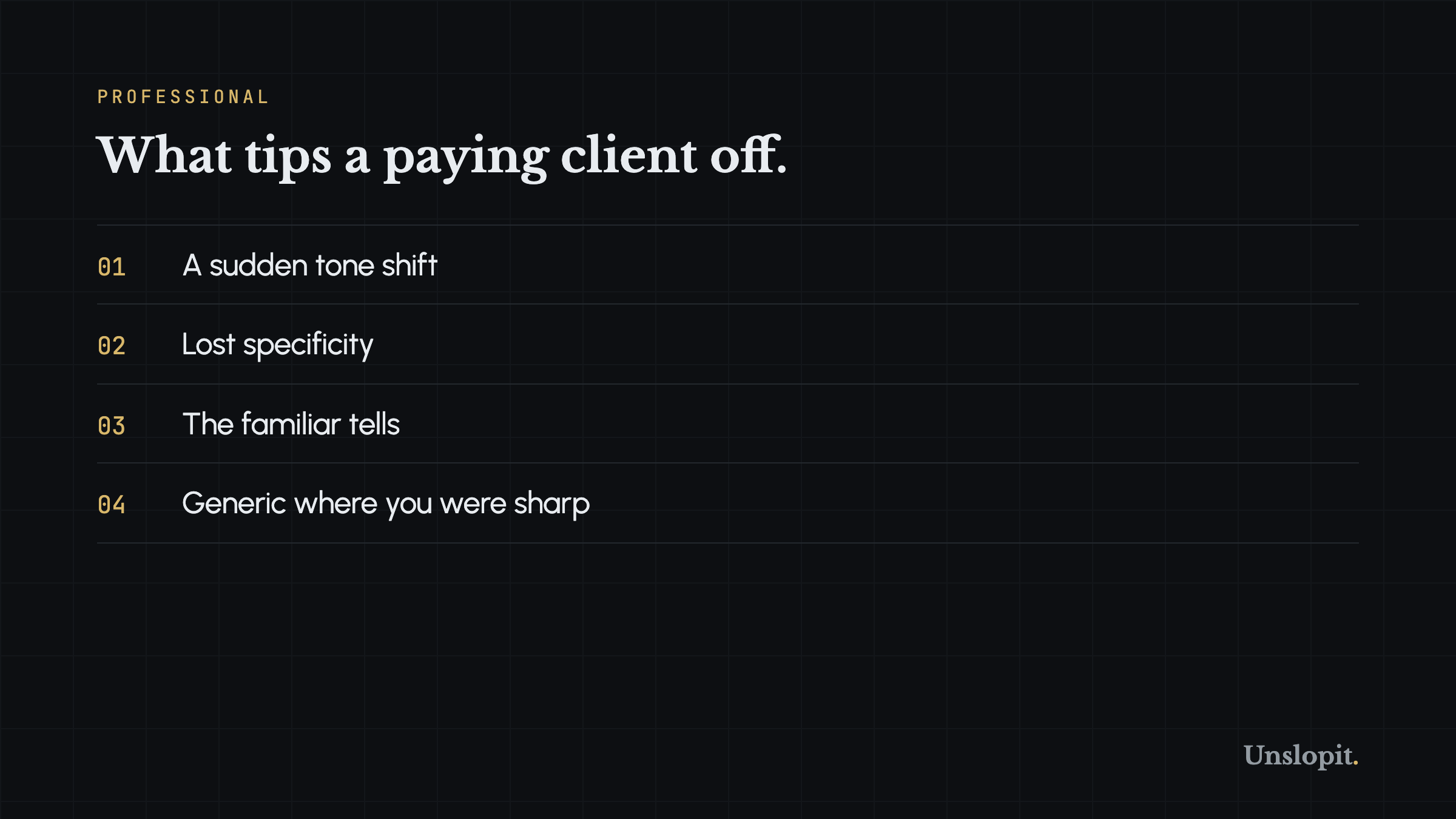
What tips clients off?
The tells are specific and consistent. Clients do not need detection software. They need a functioning sense of what sounds like a person and what sounds like a language model.
The tone shifts overnight
This is the dead giveaway. A freelancer delivers ten pieces. The first seven have a recognizable voice: specific word choices, a particular cadence, a way of opening paragraphs. Then pieces eight through ten arrive and they sound different. Flatter. More formal in some places, more casual in others, but neither matches the earlier voice. The client reads them side by side. The difference jumps out. Even if they cannot name what changed, they can feel it.
One ghostwriter I spoke with described losing a $3,000 monthly retainer this way. The client did not say "this sounds like AI." The client said the recent posts "did not feel like me anymore." Same thing. Different words.
The specifics vanish
Human writers, especially good ones, anchor their writing in concrete detail. They mention a specific client meeting last Tuesday. They reference a particular campaign metric. They name the tool someone used. AI defaults to the general. It writes "teams often struggle with communication" where a real person writes "my team spent three hours yesterday untangling a Slack thread." The absence of specifics is the tell. When a client starts a relationship with a writer who delivers specificity and then the specificity disappears, they notice immediately.
Em dashes appear everywhere
I have written about this elsewhere and I will say it again: the em dash is the single most reliable surface-level AI signal. ChatGPT uses it in almost every output. The average human uses it almost never. When a client who has been reading your work for months suddenly sees em dashes scattered through a deliverable, something changed. It is a small surface detail that signals a larger problem.
The vocabulary shifts upward
AI writing consistently reaches for a specific tier of vocabulary. The words "delve," "tapestry," "robust," "seamless," and "transformative" appear in AI output at rates far higher than in human writing. There is a reason these words have become community in-jokes in writing forums. They are statistical artifacts of the training data. When a freelancer's writing suddenly includes words they never used before, the client notices. They may not know the specific banned-word lists circulating on Reddit. But they recognize that the word choices shifted.
The structure gets formulaic
Default AI output follows a predictable structure. Opening context. Three supporting points. A conclusion that restates the opening. Every time. Real human writing meanders more. It front-loads conclusions. It skips transitions. It has dead ends and sharp turns. The formulaic structure is comfortable to read in isolation. But read alongside earlier work from the same writer, it sticks out like a new hire who learned the wrong template.
Negation-elevation sentences multiply
"It is not just about speed. It is about clarity." "This is not simply a rebrand. It is a reimagining of how we connect." These constructions, where the writer negates one thing to elevate another, are a ChatGPT fingerprint. You will spot several in almost any long AI output and almost never in human writing at the same density. A client who reads multiple deliverables will start to notice the pattern. It is the verbal equivalent of someone who ends every sentence with an upward inflection.
The business cost of getting caught
The risk is not theoretical. Freelancers lose contracts over this. The mechanism is usually quiet. The client does not call and announce "I am terminating our agreement because I detected AI-generated content." They just do not renew. Or they reduce scope. Or they bring up vague concerns about "quality" and "consistency" and then go quiet. The freelancer is left wondering what happened.
Bloomberg published a piece in January 2026 documenting how LinkedIn users have started policing AI-generated posts. They analyze emoji patterns, sentence structures, and em dash frequency to identify which posts were written by ChatGPT rather than the person whose name is on them. The piece describes professionals getting called out publicly for posting AI-generated content under their own names. The reputational damage from being identified as someone who passes off AI writing as their own is real and documented.
In the ghostwriting community, which includes roughly 17,000 members in the largest free group alone, the conversation has shifted. Writers now trade custom instruction blocks and prompt templates explicitly designed to mask AI output so clients do not notice. The demand for "voice match" tools is not hypothetical. It is people trying to solve a problem they are already losing money to.
The agencies feel it too. LinkedIn ghostwriting agencies charge $500 to $5,000 per month per client. Their entire value proposition is that the content sounds like the client wrote it. If the agency's AI pipeline produces output that sounds like AI, the client is paying for a service they could get for free from ChatGPT directly. The agency has no reason to exist.
How to use AI without your client noticing a quality drop
The fix is not to stop using AI. That ship has sailed. AI makes first drafts faster, research easier, and writer's block less punishing. The fix is to use AI in a way that the output does not degrade the thing the client hired you for.
Build a voiceprint from the client's actual writing
Before you use AI for client work, collect a sample of the client's real writing. Five hundred characters minimum. More is better. Feed it into a voiceprint tool that extracts the measurable features of their style. Sentence lengths. Word choices. Punctuation patterns. Contraction rate. Formality level. This gives the AI a target to aim at that is specific to this client, not a generic idea of "professional tone."
Every rewrite then passes through that voiceprint. The AI is not writing in its default voice. It is writing constrained by a profile built from the client's actual patterns. This is the difference between "write in a professional voice" and "match this specific person's sentence length distribution, vocabulary tier, and punctuation habits."
Run a deterministic quality check before delivery
Do not trust your eye. After a day of editing, you stop seeing the tells. Run every deliverable through a deterministic anti-slop check that scans for em dashes, banned buzzwords, scaffold phrases, copula inflation, and rhythm flatness. Get a number. If the score is below your threshold, fix it before the client sees it.
This is what Unslopit's auditor does. It is not a detector evasion tool. It is a quality gate. It tells you, in measured terms, whether the output is clean. The score is not a guess. It is a count of specific violations. Zero em dashes. Zero banned words. Good sentence variety. Concrete details present. If it fails, you know exactly what to fix.
Edit the last 10 percent yourself
A voiceprint closes most of the gap. It does not close all of it. The last 10 percent requires human judgment. Read the output. Add one specific detail the AI could not know. Replace one word that sounds slightly off. Break one sentence that is too long. This takes five minutes per piece. It is the difference between output that passes a voice match check and output that a client reads without suspicion.
Be honest with yourself about volume
The freelancers who get caught are the ones who let volume overwhelm quality. They take on more clients than they can edit for. The AI pipeline becomes the entire workflow instead of the first step. If you are running AI on 15 client accounts and personally editing none of the output, you will get caught. It is a matter of time. Scale your client load to your editing capacity. AI makes the draft. You make it yours.
What if a client has already noticed?
Most freelancers find out they have been caught indirectly. The client goes quiet. The renewal does not come. The scope shrinks. If you suspect a client has noticed a voice shift, the worst thing you can do is overcorrect by suddenly producing radically different output. That confirms their suspicion by showing you can write differently. The better move: acknowledge nothing, fix the pipeline, and let the improved output speak for itself over the next two to three deliverables. Consistency over time rebuilds trust. A single great piece does not undo the damage. Three or four in a row, all in the right voice, will.
The trust math
A client who trusts your voice is a client who renews. A client who suspects the voice is a client who is one bad month away from leaving. The math is simple. A $2,500 monthly retainer lost over a six-month period is $15,000 in revenue. The cost of using a voiceprint tool and an anti-slop auditor is a fraction of that. The cost of five minutes of editing per deliverable is even smaller.
The freelancers who figure this out first will have a structural advantage. They will deliver faster than their competitors because AI handles the heavy drafting. They will deliver better than their competitors because a voiceprint preserves the voice. And they will keep their clients longer because the quality does not drop. The ones who keep using raw ChatGPT output and hoping nobody notices will keep losing contracts they cannot explain.
Start by checking what you are sending now
Before you change your workflow, find out how clean your current output is. Grab the last deliverable you sent to a client. Paste it into the free Slop Score grader at unslopit.io/score. No signup. No card. The score tells you exactly which anti-slop dimensions are failing. If the score is strong, you are already doing the work. If it is weak, you now know which of your clients has already noticed.
The clients who notice are not asking you to stop using AI. They are asking you to stop sending them slop with your name on it. Unslopit was built for that exact job: rewrite AI drafts in your voice, verify the facts survive, and hand over a score that tells the truth. Try it free, three scored rewrites a month, no card. At unslopit.io.