There is a word that makes thousands of people flinch every time they see it in an article. That word is "delve." Type "why does AI say delve" into Google and you will find Reddit threads with titles like "I physically cringe every time ChatGPT uses the word delve" and "Does anyone else instantly know something is AI-written the moment they see 'delve into'?" This is not a pet peeve. It is a signal detection phenomenon. A single word has become reliable enough as an AI watermark that readers treat it as one.
Delve is not alone. There is a whole vocabulary set that language models reach for constantly. Tapestry. Testament. Intricate. Realm. Navigate. Landscape. These words show up in AI-generated text at rates wildly disproportionate to how humans actually write. They have become tells. And understanding why the model loves them tells you something useful about how AI writing works, and how to fix it.
The Linguistic Reason: RLHF Created a Preferred Register
Language models are trained in two major phases. First, pre-training: the model reads billions of documents and learns statistical patterns. Second, RLHF: human raters score model outputs and the model adjusts toward what raters prefer.
The RLHF phase is where these words got embedded. Human raters, when asked to evaluate model responses, consistently preferred a specific tone. Not academic. Not casual. Something in between. Formal enough to sound credible. Accessible enough to avoid jargon. This register has a name in linguistics: the "educated generalist" voice. It is the tone of a well-written magazine feature or a TED talk transcript. Polished but not technical. Warm but not personal.
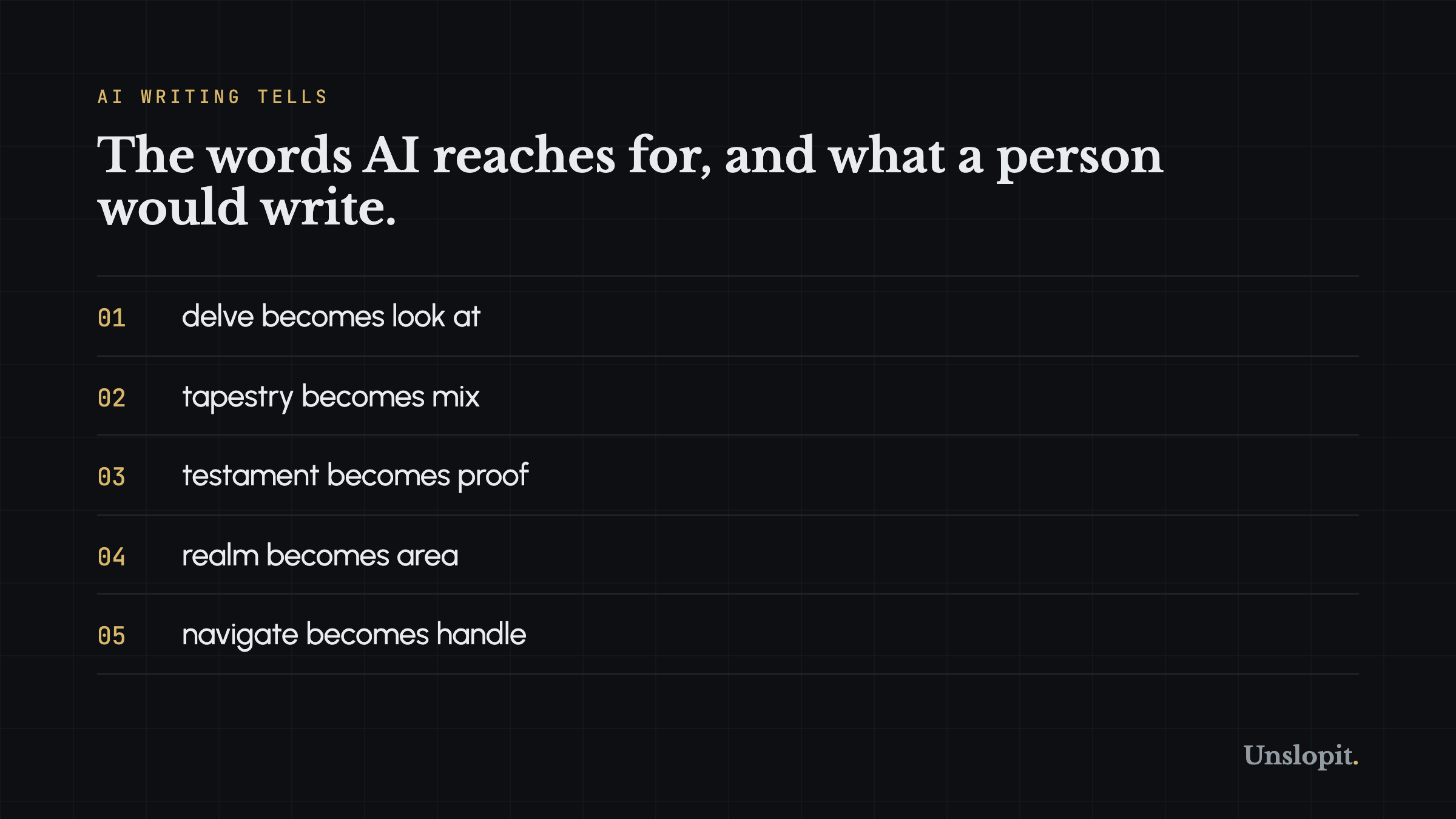
This register has a specific vocabulary. Words that signal intellectual engagement without requiring specialist knowledge. Words that make a sentence feel weightier without making it harder to read. "Delve" instead of "look into." "Tapestry" instead of "mix." "Testament" instead of "proof." The model learned that outputs using these words scored higher. So it used them more. Across millions of outputs, across every subject, the same vocabulary pool kept surfacing.
Humans who write in this register do other things too. They vary their word choices. They use specific examples. They break rhythm intentionally. The AI only learned the surface vocabulary. It got the words without the craft behind them. That is why AI text with these words feels off. The vocabulary signals one thing; the flat execution signals another.
Delve: The Word That Became a Meme
No AI vocabulary word has achieved the infamy of "delve." It appears in AI-generated text at roughly 10 to 100 times the rate it appears in human-written text, depending on the domain. In academic-adjacent AI writing (book summaries, article analyses, research explanations), the rate is astronomical. Nearly every ChatGPT summary of a complex topic contains "delve into" or "delve deeper."
Why delve? Because it solves a specific problem for the model. When the prompt asks for depth or analysis, the model needs a verb that signals "I am about to go deeper." "Look into" is too casual. "Analyze" is too formal. "Explore" is good but overused. "Delve" hits the sweet spot: it feels literary without being obscure, it implies depth without committing to it, and it transitions smoothly between a surface summary and a deeper point.
The Reddit phenomenon around delve is real and worth examining. Multiple threads with hundreds of upvotes document the experience of seeing "delve" and immediately knowing the text was AI-generated. Some users report building personal browser extensions to highlight the word. One commenter wrote: "I used to like the word delve. Now it is ruined for me. I cannot use it in my own writing without feeling like a chatbot."
The human alternative: use "look at," "get into," "cover," "dig into," "examine," or restructure the sentence so you do not need a transition verb at all. "Let us delve into the data" becomes "Here is the data." Shorter. Stronger. No flinch.
Tapestry: The Metaphor Nobody Asked For
AI loves describing anything with multiple components as a "tapestry." A "rich tapestry of influences." A "tapestry of perspectives." A "tapestry of experiences." The metaphor is technically functional: a tapestry weaves threads together into a unified picture. But humans almost never use it outside of literal textile discussions. The AI uses it constantly.
Why tapestry? Same RLHF logic. "Tapestry" sounds literary. It elevates a simple description of something having multiple parts into a sentence that feels crafted. Raters rewarded it. The model overfit to it. Now it is a dead giveaway.
The human alternative: "mix," "combination," "range," "variety," "collection." Or just list the components without a metaphor. "The project drew on design, engineering, and market research" reads cleaner than "The project wove a rich tapestry of design, engineering, and market research." The second version sounds like a museum wall label. Unless you are actually describing textiles, kill tapestry.
Testament: Inflating the Ordinary into the Grand
"A testament to" is AI shorthand for "this proves my point." The model uses it to attach weight to a claim without adding evidence. "The company's growth is a testament to its strong leadership." This sentence says nothing. What growth? Which leadership decision? By how much? The word "testament" fills the space where a specific detail should go.
Why testament? It is a prestige word. It sounds like something a historian or a critic would write. It frames a claim as self-evidently significant. The model learned that "a testament to" elevates sentence tone without requiring additional information. It is a shortcut to sounding profound.
The human alternative: "shows," "proves," "demonstrates," or, even better, just state the evidence. "Revenue grew 40% after the pricing change" is stronger than "The revenue growth is a testament to the pricing strategy." The first sentence gives you the fact. The second gives you a hand gesture toward a fact.
Intricate: Complexity Without Explanation
AI calls things "intricate" when it wants to acknowledge complexity without describing it. "An intricate system." "Intricate details." "An intricate process." The word signals that the thing is complicated, which lets the model move on without explaining how or why. It is a placeholder for analysis.
Why intricate? It is a efficiency hack. Describing how a system actually works takes specific knowledge and many words. Calling it "intricate" takes one word and sounds smart. Human raters, evaluating outputs on surface quality rather than factual depth, did not penalize this. The model learned that "intricate" safely signals depth without delivering it.
The human alternative: describe one specific aspect of the complexity. "The system routes requests through three failover layers" is more useful than "an intricate routing system." If you cannot describe what makes it intricate, you probably should not be using the word at all.
Realm: The Faux-Academic Crutch
"In the realm of." "Within the realm of." "The realm of possibility." AI uses "realm" the way academics use "domain" or "sphere." It is a boundary word that groups things together without defining the boundary. "In the realm of AI safety" tells you the topic area but adds nothing beyond what "in AI safety" already says.
Why realm? It is a register marker. Using "realm" signals formal, intellectual writing. It is the kind of word that appears in philosophy papers and literary criticism. The model over-indexed on this signal. Now "in the realm of" is a reliable AI tell.
The human alternative: drop it entirely. "In the realm of content marketing" becomes "In content marketing." You lose a word and gain credibility.
Navigate and Landscape: The Spatial Metaphor Trap
AI writers love spatial metaphors. People "navigate" challenges, complexities, landscapes, and uncertainties. Fields are "landscapes." Markets are "landscapes." The "competitive landscape" is practically a required phrase in AI-generated business writing.
Why these two? They are versatile. "Navigate" works with almost any abstract noun. "Navigate the challenges of remote work." "Navigate the complexities of international tax law." "Navigate the evolving regulatory landscape." It is a one-size-fits-all verb that sounds active and thoughtful without requiring the model to say anything specific about how navigation actually works.
"Landscape" does the same job for nouns. Any collection of things becomes a "landscape." Tech landscape. Media landscape. Threat landscape. The word creates the illusion of a systematic overview without providing one.
The human alternative for navigate: "handle," "deal with," "work through," or describe the actual action. "We navigate client expectations" becomes "We tell clients what is realistic and what is not." The human alternative for landscape: "field," "market," "industry," or just name the things directly. "The SaaS landscape" becomes "SaaS companies."
The Full Roster: Other Words AI Overuses
The seven words above are the headliners. But the AI vocabulary bloat runs deeper. Here is a quick rundown of other habitual offenders and what to use instead.
- "Harness" (as in "harness the power of") becomes "use." You do not harness AI. You use it.
- "Unlock" and "unleash" become "start using" or just... nothing. Delete the sentence and see if anything was lost. Usually nothing was.
- "Multifaceted" becomes "has several sides" or "is complicated." Or better: describe the facets.
- "Paradigm shift" becomes "big change." Unless you are Thomas Kuhn writing in 1962, skip it.
- "Game-changer" and "revolutionary" become specific claims. "This tool cut our editing time from 4 hours to 45 minutes" is a game-changer. The word alone is not.
- "Seamless" and "seamlessly" become nothing. Software is never seamless. Users always hit edges. Claiming seamlessness signals marketing, not honesty.
- "Robust" becomes "reliable" or "well-built." Or better: describe what makes it robust.
- "Elevate" becomes "improve" or "raise." "Elevate your writing" is what Instagram coaches say.
- "Leverage" (as a verb) becomes "use." Nobody in real life says "I leveraged Excel to build a budget." They say "I used Excel."
- "Groundbreaking" and "cutting-edge" become "new" or, ideally, a description of what is actually new about it.
Why This Matters Beyond 'Sounding Better'
Some people see vocabulary criticism as pedantic. "Who cares if the AI says delve? You know what it means." The issue is not comprehension. It is trust. Readers who spot AI vocabulary patterns stop trusting the content, sometimes consciously, sometimes not. They may not know why the text feels off, but they feel it. And once that trust erodes, the substance of the argument stops mattering.
There is a second problem too. These words are tells for readers, and they are tells for AI detection tools and platforms that penalize AI-generated content. Google does not officially penalize AI writing. But Google rewards content that demonstrates expertise and experience (the EEAT framework). Writing that reads like every other AI-generated article on the same topic does not demonstrate either. The vocabulary patterns are part of what makes AI content feel interchangeable.
And there is a third problem I hear about from freelancers. Clients are running AI detection tools on submitted work. False positives are a real risk, but certain vocabulary patterns increase the odds. A writer who uses "delve" three times in a 1,000-word article is painting a target on their own work, regardless of whether they actually wrote it. Several freelancers in writing communities have reported losing contracts after clients flagged their work as AI-generated, even when they could prove authorship through draft histories. The vocabulary alone was enough to trigger suspicion.
The One-Word Test
Here is a quick test I use on my own writing and on drafts that cross my desk. Search the document for these seven words: delve, tapestry, testament, intricate, realm, navigate, landscape. If any of them appear, ask yourself: would I have used this word if I were writing from scratch, without AI assistance? If the answer is no, replace it. If the answer is yes but you use it once every six months and the draft uses it three times, replace two of them.
Building Your Own Banned-Word List
The seven words in this article are the most common offenders. Your personal list might be different. Pay attention to which words you instinctively reach for when you are writing fast. If you notice a word showing up in multiple drafts, add it to your banned list. My personal list has 40 words on it. I do not ban them from my own writing. I ban them from my first drafts, because I know they are the words that show up when I am on autopilot.
The most effective approach I have seen combines a banned-words list with a style checker. Write the draft. Run it through a tool that flags these words automatically. Replace them. The combination of awareness (knowing which words are tells) and enforcement (having a tool that catches them when you miss one) is what keeps the output clean.
Check Your Writing for AI Vocabulary
Wondering how many AI-tell words are hiding in your last draft? Run it through the free Slop Score grader at unslopit.io/score. No signup, no credit card. It scans for em dashes, buzzwords (including every word discussed in this article), scaffold phrases, copula inflation, rhythm problems, and specificity, then gives you a score from 0 to 20. If your draft is clean, you will know. If it is not, the report tells you exactly which words to replace and where they are. Try it on something you wrote this week.