No. AI humanizers do not work reliably. They claim to make AI text undetectable, but what they actually do is swap synonyms, restructure sentences, and inject enough randomness to confuse the current generation of detectors. The detectors adapt. The humanizers adapt. The writing quality degrades with every cycle. The facts in your text drift with every pass. It is an arms race where the text is the casualty, and it is a race you cannot win.
If you need AI output that reads as genuinely human, the answer is not a humanizer. The answer is a system that rewrites the output in your actual voice and then audits it for the mechanical tells that make AI writing obvious. I will walk through how humanizers work, where they fail, and what actually solves the problem. No marketing fluff. Just what the tools do and why it does not hold up.
What AI humanizers claim to do
AI humanizers market themselves as the bridge between machine output and human readers. The pitch is direct: paste your ChatGPT draft into our tool. We will rewrite it so AI detectors cannot flag it and human readers cannot tell a machine wrote it. Some tools claim to bypass specific detectors by name: GPTZero, Originality.ai, Turnitin, Copyleaks. Some guarantee a "human score" or offer a refund if the output gets flagged.
The market for these tools is large and growing. Students want to submit AI-generated essays without getting caught by academic integrity software. Content marketers want to publish AI drafts without their editors flagging them. Job seekers want AI-written cover letters to pass automated screening. Freelancers want to deliver AI-assisted work without clients terminating contracts. The demand is real and the tools promise to meet it. The problem is that the promise is mechanically impossible to keep across any meaningful timeframe.
How humanizers actually work under the hood
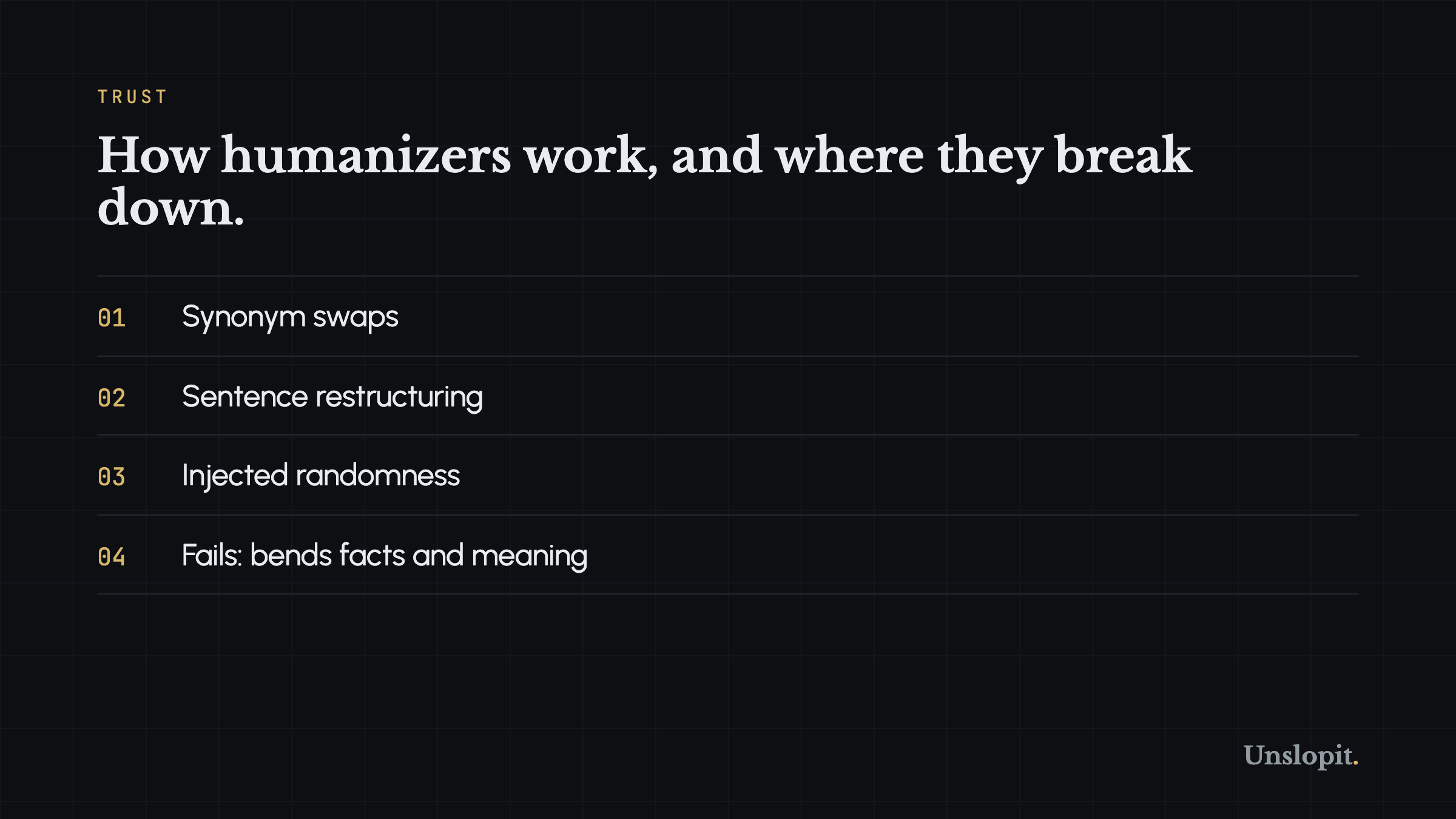
Most AI humanizers use a small set of techniques. None of them produce genuinely human writing. Here is what happens when you hit "humanize."
Synonym replacement is the most common approach. The tool scans the text and swaps words for near-equivalents. "Utilize" becomes "use." "However" becomes "but." "Facilitate" becomes "help." Sometimes this improves the text. A sentence that said "the initiative will facilitate organizational transformation" becomes "the initiative will help the organization change." That is genuinely better. More often, the swaps produce awkward constructions. "The quarterly earnings growth facilitated investor confidence" becomes "the quarterly earnings growth helped investor confidence." Grammatically fine. Semantically a little off. A human would have written "the quarterly earnings growth boosted investor confidence" or reworked the sentence entirely. The synonym swap gets close but not close enough.
Sentence restructuring is the second technique. The tool breaks long sentences into shorter ones or merges short sentences into longer ones. The goal is to disrupt the statistical patterns that detectors look for, specifically the uniform sentence length that characterizes most AI output. The side effect is prose that reads like it was assembled by a committee. Meaning shifts between the cracks. Connections between ideas weaken. A paragraph that was coherent becomes harder to follow because the logical thread was snipped into pieces and stitched back together by an algorithm that does not understand it.
Randomness injection is the third technique, and it is the most revealing. Some humanizers deliberately introduce small errors: a missing comma, a slightly awkward word choice, a sentence fragment where one does not belong. The theory is that perfect grammar is an AI tell, so imperfection signals humanity. In practice, this produces writing that is both machine-generated and bad. You trade one set of tells for a worse set. The text no longer screams "ChatGPT" but it starts whispering "something is wrong here." Readers may not know what, but they know something.
Perplexity and burstiness tuning is what the more sophisticated tools attempt. Perplexity measures how predictable each word is given the words before it. Humans write with higher perplexity because we make less predictable choices. Burstiness measures variation in sentence length and structure. Human writing is bursty. AI writing is flat. Some humanizers try to tune these statistical properties by adjusting word choices and sentence structures to hit human-like targets. This is more mathematically grounded than random synonym swapping, but it still operates at the surface level. The text becomes statistically more human-shaped without becoming human-authored. A reader might not flag it as AI. They will flag it as dull.
Where humanizers fail
The failures fall into several categories, and any one of them is enough to sink the output for any professional use case.
Meaning degradation
Every transformation step introduces small errors. A synonym that almost fits but not quite. A restructured sentence that shifts the emphasis from the second clause to the first. A technical term that gets replaced with a near-equivalent that means something different in context. After two or three passes through a humanizer, the original meaning is compromised. For anything where accuracy matters, from technical documentation to legal language to medical information, this is unacceptable. You cannot ship writing where you are not sure the facts survived.
A different flavor of weird
Humanized text does not read like natural human writing. It reads like AI writing that someone tried to fix. The tells change but they do not disappear. Instead of em dashes and "delve," you get awkward syntax and mismatched tone. The text stops screaming "ChatGPT" and starts whispering "something is off here." Readers may not be able to name what is wrong, but they pick up on it. The uncanny valley of prose is real. Humanizers push text into it rather than out of it.
The detectors adapt fast
Every major AI detector updates its models regularly. When a humanizer tool finds a technique that beats the current detector, the detector team trains on humanized samples and closes the gap. The humanizer responds with new techniques. The detector responds again. This is an arms race with a structural asymmetry: detectors train on millions of samples, and humanizers try to mask patterns in individual documents. The detectors have the advantage and they always will. Any technique that works today will stop working within weeks or months.
Facts do not survive
This is the failure nobody talks about in the humanizer marketing pages. Humanizers do not understand what your text means. They cannot verify that a name, number, date, or claim survived the rewrite intact. When the tool swaps words and restructures sentences, facts drift. A revenue figure shifts from "4.2 million" to "approximately 4 million." A product name changes from "MailChimp" to "the email platform." A statistic cited from a study becomes vague enough to be technically wrong. A person's title changes from "VP of Engineering" to "engineering lead." For a casual blog post, this might not matter. For a client deliverable, a grant application, a legal filing, or any document where accuracy is the point, the humanizer is actively dangerous.
The arms race is a losing game
The humanizer category exists because of a framing problem. People think the issue with AI writing is that detectors can spot it. The real issue is that AI writing is bad. It is monotonous. It is vague. It is impersonal. It reads like a committee wrote it because a committee, in the form of a training dataset, did.
Fooling a detector does not fix this. It makes the problem invisible to automated tools while leaving it fully visible to human readers. Your boss will not run your memo through GPTZero. They will read it, notice it has no point of view, and conclude you did not think very hard about it. The detector was never the audience. Other people were. Playing to the wrong metric produces the wrong outcome.
The alternative is to stop treating detection as the enemy and start treating quality as the goal. Make the output good enough that nobody cares how it was produced. This is not a prompt engineering problem. It is a systems problem. You need a voiceprint that reshapes AI output into your actual patterns and an audit that catches the mechanical tells before they ship.
How to evaluate writing without an arms race
At Unslopit, we do not try to beat detectors. We score writing on dimensions that matter regardless of who or what produced it. Here is what the anti-slop auditor counts.
Em dashes. Every single one. Most human writers use zero to one em dash per thousand words. AI output averages five to fifteen. The auditor flags every instance. This dimension alone catches most AI-generated drafts before any other check runs.
Banned words. A fixed list of terms that appear disproportionately in AI output: delve, tapestry, testament, realm, landscape, the verb leverage, and about forty more. Each instance counts against the score. A draft with seven banned words is a draft that needs work. The list is public and transparent. Nothing is hidden in a black box.
Scaffold phrases. "It is important to note." "Furthermore." "In conclusion." "It is worth mentioning." These are filler. They add no information. The auditor counts them and deducts. A draft heavy on scaffolds is a draft that padded itself instead of saying something.
Copula inflation. "Serves as," "stands as," "represents," "embodies." When "is" would work, anything longer is inflation. Counted and deducted. Eight instances of copula inflation in a thousand-word draft is not a style choice. It is an AI fingerprint.
Rhythm flatness. The auditor measures sentence length variation across the entire draft. Human writing has texture. Short sentences. Long ones. Fragments. AI writing tends toward uniform length, sentence after sentence. The auditor compares the draft's sentence length distribution to a human baseline and scores the gap. A flat rhythm is one of the hardest tells to spot by eye and one of the easiest to measure algorithmically.
Specificity. Concrete details per hundred words. Names. Numbers. Dates. Specific claims. Vague writing scores low regardless of who wrote it. This dimension rewards substance. It catches the hollow, detail-free prose that characterizes both bad AI output and bad human writing.
These dimensions are deterministic. The auditor is not guessing. It is counting. A score of 18 out of 20 means the draft is clean on nearly every dimension. A score of 10 means specific flagged items are dragging it down and you can see exactly what they are. This is the difference between a humanizer, which applies blind transformations and hopes the result fools a detector, and an audit, which counts defined problems and tells you what to fix.
The Fact-Lock problem that humanizers ignore
There is one more piece to this, and it is the one humanizers ignore entirely. Facts have to survive the rewrite.
When you run AI output through any transformation pipeline, something always shifts. A number rounds up or down. A name changes or gets replaced with a generic descriptor. A claim softens from a specific assertion into a vague generality. For a blog post about productivity tips, this kind of drift might not matter. For a client deliverable with revenue figures, product specifications, or regulatory language, it matters enormously. It is the difference between a usable draft and a liability.
At Unslopit, Fact-Lock anchors every name, number, and claim in the original draft, verifies they survived the rewrite, and flags anything that changed. If a fact drifts through the system, that month is free. This guarantee exists because the problem is real and universal: the more processing steps between the AI and the reader, the more facts degrade. Humanizers add processing steps. They cannot solve the fact-integrity problem because they do not understand what the text means. They understand word frequencies.
What to do instead of chasing detectors
If you want AI-assisted writing that reads well and does not set off anyone's "something is off here" alarm, the path is straightforward. No humanizer required.
- Accept that detectors are not the audience. Other people are. Write for them.
- Build a voiceprint from your actual writing. Not a prompt. Not a style guide. A statistical model of your patterns. Run AI output through it every time.
- Audit every draft before it ships. Count the tells. Fix what the numbers tell you to fix. Do not guess. Count.
- Lock the facts. Verify that everything that was true in the draft is still true in the final version. If you cannot verify, do not publish.
This is not as easy as pasting into a humanizer and hoping. It is slower. It requires building a voiceprint upfront. It requires running a gate. It requires reading the output. But it produces better results. Writing that sounds like you. Writing that carries your point of view. Writing with facts that are still facts. Writing you are not embarrassed to put your name on.
That is the actual goal. Detector evasion is a distraction. A number on a dashboard that tells you a tool thinks your text is "92 percent human" means nothing if the text is bad, the facts are wrong, and the reader can tell something is off. Quality beats evasion every time. The humanizers will keep playing their arms race. The rest of us can just write better.
If you want to see how your writing scores on the dimensions that actually matter, run a draft through the free Slop Score grader at unslopit.io/score. No signup. No credit card. Paste in your text and get a number from 0 to 20 plus a breakdown of what is dragging it down. No humanizer required.