Yes. AI rewriting tools change facts all the time. They swap words that seem like synonyms but carry different weights. They drop numbers because the model does not understand which digits matter. And when there is a gap in the source text, they fill it with something that sounds right. The result reads fine at a glance. But the facts underneath? They have drifted. Sometimes a little. Sometimes a lot.
I run a writing tool and I see this every day. Someone pastes a draft with a budget figure of $47,300. The AI rewrites it as "about fifty thousand dollars." That is a 5.7% error. In a grant application, that gets you disqualified. In a legal document, that opens you to liability. In a medical summary, that changes a dosage threshold. The prose looks cleaner. The number is wrong.
What actually happens when AI rewrites text?
Most people think AI rewriting is like a smart thesaurus. Swap a word here, reorder a sentence there, keep everything else the same. That is not what happens. The model generates new text from scratch based on what it understood from your input. It is not editing. It is regenerating. And regeneration is a lossy process.
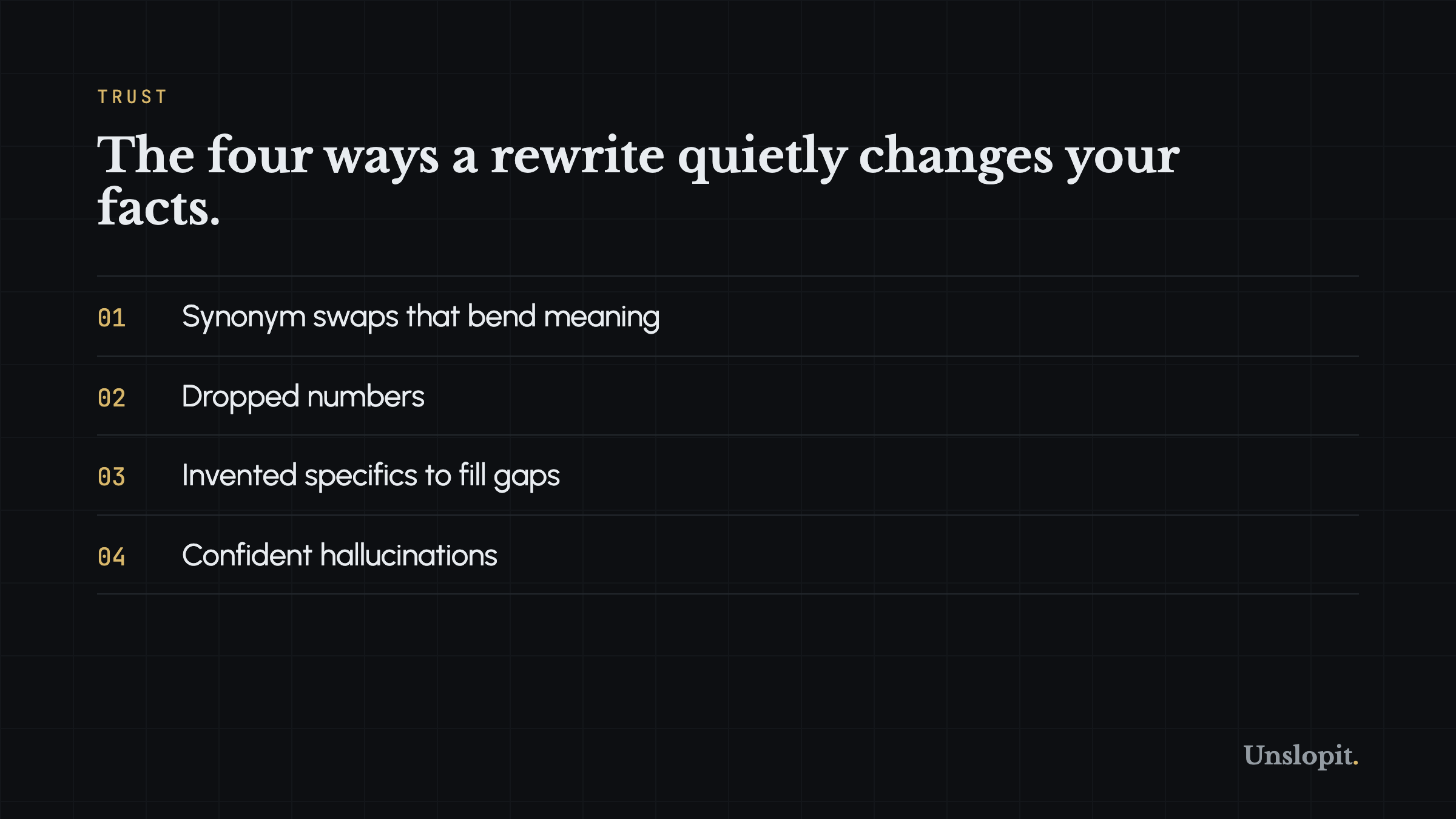
Here is what goes wrong, in order of frequency:
- Synonym drift: The model replaces a precise term with a near-equivalent that shifts the meaning. "Quarterly revenue declined 3.2%" becomes "quarterly revenue fell slightly." "Declined 3.2%" is a measured claim. "Fell slightly" is a vibe. Same structure, less truth.
- Number rounding or omission: Models do not treat numbers as sacred. They treat them as tokens like any other word. A specific figure like "1,247 respondents" might become "over a thousand respondents" or disappear entirely.
- Gap filling: When the source text is vague, the model fills in specifics to make the output sound more confident. You wrote "the study found improved outcomes." The AI rewrites it as "the landmark study found a 34% improvement in patient outcomes." The number and the adjective are invented.
- Entity confusion: Names, dates, and proper nouns can shift across a long rewrite. "Dr. Elena Torres" becomes "Dr. Torres" or worse, "Dr. Elena" in subsequent mentions. Two separate companies mentioned in one paragraph get merged into one by the second reference.
- Hallucinated structure: The model adds transition phrases, subheadings, or conclusions that were not in your original. These carry implied claims you never made.
All of these happen silently. The output reads well. That is the trap. Fluency masks error.
Why does AI drift facts so easily?
The short answer: language models do not know what a fact is. They work with statistical patterns across billions of sentences. They know that "revenue" often appears near "declined" and that "declined" often appears near "slightly." They know that scientific papers contain numbers with percentage signs. They do not know that your specific number matters.
There is a deeper issue too. Most AI rewriting tools optimize for two things: producing text that sounds human and avoiding detection patterns. Factual accuracy is not in the loss function. Neither is meaning preservation. The model is rewarded for output that reads naturally, not output that stays true to the source. When those goals conflict, truth loses.
I have seen this play out in predictable ways. If you ask a standard AI rewriter to process a paragraph with five specific claims, you will typically get back a paragraph with four of those claims intact, one altered, and one new claim added. The altered claim often keeps the shape but shifts the weight. The added claim sounds so natural you will not notice it unless you check line by line.
Which facts are most at risk?
Numbers top the list. Percentages, dollar amounts, dates, counts, and statistical figures all degrade during rewriting. Models round them, approximate them, or drop them. If your writing depends on numerical precision, a standard AI rewriter is a liability.
Named entities come next. People's names, company names, product names, place names. These get truncated ("Johnson & Johnson" becomes "Johnson"), mangled, or confused when multiple entities appear close together. I once ran a test where a paragraph mentioned Merck, Pfizer, and Moderna and the rewriter merged two of them into a single entity by the second reference.
Specific claims about causation and attribution are also vulnerable. "Linked to" becomes "caused by." "Associated with" becomes "drives." "Found in a preliminary study" becomes "proven by research." These shifts feel small on the page. In regulated industries, they are the difference between compliance and a lawsuit.
Quotes and attributions. If your source text says "As Dr. Chen noted in her 2022 review," a rewriter might output "According to researchers." That goes beyond imprecision. It misattributes the claim to an unnamed group and strips the citation that lets someone verify it.
Can you trust AI humanizers with your facts?
No. Most AI humanizers are built to do one thing: scramble text enough that AI detectors cannot flag it. They add typos on purpose. They swap synonyms aggressively. They vary sentence length by making some sentences weirdly short and others unnecessarily long. Fact preservation is not part of the design.
This matters because humanizers are marketed as quality tools. The pitch is "make your AI writing sound human." But the mechanism is deception. The goal is passing a test, not producing good writing. When you optimize for fooling a classifier, you make choices that degrade the content. Synonyms get swapped for words that do not quite fit. Numbers get paraphrased into vagueness. The text survives the detector and loses its meaning.
How Fact-Lock actually works
Here is the process, step by step:
- Extraction: Before rewriting, the system scans your input and pulls out every proper noun, every number (including ranges and units), every date, every quoted passage, and every claim that contains a specific assertion. These become the anchor set.
- Anchoring: Each extracted fact gets tagged with its location and context. A number goes from "47,300" to "budget figure, paragraph 3, preceded by 'total project budget of.'"
- Rewrite: The voice engine rewrites the text using your saved voiceprint. This step transforms the style and structure while the anchor set sits locked to the side.
- Verification: After the rewrite, the system scans the output and matches it against the anchor set. Every anchor must appear in the output with the same value. Numbers must match digit for digit. Names must appear fully intact. Claims must carry the same assertion weight.
- Flagging: Any anchor that cannot be verified in the output gets flagged. You see exactly what drifted and where. You decide whether to accept, fix, or revert.
This is not a probabilistic check. It is not a model estimating whether the rewrite "probably" preserved your facts. It is extraction and comparison. If the output says "approximately fifty thousand" and the input said "$47,300," the system flags it. No matter how natural the rewrite reads.
How to check if your rewrite changed anything
Even if you are not using Unslopit, you can apply the same principle manually. Here is what I do when I am reviewing rewritten text:
- Extract the facts first. Before you read the rewritten version for flow, scan the original and pull out every number, name, date, and specific claim. Write them down.
- Read the rewrite against your list. Do not read for style yet. Just check: is every item from your list present and unchanged in the output?
- Pay special attention to numbers. Did "37%" stay "37%"? Did "Q3 2024" stay "Q3 2024"? Did the dollar figure keep its exact value?
- Watch for added claims. Read the rewrite carefully for any assertion that was not in your original. New claims are harder to spot than missing ones because they blend into the flow.
- Check attribution chains. If you cited someone, did the citation survive? If you attributed a finding, did the attribution stay attached to the right entity?
This takes about three minutes for a thousand words. It is tedious. It is also the only way to be certain. Fluency is not a proxy for accuracy. Never has been.
Why this matters more than people think
The conversation about AI writing focuses heavily on detection and authenticity. Will the professor know? Will the client flag it? That framing misses a larger problem. Detection matters for reputation. Fact preservation matters for everything else.
I hear from users in fields where factual drift is genuinely dangerous. Medical writers whose summaries affect treatment decisions. Legal professionals whose briefs cite case law with specific page numbers. Researchers submitting grant applications with budget line items. Journalists whose editors will spike a piece if a single figure cannot be verified. These people do not care whether their writing "sounds like ChatGPT." They care whether the rewrite introduced errors they will be accountable for.
The standard AI writing pipeline treats all words as equally replaceable. They are not. Some words carry legal weight. Some carry scientific precision. Some are someone's name, and getting it wrong is disrespectful in a way that matters. A tool that does not distinguish between a transition phrase and a dosage figure is a tool that should not be used in any context where facts count.
The academic context is particularly bad. Students who use AI to polish essays are discovering that their citations drift. A paper citing "Smith et al. (2023)" comes back from the rewriter citing "researchers" or, worse, attributing the finding to the wrong author. Professors do not need AI detectors when the references do not match the bibliography. The rewrite passed a grammar check and failed the only check that matters in academia: can the reader trace every claim back to its source?
I have also seen this in journalism. A newsroom I consulted for ran a test. They took a 600-word article with seven attributed facts and ran it through three different AI rewriters. Across nine total rewrites, 23 percent of the facts changed. Some changed subtly. A quote from a city council member became a paraphrase attributed to "city officials." A specific budget cut of $2.4 million became "significant budget reductions." The rewrites read well. They would have passed any editor scanning for style. They would have failed a fact-checker in under two minutes.
The good news is that distinction can be built. Extraction and verification are mechanical problems with deterministic solutions. We do not need a smarter model that "understands" facts better. We need a system that simply refuses to let them move.
Drop your next draft into the free Slop Score grader at unslopit.io/score. It will flag every drifted number, missing name, and invented claim before your readers do. No signup required.