The Short Answer
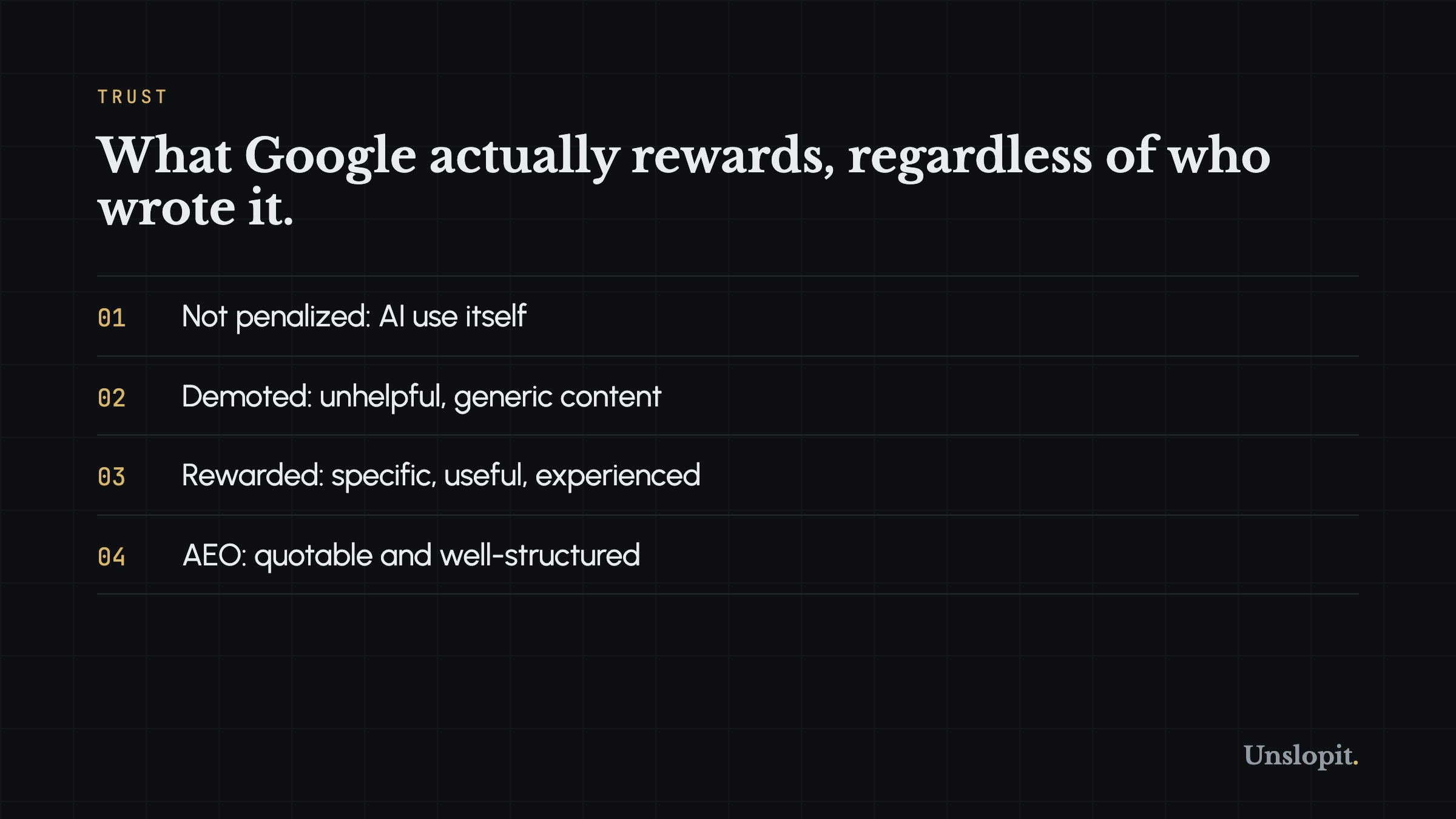
No. Google does not penalize content because AI wrote it. Google penalizes content that is unhelpful, spammy, or designed to manipulate rankings. The tool used to produce the words is not a ranking factor. The quality of those words is.
That is the official position. Google published it in February 2023 on the Search Central Blog. The title of the post is "Google Search's guidance about AI-generated content." The core line: "Google's ranking systems aim to reward original, high-quality content that demonstrates qualities of what we call E-E-A-T: expertise, experience, authoritativeness, and trustworthiness." The method of creation is not part of that sentence. It has not been added since.
But the conversation usually stops there, and it should not. Because AI content does get demoted all the time. Just not for the reason people assume.
What Google Actually Says About AI Content
Google's guidance draws a clear line. Using automation, including AI, to generate content with the primary purpose of manipulating search rankings violates Google's spam policies. That is the spam side. The quality side is separate. Google has said, publicly and repeatedly, that AI-generated content can rank well if it demonstrates E-E-A-T and satisfies the helpful content standard. The distinction is intent plus execution, not tool choice.
Google compares this to the human-generated content farm era. About a decade ago, mass-produced human content flooded search results. Demand Media, Associated Content, and dozens of content mills pumped out articles by the thousand. Google did not ban human writers. It improved its systems to reward quality and demote garbage. The Panda update in 2011 targeted thin content. The helpful content update in 2022 extended that logic. The same framework applies to AI. The problem was never the author. It was the output.
SpamBrain, Google's automated spam detection system, does not check whether a language model produced your page. It checks for scaled content abuse, keyword stuffing, thin content with no added value, and pages that exist only to capture traffic without answering the query. Those signals work regardless of whether a human or a model generated the text. A page of 500 words that rephrases the Wikipedia entry on a topic with no original insight will not rank well, and it does not matter if a human spent two hours writing it or an AI spent two seconds.
Why AI Content Still Gets Penalized
If Google does not penalize AI content directly, why do sites built on AI output keep losing rankings? The answer is indirect but predictable.
Raw AI output is generic. It summarizes existing content rather than adding anything new. It avoids taking positions. It lacks specific examples, original data, or firsthand experience. These are exactly the qualities that Google's helpful content system was designed to filter out. A page that rephrases what the top three results already say contributes nothing. Google's systems can detect that now. They do not need to know AI wrote it. They just need to know the page offers zero marginal value.
The helpful content system evaluates pages holistically. It asks whether a page feels like it was written by someone with firsthand knowledge. Whether the content leaves the reader satisfied or still searching. Whether the page has a primary focus or tries to be about everything. These are the same signals that separate a Wikipedia summary from a product review by someone who actually used the product for six months. AI drafts tend to land on the Wikipedia side of that divide. They describe. They do not evaluate. They list features. They do not report outcomes.
E-E-A-T makes this worse for AI content. Experience, the second E, was added specifically to reward firsthand knowledge. Google wants content from people who have done the thing they are writing about. AI models have not done anything. They have no experience to draw from. A human can layer their own experience onto an AI draft. But if you publish raw model output, the experience signal is missing entirely. That absence is a ranking liability.
The third problem is noise. When thousands of sites publish AI-generated articles targeting the same keywords, the results are nearly identical. Google's systems see duplicate or near-duplicate content across domains and demote the weaker ones. The content was not penalized for being AI-generated. It was penalized for being indistinguishable from everything else in the index. The same thing happened with human-written listicles in 2017. Differentiation matters more than origin.
Google does not need an AI detector. Generic content is its own penalty.
How to Use AI Without Getting Penalized
The pattern that works is straightforward. Use AI to handle structure, research synthesis, or first-draft generation. Then add the layer that only you can provide. Specific data from your own work. Examples from your client projects. Opinions formed through direct experience. Numbers from your analytics. Names of real tools you use and why. This turns a generic AI draft into something original, experience-backed, and genuinely helpful.
Some of the best-performing content on the web right now was written with AI assistance and edited by a subject expert. The combination works because each half does what the other cannot. The AI handles volume, structure, and research recall. The human handles judgment, specificity, and voice. Neither one alone produces publishable content. Together they produce content that is faster to create than pure human writing and higher quality than pure AI output. The trick is knowing which half to trust with which job.
A useful mental model: treat AI output the way a newspaper editor treats a wire service report. The wire gives you the facts and a serviceable draft. Your job is to add local context, verify the details, rewrite the lede for your audience, and kill anything that reads like boilerplate. You would never publish a raw AP wire story under your byline. You should not publish raw AI output under it either.
Here is a concrete checklist for every AI-assisted page before you publish it.
- Does this page contain at least one specific detail that does not appear in the current top 10 results?
- Does the content reflect direct experience (I did this, I saw this, I measured this) rather than summarized generalizations?
- Is the opening paragraph answering the query or warming up with generic context?
- Are the examples, numbers, and names real and verifiable?
- Would this page still be useful if every other article on this keyword disappeared?
If you answer "no" to questions one, two, or five, the page is at risk regardless of how it was produced. AI did not cause the problem. Thin content did.
What Site-Level Signals Look Like in Practice
Google's helpful content system evaluates sites, not just pages. A site that publishes mostly unedited AI output will accumulate a site-level signal that drags down every page, including the ones a human wrote. This is the pattern that catches people off guard. They publish 50 AI-generated articles targeting long-tail keywords. Traffic spikes for a few weeks. Then Search Console shows impressions falling across the board. Even the older, human-written pages lose rankings. The site acquired a reputation for thin content, and Google applied that reputation site-wide.
Recovery from a site-level helpful content demotion is slow. Google has said it can take several months, and the site needs to demonstrate sustained improvement over that period. A single batch of good content will not fix it. This is the real cost of publishing AI output without editing. It is not a per-page penalty. It is a trust problem that takes a quarter or more to repair.
The AEO Angle: AI Search Engines Reward Specificity More Than Google Does
Google is not the only search engine that matters anymore. ChatGPT, Perplexity, Claude, and other AI-powered search tools now drive meaningful traffic. And these engines evaluate content differently than Google does. They favor pages that are quotable. A specific, well-structured answer that can be cited inline is more valuable to an AI search engine than a comprehensive guide that requires skimming.
This changes the optimization strategy. With traditional SEO, you might write a 3,000-word pillar page that covers a topic exhaustively. With Answer Engine Optimization, you want short, self-contained passages that answer a single question clearly. Citations come from the passage, not the page. Google's John Mueller has noted that AI-generated summaries are pulling from pages that provide concise, quotable information. The irony is that AI search tools reward the opposite of what AI content tools tend to produce. AI content tools generate long, padded, generic text. AI search tools want short, specific, attributable text.
Think about how Perplexity or ChatGPT answers a question. It pulls a passage from a page and cites it inline. If the passage says something specific like "the median time to first sale on Shopify is 38 days," it gets cited. If the passage says something vague like "it can take time to make your first sale on an ecommerce platform," it does not. The AI search engine already generated that level of generality itself. It needs you to provide the specifics. That is the job of content in an AI-mediated search landscape. Be the source the engine cannot generate on its own.
The winning strategy for both traditional SEO and AEO is the same. Write content that could only come from you. Add the specifics. Add the experience. Structure for quotability. If the content is original enough to cite, it is original enough to rank, whether Google or an AI search engine is doing the ranking.
The Bottom Line
Google does not penalize AI content. It penalizes content that fails to help. The distinction matters because it tells you where to spend your effort. You do not need to hide your use of AI from Google. You need to make sure the final page says something specific, draws on real experience, and adds value the search results do not already have. That is the same standard human-written content has always been held to. AI did not lower the bar. It just gave more people a way to trip over it. And the people who trip are the ones who hit publish before they hit edit.
If you are publishing AI-assisted content and want to check whether it passes the quality threshold before it goes live, run it through the free Slop Score grader at unslopit.io/score. It flags the generic language patterns that correlate with thin content. Fix those. Add your specifics. Then publish. No signup. No card. Just a score and a breakdown.