Your writing might sound like AI. Not because you used AI to write it. Because you absorbed its patterns without noticing. Spend enough time reading ChatGPT output and the rhythms seep in. Your emails get longer. Your LinkedIn posts develop a certain cadence. Your sentences start connecting in ways they never did before. The good news: you can diagnose this yourself in about ten minutes. Below is a six-point self-check I use on every draft I touch. I run Unslopit, an AI voice editor, and I read machine-generated text all day. These tells show up in almost every first draft from ChatGPT, Claude, and Gemini. The patterns are consistent enough that I can usually spot AI writing from the first three sentences.
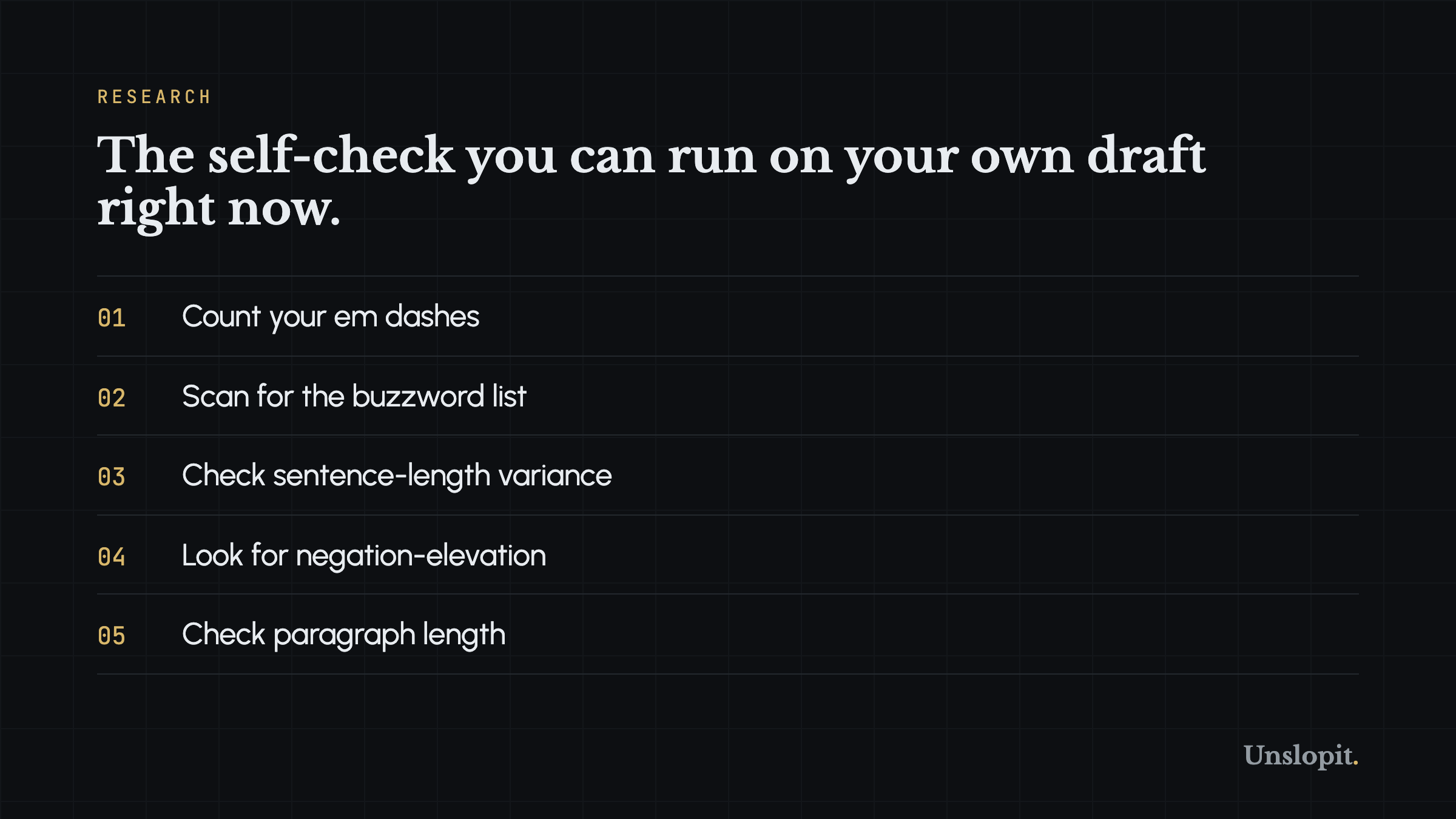
1. Count Your Em Dashes
This is the fastest test. Copy your text into any editor with a find function. Search for the em dash character. Count how many you find. Then divide by your word count and multiply by 500 to get dashes per 500 words. Most human writers use zero to one em dash per 500 words. Some never use them at all. GPT-family models average three to eight em dashes per 500 words. If your count is above two, that is a signal. If it is above five, your writing will read as AI-generated to anyone paying attention.
The em dash became the poster child of AI slop for good reason. Reddit threads with thousands of upvotes have turned it into a running joke. One user wrote: "I immediately scan for em dashes now. If there are more than two in a short post, I assume ChatGPT wrote it." The overuse pattern is so reliable that some freelance platforms have clients who reject drafts based on dash density alone. I have heard from writers who lost contracts because a client spotted the long horizontal strokes and made the call.
This test takes 30 seconds. If your count is alarming, the fix is mechanical: find and replace each dash with a period, comma, or semicolon. Then smooth the resulting punctuation collisions. This is tedious manual work but it removes the single loudest AI tell immediately.
2. The Buzzword Audit
AI models have a vocabulary fingerprint. Certain words appear in machine-generated text at massively higher rates than in human writing. Scan your draft for the following list. Circle every hit. These are the words the Unslopit auditor flags because their frequency in ChatGPT output dwarfs their frequency in real human prose:
- delve, delve into, deep dive
- tapestry, a testament to, testament to
- intricate, multifaceted, in the realm of, in the world of
- harness, unlock, unleash, supercharge
- robust, holistic, seamless, seamlessly
- cutting-edge, transformative, game-changer, game-changing, revolutionize
- groundbreaking, unprecedented, world-class, best-in-class, next-gen
- paradigm shift, meticulously, painstakingly
- elevate, empower, empowering
- underscore, underscores, reimagined, purpose-built, turbocharge
- leverage (used as a verb)
- showcase, designed to, robust, seamless
A single instance of "delve" is not a conviction. But when your draft contains "delve" plus "tapestry" plus "seamless" plus "game-changing," readers will feel it even if they can not name why. The buzzwords cluster. That clustering is what makes the prose smell synthetic. Count your hits. Zero to two is clean. Three to five is questionable. Above five and your text will read like an AI content brief to anyone who has used ChatGPT more than twice.
The phenomenon has gotten so widespread that Merriam-Webster published a piece on "AI slop" terminology entering public consciousness. People are building personal ban-lists. Freelancers share Google Docs of words they strip from every draft. The buzzword problem is not academic. It has real economic consequences for people whose writing gets flagged as AI-generated because they let the model's default vocabulary bleed through.
3. Sentence Length Variance
Count the words in ten consecutive sentences from your draft. Human writing varies. Short sentences. Then longer ones that run for a while, the kind that build momentum and carry the reader through a thought before landing on something crisp. Then fragments. Then another short one. The rhythm feels alive.
AI writing flattens this. ChatGPT tends to produce sentences of remarkably consistent length. Not identical, but close enough that the rhythm feels mechanical after a few paragraphs. Count your ten sentences. If seven or more are within three words of each other, your rhythm has a problem. The fix is not complicated. Go through and break some long sentences into fragments. Combine some short ones into longer compound sentences. Make the reader's internal voice speed up and slow down. That variance is what signals a human behind the keyboard.
4. The Negation Pattern
Search your text for the word "just" preceded by "not." The construction "not just X, but Y" is the single most recognizable AI sentence structure. It appears in nearly every ChatGPT draft. The model learned it from formal writing and overuses it to the point of parody. "This is not just a tool, but a paradigm shift." "The results were not just better, but transformative." After the third one in a single page, the reader stops trusting the writer.
Humans use this construction occasionally. AI uses it as a default sentence shape. If your draft contains more than one "not just" construction in a thousand words, that is a red flag. More than two and you are in robot territory. The fix: delete "not just" and state the positive directly. "This is a tool that saves time." Done. No construction needed.
Related negation patterns to watch for: "not only X but also Y," "it is not X, it is Y," and "more than just X." Same logic. Same fix.
5. Paragraph Shape
Scroll through your draft without reading. Just look at the shape of the paragraphs on the page. AI-generated text tends toward uniform paragraph length. Three to five sentences each. Predictable block after predictable block. Human writing is messier. A one-sentence paragraph for emphasis. Then a meaty eight-sentence paragraph. Then two short ones. The visual rhythm on the page tells you something about who wrote it.
If every paragraph in your draft is roughly the same size, break one of them. Make a single-line paragraph. Then merge two short ones. The fix is visual before it is verbal. Your paragraphs should look uneven on the page. That unevenness signals a human making judgment calls about emphasis and pacing rather than a model optimizing for uniform output.
6. The Opening and Closing Trap
Read your first paragraph. Does it warm up before getting to the point? Phrases like "in today's fast-paced digital landscape" or "as we navigate the ever-changing world of" are throat-clearing. Real human writers get to the point. AI writes introductions that circle the topic before landing. Delete your first paragraph entirely. Start from the second one. Nine times out of ten, the second paragraph is where you actually began.
Now read your conclusion. Does it end with something specific or does it drift into vague profundity? AI loves to close with lines like "the future of writing will be defined by those who embrace both technology and humanity" or some equivalent pablum. A real conclusion says something concrete. It might be a specific recommendation. It might be a question. It might just stop. The fake-profound ending is a tell. If your last paragraph could apply to any article about any topic, rewrite it so it could only apply to this one.
How to Score Your Self-Check
Give yourself points for each tell you find. This is a diagnostic, not a condemnation. The goal is to know where you stand.
- Em dashes: 2+ per 500 words = 2 points. 5+ = 4 points.
- Buzzwords: 3-5 flagged words = 2 points. 6+ = 4 points.
- Sentence rhythm: 7+ sentences within 3 words of each other = 2 points.
- Negation pattern: 2+ "not just" constructions = 2 points. 4+ = 3 points.
- Paragraph uniformity: every paragraph within 1 sentence of each other = 2 points.
- Opening/closing: throat-clearing intro or fake-profound conclusion = 2 points each.
Tally your score. Zero to three points: your writing is clean. You might use AI as a tool but your human signal is intact. Four to seven points: there are patterns worth fixing. Readers probably will not accuse you of being a bot but the prose feels slightly off. Eight or above: your writing carries multiple AI tells simultaneously. Readers will notice. Some of them will make assumptions.
The tells compound in ways that make individual scores misleading. A draft with three em dashes and four buzzwords reads differently than a draft with seven buzzwords and zero em dashes. The first feels off in a way that is hard to pin down. The second announces itself loudly. What matters is not any single tell in isolation. It is the pattern. Two or three moderate signals combine into a strong one. Readers process these signals holistically even when they cannot name a single one. You have probably experienced this yourself. You read something and think "this sounds like ChatGPT" without being able to point to the exact sentence that gave it away. That is pattern recognition at work.
What Your Score Means in Practice
A low score does not mean your writing is good. It means it passes the basic smell test. You could still have structure problems, weak arguments, or boring prose. The tells covered here answer one question: does this sound like it came from a language model? A clean score means no, which is the baseline. Everything else is writing craft.
A high score matters more than most people think. Readers are getting better at pattern recognition. They may not know the term "negation-elevation" or "copula inflation." But they have read enough ChatGPT-generated LinkedIn posts that their subconscious flags the rhythm. They bail. They scroll past. If you are writing for an audience that matters to you, slop tells are a quiet credibility killer.
I have watched freelance writers get flagged, questioned, and sometimes dropped because their drafts hit too many of these markers. The accusation is rarely direct. Clients do not always say "I think you used AI." They say the writing "feels off" or "does not sound like you." Then the contract ends. The cost of slop tells is real and measurable in lost work.
The Automated Version
You can run this whole self-check manually. It works. I do it. But it takes time and you will miss things. The buzzword list alone is dozens of terms across multiple categories. The rhythm check requires actual counting. The negation patterns hide in long sentences. A manual scan catches maybe 60% of the tells in a given draft.
Our anti-slop auditor at Unslopit automates this entire process. You paste a draft. It scans for em dashes, runs the full buzzword list, checks sentence-length variance, flags negation patterns, counts scaffolds, measures copula inflation, and scores paragraph rhythm. It assigns a score from 0 to 20 across six anti-slop dimensions. You see exactly what you are getting wrong and where. The free Slop Score grader is at unslopit.io/score. No account. No card. Paste anything and get a number back in seconds.
If you write anything that matters to you, run it through the grader before you ship. A quick scan takes less time than the manual self-check and catches everything the human eye skips. Your readers are already pattern-matching. Give them a draft worth their attention.
If you ran the checklist above and a few flags went up, the free Slop Score grader at unslopit.io/score automates the whole thing. Paste any text and get your score in seconds. No signup, no card. Then if you want to fix what the score caught, three free rewrites a month will show you what the difference looks like.