What Is a Slop Score?
A slop score measures writing quality by counting specific, detectable signals that AI-generated text leaves behind. Think of it as the counterpart to a readability score. Flesch-Kincaid tells you whether a seventh-grader can read something. A slop score tells you whether a human wrote it, or whether a language model assembled it from statistical patterns.
The idea is straightforward. AI writing has fingerprints. Em dashes everywhere. Banned buzzwords used unironically. Flat, same-length sentences that feel like a content farm conveyor belt. These are not subjective vibes. They are countable. And when you count them, you get a number that tracks quality more reliably than any gut check.
Why "Good" and "Bad" Are Not Measurements
I read AI-generated drafts every day. Some of them are fine. Most of them are not. But when I ask someone why they think a draft is bad, I get answers like "it sounds robotic" or "you can just tell." That is useless feedback. It does not tell you what to fix. It does not even tell you whether the problem is word choice, sentence structure, or something else entirely.
Measuring quality requires dimensions. You cannot improve what you cannot count. The reading world figured this out decades ago with readability formulas. Flesch-Kincaid measures grade level. Gunning Fog measures complexity. SMOG estimates years of education needed. Each formula isolates specific signals: syllables per word, words per sentence, percentage of complex words. The AI writing world needs the same thing. A scorecard that says: here are the signals, here is what they mean, and here is how you fix them.
This is not about catching people using AI. Plenty of good writers use AI. The problem is that undoctored AI output shares a set of measurable traits, and those traits correlate with content that readers find generic, untrustworthy, or exhausting to read. A scorecard makes those traits visible. Once they are visible, they are fixable.
The Anti-Slop Scorecard: 7 Dimensions That Actually Measure Quality
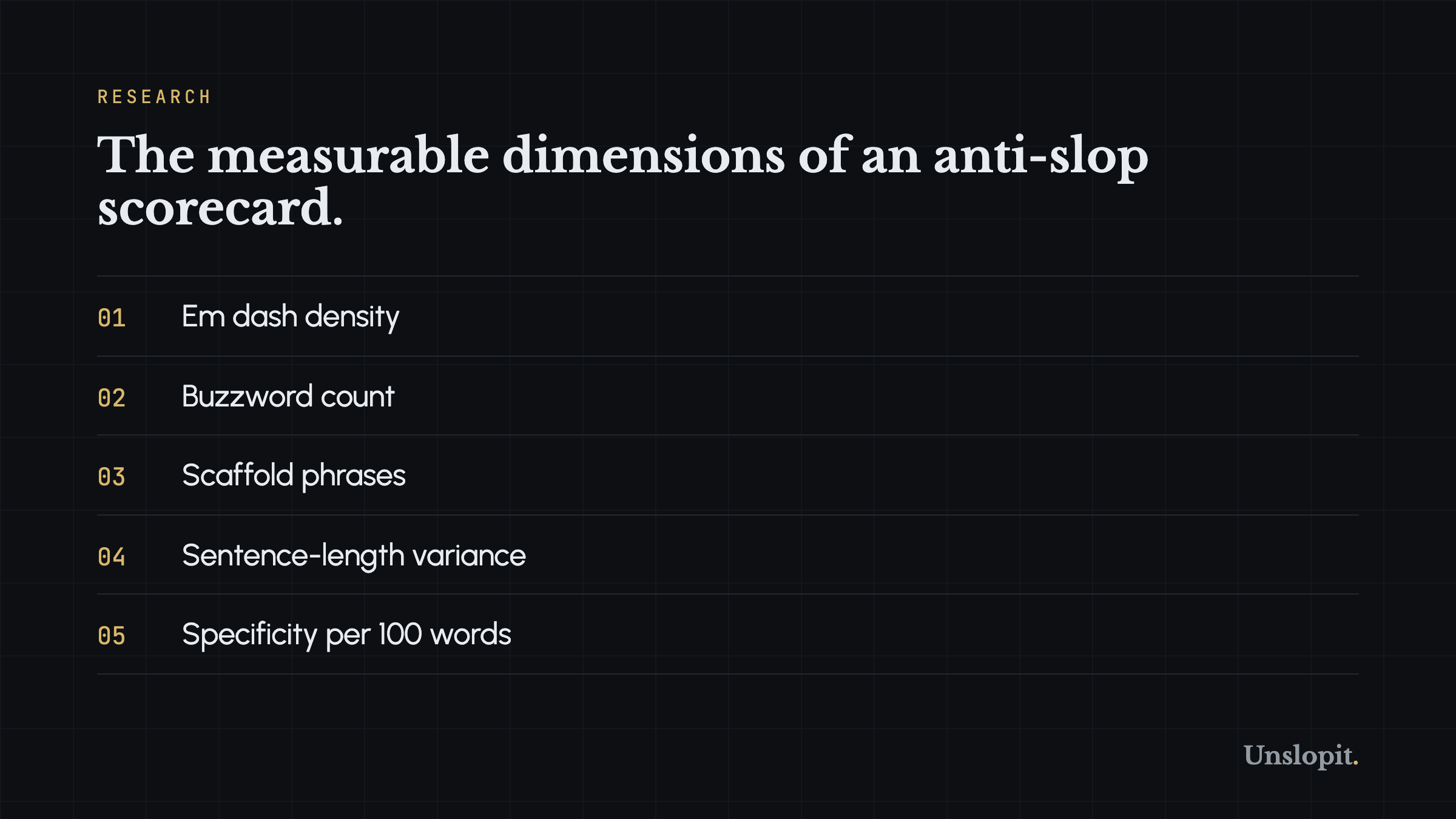
I built this scorecard at Unslopit after auditing thousands of AI-generated drafts. Each dimension targets a specific, measurable pattern. You can check every one of them manually with a word processor and a few minutes. Or you can run the Slop Score grader at unslopit.io/score and get a number back automatically. Either way, the dimensions are what matter.
1. Em Dash Density
The em dash is the single loudest AI tell in 2026. Real human writers use them sometimes. Real human writers do not use three per paragraph. ChatGPT and Claude love them. They insert them between clauses as a default punctuation choice, which creates a distinctive rhythm that reads like a large language model picked the most probable next token.
How to count it: take your em dash count, divide by total word count, multiply by 1,000. That gives you em dashes per 1,000 words. Human writing tends to sit below 1.0. AI drafts frequently land at 3.0 to 8.0. You can also just search for the character in your document. If it lights up like a Christmas tree, you have a problem.
2. Buzzword Count
Some words appear in AI output far more often than any human would use them. "Delve" became such a reliable tell that the community turned it into a joke. But the list is longer: tapestry, testament, intricate, multifaceted, robust, seamless, cutting-edge, transformative, game-changer, revolutionize, groundbreaking. These words are not banned because they are bad English. They are signals because their frequency in AI output is wildly disproportionate to human usage.
How to count it: maintain a word bank of known AI buzzwords. Count occurrences. Normalize per 100 words. A high buzzword density is a double signal. It marks the text as AI-generated. And it marks it as generic. Sameness is the real problem.
3. Scaffold Phrases
Scaffold phrases are the verbal filler language models use to pad sentences and sound authoritative without actually saying anything. "It is important to note." "It is worth mentioning." "Needless to say." "At the end of the day." "In today's fast-paced world." These phrases serve no purpose except to make the model sound like it is building toward a point. They are scaffolding around an empty building.
How to count it: search your text for a known list of scaffold phrases. Count matches. A real human might use one or two in a long piece, usually unconsciously. AI text deploys them systematically, often one per paragraph, because the model has learned they are safe transitions between ideas.
4. Copula Inflation
Copula inflation means replacing the verb "is" with something fancier that adds zero information. "Serves as" instead of "is." "Stands as" instead of "is." "Represents" instead of "is." "Marks a" instead of "is." Language models love these constructions. They make the prose feel weightier. But weight is not meaning. A sentence that says "the policy serves as a framework" says nothing more than "the policy is a framework." The extra syllables are performative.
How to count it: identify every instance where a bloated copula replaces a simple "is." Divide by total sentences. A score above 5 percent of sentences using inflated copulas is a strong AI signal. Good human writing uses "is" most of the time because it is clearer.
5. Sentence-Length Variance
AI writing tends toward a steady, medium-length rhythm. Every sentence lands between 18 and 24 words. Real human writing varies. Short sentences. Then a longer one that winds through a couple of clauses before arriving somewhere unexpected. Then another short one. The rhythm itself carries information.
How to measure it: calculate the standard deviation of sentence lengths in your document. Low variance means the model is pacing itself. High variance means a human is thinking on the page. Fragments count. So do very long sentences broken by natural pauses. The number does not need to be exact. You can see the pattern visually by printing your text and looking at paragraph shape. If every line ends at roughly the same column, you found the tell.
6. Specificity: Concrete Details Per 100 Words
AI writing is vague. It deals in abstractions. It says "many companies are adopting AI" instead of naming a company, a tool, a date, or a result. Specificity is the single dimension that correlates most strongly with whether a reader trusts what they are reading. Numbers. Names. Dates. Dollar amounts. Tool names. Real examples pulled from experience.
How to count it: tally every named entity, numeric value, date, direct quote, or concrete example in your text. Divide by total words and multiply by 100. Aim for at least two concrete details per 100 words. This is not a soft guideline. It is the difference between content that proves it knows something and content that just sounds like it might.
7. Opening and Closing Restraint
AI models waste their first paragraph warming up. "In today's digital landscape, content creation has become increasingly important for businesses seeking to establish their online presence." Nobody reads that. Nobody needs it. And the closing paragraph mirrors the same problem. "In conclusion, the evidence clearly demonstrates that quality content remains paramount in the ever-evolving world of digital marketing."
How to measure it: look at the first 100 words and the last 100 words of your piece. Count how many carry actual information versus how many are throat-clearing. A strong opening answers the query in the first two sentences. A strong closing ends on a specific takeaway, not a summary no one asked for. This is a binary check more than a ratio. If your opening and closing could apply to any article on any topic, they fail.
AI writing has fingerprints. They are not subtle. You just need to know what to look for.
How the Score Is Calculated
Each dimension gets a subscore from 0 to a max weighted by its signal strength. Em dashes are weighted high because they are uniquely diagnostic. Buzzwords get moderate weight because a single "delve" is louder than one scaffold phrase. Sentence-length variance and specificity carry the most weight because they measure the structural patterns that separate human thought from model output.
The weighting was developed by auditing thousands of AI-generated drafts across different models, different prompts, and different content types. Certain signals appear consistently regardless of model or prompt. Em dashes appear at 3 to 8 times the human baseline across ChatGPT, Claude, and Gemini output. Scaffold phrases cluster at roughly one per paragraph. Buzzwords appear in roughly 70 percent of unedited AI drafts at a density above 2 per 1,000 words. These are not anecdotal patterns. They are statistically reliable.
The subscores combine into a single number, 0 to 20. That is the slop score. Zero means the text reads like raw model output with zero editing. Twenty means a human wrote it or an AI draft was edited heavily enough that the signals disappeared. Scores in the middle tell you how much work remains.
The auditor that powers Unslopit runs deterministically. No machine learning guesswork. It counts, normalizes, weights, and returns. You get the same score every time for the same text. That matters because it means you can iterate. Edit a draft. Re-score it. Watch the number move. This turns quality from a conversation into a feedback loop. The same way a writer might revise to hit a target Flesch-Kincaid grade level, they can revise to hit a target slop score.
Why a Slop Score Matters Now
Two things are true at the same time. First, AI writing tools are good enough that raw output passes for competent. Second, readers are getting better at spotting the difference. The window where undifferentiated AI content worked is closing. People scrolling LinkedIn can spot the template from a mile away. Editors reject drafts they cannot articulate why they dislike. Freelancers lose contracts because clients feel something is off.
A measurable score changes the conversation. Instead of "this sounds like AI," you get "your em dash density is 4.7 per 1,000 words and your specificity score dropped below the threshold." That tells the writer exactly what to fix. It also protects honest writers who use AI as a tool. The goal is not to hide AI use. The goal is to make sure the output reads like the person whose name is on it.
Readability scores gave us a shared vocabulary for text complexity. Slop scores give us a shared vocabulary for authenticity. They will not replace editorial judgment. But they make it faster, fairer, and harder to argue with.
You can check your own writing against these seven dimensions right now. Grab a recent draft. Search for em dashes. Count your buzzwords. Look at your opening paragraph and ask whether it would make sense on any other article. If the answers make you uncomfortable, good. That means you found something to fix. And if you want a number instead of a feeling, run it through the free Slop Score grader at unslopit.io/score. No signup. No credit card. Just a score and a breakdown of what needs work.