Brand voice does not survive AI by accident. If your team generates marketing copy, blog posts, or client deliverables through AI tools and you have not built a voice system around those tools, you are losing your voice right now. Every draft drifts a little closer to the same statistical average every other company gets from the same models. You can stop this. It takes three things: a documented voice guide, a shared voiceprint, and a consistency gate on every draft. None of this is complicated. All of it is mandatory if you want your content to keep sounding like you.
Why brand voice is an actual asset
Most companies spend years developing a voice. A particular way of talking to customers. A rhythm. Shorthand. Industry vocabulary that signals membership. A stance about what the product says and what it refuses to say. This voice is not decoration. It is how customers recognize you in a feed full of competitors. It is what makes a Stripe doc read like Stripe and a Monzo email read like Monzo. It is hard to build and expensive to rebuild.
When a human writer produces copy, the voice comes through naturally. The writer absorbed it through onboarding, through reading old material, through edits from senior editors who said "we would not phrase it that way." The voice lives in their head. When AI writes, none of that transfer happens. The model has no loyalty to your brand. It was trained on the internet. Its default output is competent. Neutral. Flat. Competent belongs to everyone. It does not belong to you.
Three ways teams lose their voice to AI
I run a studio and talk to marketing directors and agency owners about this constantly. The erosion pattern is always the same. Here is how it happens, in order.
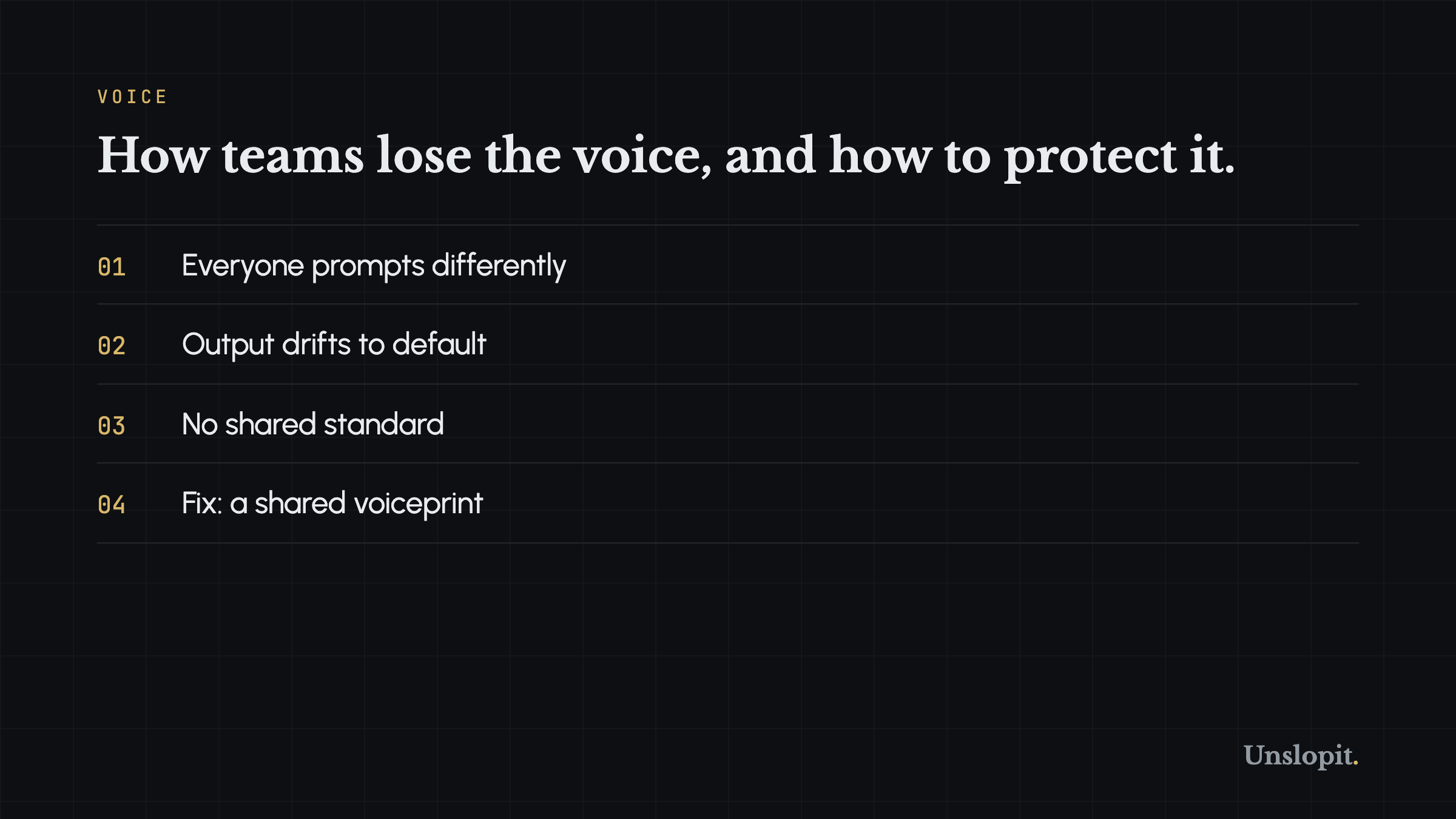
First, everyone prompts differently. Sarah pastes a raw brief and hits enter. Miguel adds "make it sound professional." Priya asks for "conversational tone and short paragraphs." None of them is wrong. None of them is working from the same voice instructions. The output across the team diverges immediately. Three writers, three different AI outputs, three different versions of what your brand supposedly sounds like. Over a month, the accumulated divergence is large enough that a customer could read two pieces from the same brand and assume different companies wrote them.
Second, the model drifts to its training default. Even when someone writes a strong system prompt, the model's output gravitates toward its training distribution over a long draft. The first paragraph might sound close to your voice. By paragraph five, the pull of the training data has reasserted itself. The writer may not notice. They are reading for facts and structure, not for voice drift. The reader notices. Readers always notice.
Third, no shared standard exists. Most teams I talk to have no written voice guide at all. The ones that do keep it in a Notion page that nobody opens after onboarding week. There is no gate. No check. Nothing between the final draft and the publish button that says "this does not sound like us." The result sneaks up on you. A few sentences that feel slightly off. Then whole paragraphs. Then entire campaigns. Nobody can point to the moment it happened, because it happened one draft at a time, and nobody was watching.
Step one: write down your voice like it is a product spec
Most voice guides are vague to the point of uselessness. "We are friendly but professional." "We are approachable and knowledgeable." This gives a human writer almost nothing to work with and gives an AI absolutely nothing. A model cannot execute "friendly but professional." It can execute "use contractions, open emails with the recipient's first name, never use the word 'utilize.'"
A real voice document needs specifics. Here is what belongs in it.
- Sentence length: short average, long average, or mixed? What ratio of short to long?
- Punctuation: semicolons or no? Oxford comma or no? Parentheticals or no?
- Opening conventions: how do blog posts open versus emails versus social posts?
- Banned words: every brand has words it never uses. Write them down.
- Required words: the terms your audience expects to see because they signal domain knowledge.
- Technical depth: do you define terms or assume the reader knows them?
- Contractions: yes, no, or context-dependent?
- Rhetorical questions: do you ask them or state things directly?
- Stance words: what does your brand believe? What does it reject?
- Humor: where does it fit, how much, what kind?
Spend an afternoon reading through your best-performing content. Find the patterns. Write them down. If you have a writer who always nails the voice, interview them. Ask what they do and what they avoid. Turn their instinct into rules another person can follow. The goal is a document concrete enough that two different people, working with two different AI tools, produce output that reads like the same company wrote it.
Step two: build a voiceprint that constrains the AI
A voice guide tells people what to aim for. A voiceprint tells the machine what pattern to follow. This is the difference between giving someone directions and driving the car yourself.
A voiceprint captures the statistical fingerprint of how you actually write. Not how you think you write. How you write. Sentence length distribution. Word variety. Transition patterns. The ratio of short sentences to long ones. How often you use passive voice. Whether your paragraphs open with questions or statements. Your punctuation density and which marks you favor. Your paragraph length and how it varies across content types.
At Unslopit, we build a voiceprint from a writing sample of at least 500 characters. The system extracts these patterns and turns them into constraints the AI must follow during a rewrite. The voiceprint is not a prompt you paste into ChatGPT. It is a constraint layer. It sits between the LLM's raw output and what the user actually ships, reshaping the draft into the user's real patterns. The result does not sound "more human." It sounds more like the person whose sample trained the voiceprint.
The operational advantage is that a voiceprint is shareable. Once built, every writer on the team uses the same one. Sarah, Miguel, and Priya all route their drafts through the same voiceprint. The output converges instead of diverging. The voice stays consistent whether the draft was prompted by a senior strategist or a junior writer on their second week.
Step three: gate every draft before it ships
Even with a voice guide and a voiceprint, output drifts. Deadlines compress. Someone grabs a draft from another project and repurposes it. A new team member prompts with different habits. The gate catches what the process misses.
A consistency gate is simple. Every piece of content gets checked against the voice guide before it publishes. Does it use banned words? Does the sentence rhythm match the spec? Does the opening paragraph do what the guide says openings should do? Are technical terms handled correctly? Did the voiceprint actually run or did someone skip that step?
At Unslopit, this gate is the anti-slop auditor. It scores every draft on a set of concrete, countable dimensions: em dashes, buzzwords, scaffold phrases, copula inflation (writing "serves as" instead of "is"), rhythm flatness, and specificity. Each dimension is deterministic. The score is not a vibe. It is a count. If your draft comes back at 11 out of 20, you know exactly which items to fix because the report names them. Fix the flagged items, rerun the gate, ship when the score meets your threshold. The gate adds maybe four minutes to a draft. It prevents the kind of voice damage that takes months to undo.
The agency problem: twelve voices, one team
This gets harder for agencies. A studio might manage twelve client voices simultaneously. One client writes in sentence fragments and swears. Another writes in long, looping, formal paragraphs and would never use a contraction. A third bans the word "solution" and insists on "tool" or "product" instead. A fourth requires Oxford commas. A fifth bans them. A sixth is a fintech brand with compliance language woven into every sentence. A seventh is a consumer app that communicates exclusively in lowercase.
Without a voice system, agencies handle this by assigning senior writers to each account and hoping. The voice lives in that one person's head. When the writer leaves, the voice leaves with them. The replacement writer gets a brief and some old samples. They approximate. They get close. But the client notices the shift within two or three pieces of content and the agency has no answer for why the quality changed.
When AI gets introduced into this environment, the problem compounds fast. A junior writer using ChatGPT on a client account is five drafts away from making a fintech brand sound like a generic B2B SaaS company. An account manager pasting a client's product update into an AI tool gets output that sounds like everyone else's product update. The agency's value proposition, which is voice expertise and consistency, erodes in real time.
The fix is the same three steps, applied per client. A voice doc per account. A voiceprint per account. A gate per account. Yes, this is overhead. But the alternative is client churn. Agency owners I have talked to describe voice consistency as a retention problem hiding in plain sight. Clients rarely articulate "the voice changed." They say "the quality dropped" or "it does not feel like us anymore." Then they leave. Building per-client voice systems is cheaper than replacing clients. One agency I know lost a retainer worth $8,000 a month because the client's blog went generic over six months and nobody caught it until the contract was up for renewal.
The real cost of doing nothing
Here is the blunt version. If your team generates more than ten AI-assisted drafts per week and you do not have a voice system, you are bleeding brand equity. Every draft that ships in default-AI voice trains your audience to associate your brand with generic writing. The damage compounds. Over months, the accumulated effect is a brand that sounds like everyone else, indistinguishable in a feed full of competitors.
Building a voice system takes a few hours upfront and a few minutes per draft to run the gate. That is cheaper than trying to rebuild a voice from zero, and much cheaper than losing customers who stopped feeling the connection. The math is not complicated. The discipline is.
Monday morning with a voice system
Here is what the workflow looks like in practice. A content writer at a B2B SaaS company pastes a product update into an AI tool on Monday morning. The tool generates a draft. She drops it into Unslopit. The auditor scores it at 11 out of 20.
The report surfaces fourteen em dashes. Seven banned words including "delve" and the verb "leverage." Three scaffold phrases. Copula inflation in eight sentences where "serves as" should be "is." Uniform sentence rhythm across the entire piece. Voice match against the company voiceprint: 62 percent.
She clicks rewrite. The voiceprint reshapes the draft into the company's actual patterns. The auditor rescore comes back at 18. Voice match at 91 percent. She reads the result, makes two small edits for factual nuance, and publishes. The process added about four minutes to her workflow. The output sounds like the company. Not like ChatGPT. Not like a humanizer tool that swapped some synonyms and called it done.
That is the system. Document. Voiceprint. Gate. Three steps. None of them optional if your brand voice is an asset you intend to keep.
If you want to know where your current drafts stand, run one through the free Slop Score grader at unslopit.io/score. No signup needed. No credit card. Paste something in, get your number. If it is lower than you thought, at least now you know what to fix.