Open LinkedIn right now. Scroll for thirty seconds. Count how many posts use one-line paragraphs, emoji checkmarks, and an ending that asks 'What do you think?' You will lose count before you hit the bottom of your screen.
This is not a coincidence. It is not a trend. It is a template, and ChatGPT knows it by heart. Tens of thousands of professionals are feeding the same prompt into the same model and getting the same post back. The result is a feed that reads like one person wrote everything, and that person is a bot having a motivational crisis.
A Reddit thread cataloging this phenomenon hit 170 upvotes because everyone recognized it instantly. One commenter put it bluntly: 'dude don't use that AI crap on me.' The professional cost of sounding like everyone else is higher than most people realize.
The LinkedIn AI template, deconstructed
Here is the format. Once you see it spelled out, you will start spotting it in under two seconds. Every component serves a function in the AI's probability model. None of them serve the reader.
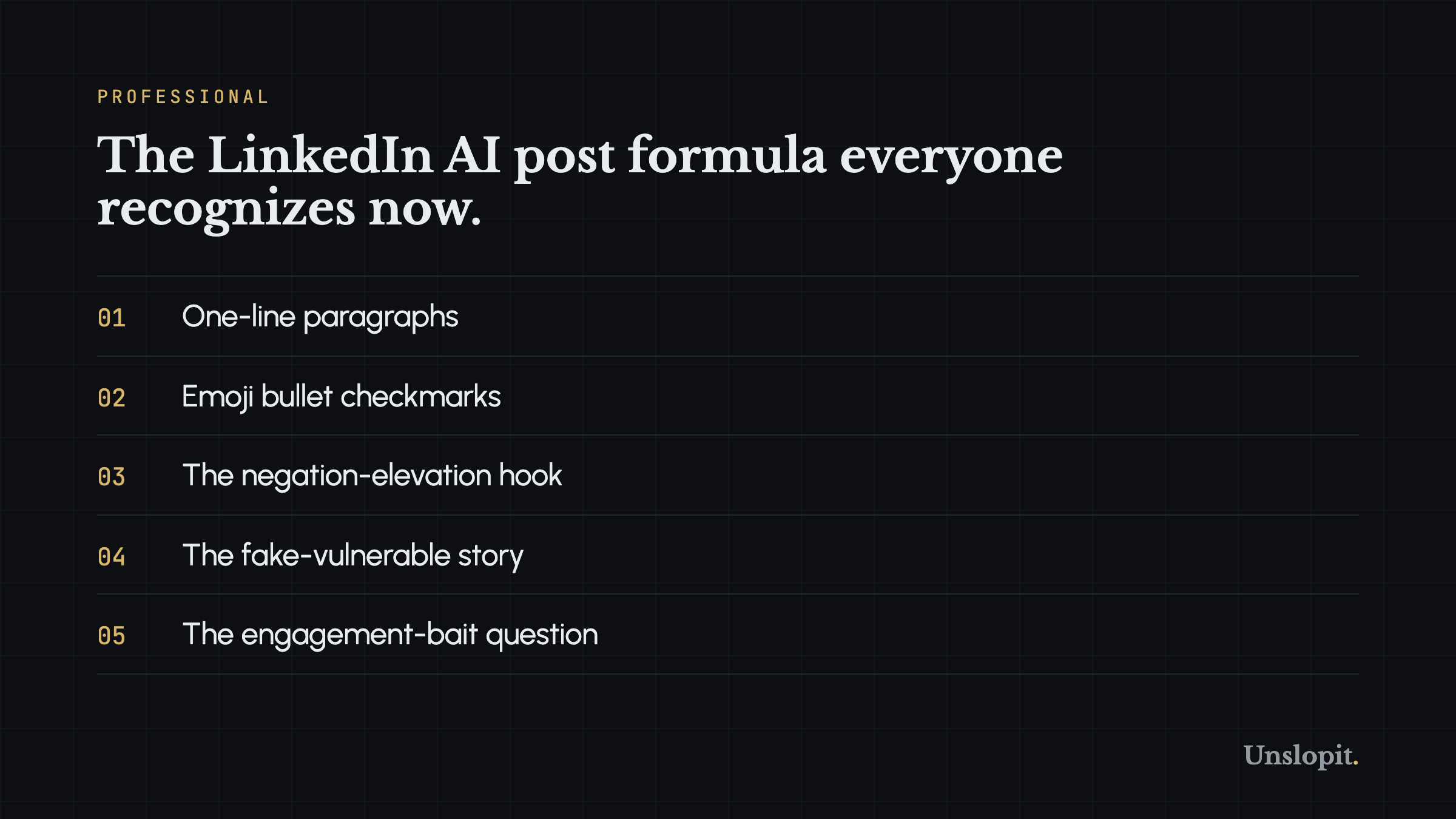
Component 1: The one-line paragraph rhythm
AI-generated LinkedIn posts are visually distinctive before you even read a word. They are built from single-sentence paragraphs stacked like index cards.
Each sentence gets its own paragraph.
Every time.
The model does this because LinkedIn engagement data rewards white space. Short paragraphs look breezy on mobile. They signal 'this is easy to read' before line one. But when every post on the platform adopts the same visual rhythm, that signal flips. It stops meaning 'easy to read' and starts meaning 'AI wrote this.' The visual pattern has become a dead giveaway.
Component 2: The emoji bullet checkmarks
The AI LinkedIn post loves a checkmark. Usually three of them, stacked vertically, each preceded by a green check emoji:
- ✅ Showing up consistently
- ✅ Adding value before asking
- ✅ Building an authentic brand
The emoji checkmark list is a formatting crutch. It breaks text into scannable chunks without requiring the writer to say anything scannable. The items in these lists are almost always generic enough to apply to any profession. 'Showing up consistently' could be advice for a salesperson, a software engineer, or a ceramics instructor. That is the point. Specificity requires knowing your audience. Templates work for everyone because they commit to no one.
Component 3: The negation-elevation hook
This is the single most reliable AI tell on LinkedIn. The post opens by telling you what something is not, then pivots to what it really is:
Leadership isn't about titles. It's about influence. Success isn't just hard work. It's strategic alignment. Hiring isn't about filling seats. It's about building teams.
Every one of these follows the identical syntactical skeleton: '[Topic] is not [obvious thing]. It is [slightly less obvious thing].' The structure is mathematically efficient for a language model. It produces a complete thought with minimal tokens. It sounds wise without being wrong. It requires zero domain knowledge. That triad of properties makes it the most overused sentence pattern in AI writing.
The problem is that readers have now seen this pattern thousands of times. Their brains flag it the way your spam filter flags 'URGENT: Action Required.' The hook designed to grab attention now triggers the opposite reaction.
Component 4: The fake-vulnerable story
AI LinkedIn posts love a redemption arc. The writer overcomes something, learns something, and shares the lesson. These stories follow a narrow set of templates:
- "I used to think hard work was enough. Then I burned out. Now I know balance matters."
- "I walked into the boardroom feeling like an imposter. Then I realized: I earned this seat."
- "A mentor once told me something I'll never forget. It changed how I lead."
What makes these fake is the lack of concrete detail. A real story about burnout names the week, the project, the physical symptom. 'I burned out' is a category label. 'I woke up at 3 AM on a Tuesday, stared at my ceiling for an hour, and realized I had not taken a full weekend off in eleven months' is a story. AI produces the label. Humans produce the Tuesday.
Component 5: The engagement-bait question
Every AI LinkedIn post ends the same way: a question posed to the audience, often with a pointing-down emoji.
What's one leadership lesson that changed your career? Share below. 👇 I'd love to hear your thoughts in the comments. What's one challenge you've overcome that shaped who you are today?
The model includes this because LinkedIn's algorithm rewards comments, and posts that ask for comments get more comments. But the formula is now so saturated that the question itself signals AI authorship. Readers scroll past it the way they scroll past cookie consent banners. They have seen it too many times. It stopped working the month it became a template.
Why did everyone adopt the same format?
Three reasons, all boring and predictable.
First, tool convergence. Most LinkedIn users who reach for AI use ChatGPT. Most use the free tier. Most do not customize the system prompt, provide a voice sample, or give specific formatting instructions. They type 'write a LinkedIn post about leadership' and paste the output. GPT-4 and GPT-4o default to the same stylistic choices because they were trained on overlapping corpora and fine-tuned with similar RLHF preferences. The em dash, the one-line paragraph, the negation-elevation hook: these are not bugs. They are the model's most probable completions for the 'professional social media post' genre.
Second, social proof loops. The first wave of AI-generated LinkedIn posts did well. Real well. People saw the engagement numbers and copied the format. LinkedIn gurus started teaching 'the framework' in courses and newsletters. 'One line per sentence. Start with a controversial hook. End with a question.' The format spread faster than the fact that it was AI-generated, so by the time the backlash started, the template was already baked into a thousand 'how to grow on LinkedIn' playbooks. People who think they are following best practices are actually following AI priors.
Third, speed economics. Writing a LinkedIn post from scratch takes somewhere between ten and forty minutes. Getting ChatGPT to do it takes thirty seconds. For a salesperson or founder posting three times a week, that tradeoff looks like a no-brainer. The composition cost drops from roughly two hours per week to ninety seconds. The quality cost is invisible until it is not. And by the time it becomes visible (fewer replies, lower trust, readers tuning out), the habit is locked in.
The professional cost of sounding like everyone else
This is the part that does not get talked about enough. The real cost of posting AI slop on LinkedIn is getting categorized.
Readers build mental models of who they follow. When your posts follow the AI template, you get filed under 'generic LinkedIn poster,' the same bucket as the people posting stock photography quotes and the 'Agree?' polls. Once you are in that bucket, it is nearly impossible to get out. Your actual expertise stops mattering because nobody reads far enough to find it. The template triggers the scroll.
I have seen this happen to genuinely smart people. A cybersecurity founder I know started using AI for his LinkedIn posts. His engagement dropped 40 percent in two months. His actual knowledge had not changed. He was the same expert quoting the same research. But the AI wrapper made every post smell like content marketing. Readers could not tell the difference between his real insight and GPT's filler, so they stopped trying.
The cost compounds. LinkedIn is where recruiters, clients, and partners form first impressions. If your posts read like AI, they assume your thinking does too. That assumption is usually wrong. But the burden of proof shifts onto you. Now you have to prove you are not a bot, and the platform you are posting on gives you about 1.4 seconds before the thumb scrolls past.
How to write LinkedIn posts that sound like a person
The fix is simpler than most people think. It is not about learning to write better. It is about unlearning the AI template.
1. Delete every negation-elevation hook
Search your draft for the words 'not just' and 'more than.' Delete the entire sentence. Restate the point in plain language. 'Leadership is not about titles, it is about influence' becomes 'I ignored my title and got more done.' Same idea, zero AI smell.
2. Write in the voice you use on Slack
Most people have a crisp, direct voice when they message colleagues. That voice disappears the moment they open the LinkedIn composer. They put on what I call the 'professional voice,' which is really just the least interesting version of themselves. Ditch it. Write the post like you are explaining something to a coworker in a DM. Contractions. Fragments. Things you would actually say out loud.
3. Name something real in the first three lines
AI posts open with abstraction. Human posts open with specifics. 'Last Tuesday, a client told me...' beats 'In today's professional landscape' every single time. If you cannot name a person, a date, a number, a place, or a specific event in your first three lines, you are warming up. Cut the warmup.
4. Vary your paragraph length
The one-line-per-paragraph format is the most visually recognizable AI tell on LinkedIn. Break it. Use a three-line paragraph. Then a one-liner. Then a dense block. Let the shape of the text do some of the work. Uniform paragraph length is a signal. Non-uniform paragraph length is not a signal, which means it does not trigger the AI alarm.
5. End with a statement, not a question
You do not need to ask 'What do you think?' at the end of every post. If someone has a thought, they will share it. Ending with a confident statement ('This worked for us. Might not work for you.') invites real discussion more reliably than a canned question. The people who want to argue will argue either way.
6. Run your draft through a slop checker
If you use AI to draft (and that is fine, most people do), run the output through something that flags the tells. Unslopit's free Slop Score grader at unslopit.io/score checks for em dashes, buzzwords, scaffold phrases, copula inflation, sentence rhythm monotony, and abstract filler. It gives you a score from 0 to 20, with 20 being clean. If your draft scores below 14, it needs a human pass before you publish. No signup. No credit card. Just paste and see.
The one sentence that fixes most LinkedIn posts
I will leave you with the filter I use on everything I write for the platform. Before you hit post, read your draft out loud and ask:
Would I actually say this to someone at a bar?
If the answer is no, rewrite it until the answer is yes. Nobody at a bar has ever said 'I believe authentic connection is the cornerstone of professional growth.' They have said 'I met this guy, we got along, now we do business.' Same point. Different register. One sounds like a person. The other sounds like ChatGPT, and LinkedIn is drowning in it.
The people who recognized the post you just scrolled past as AI are not a niche. They are most of LinkedIn now. If you want the posts under your name to actually sound like you, run a draft through the free Slop Score grader at unslopit.io/score and see how many tells it flags. Then try three free rewrites, no card, and compare what comes back.