You can spot AI writing without a detector. Human readers have been doing it instinctively since ChatGPT launched. The tells are not hidden or subtle. They are patterns that repeat across every model, every prompt, and every draft. I read AI-generated content professionally, and after a few thousand pieces, the signs become impossible to miss. Here are the 15 most reliable ones, explained with examples and the reason behind each.
1. Em Dashes in Every Paragraph
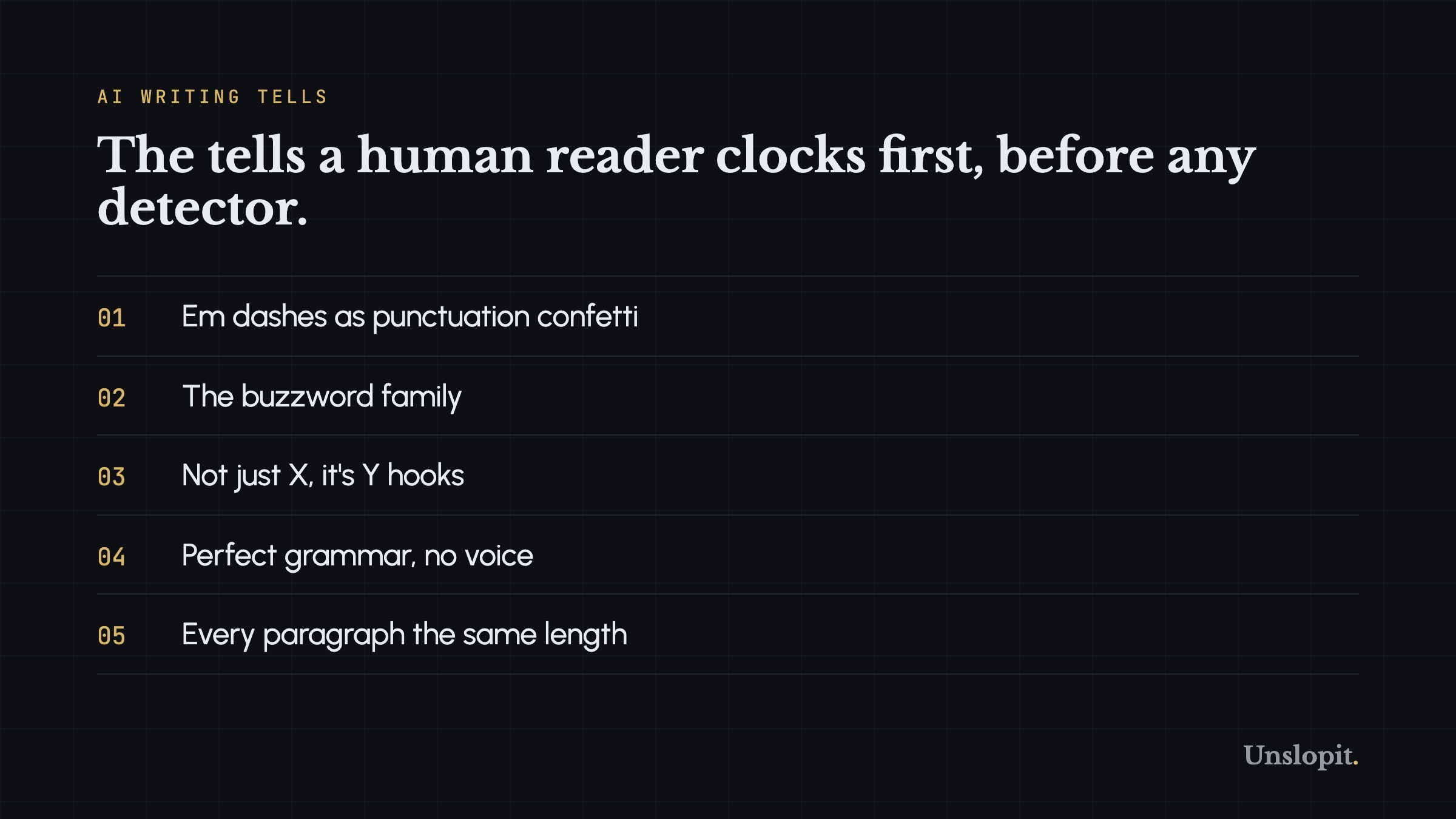
The tell: long horizontal strokes connecting clauses at least once per paragraph, often more. Example: "The results were clear, and the team moved quickly to implement the changes. The timeline shifted by several weeks. The budget held steady throughout the process." That rhythm is not how people write. It is how ChatGPT structures every single output.
Why it happens: training data packed with formal writing and RLHF feedback that rewarded punctuation patterns signaling thorough, organized thinking. The model learned that dashes equal quality. Now it can not stop.
2. The Buzzword Family
The tell: a cluster of words that almost never appear in human writing at the density ChatGPT uses them. "Delve" is the most infamous. But the family includes "tapestry," "a testament to," "intricate," "multifaceted," and the verb "leverage." Example: "We will delve into the intricate tapestry of modern marketing, a testament to the multifaceted nature of consumer behavior." No human has ever said that sentence out loud.
Why it happens: these words appear frequently in the academic and business writing that dominates the training corpus. They are high-status words in formal registers. The model learned that using them sounds authoritative. It does not know they sound like a LinkedIn post from 2018.
3. The Negation-Elevation Scaffold
The tell: any sentence built on "not just X, but Y" or "it's not X, it's Y" or "more than just." Example: "This is not just a productivity tool. It is a fundamental rethinking of how teams collaborate." This structure is so common in AI output that seeing it once raises suspicion. Seeing it twice is a conviction.
Why it happens: the pattern is rhetorically effective in small doses. But LLMs over-learned it from persuasive writing in the training data. The model reaches for it as a default way to sound insightful without actually being insightful. It lets the AI say two things at once without committing to either.
4. Copula Inflation
The tell: replacing "is" with inflated verbs that add nothing. "Serves as" instead of "is." "Represents" instead of "is." "Stands as" instead of "is." "Embodies." "Boasts." "Emerges as." Example: "This framework serves as a foundation for our strategy." Translation: "This framework is our strategy's foundation." Same meaning, half the pretension.
Why it happens: the model was trained on writing where word count and formality were rewarded. Longer phrases feel more complete to the model's probability engine. It has no instinct for the fact that "is" is almost always better.
5. Throat-Clearing Openers
The tell: starting an article or section with filler phrases that delay the actual point. Example: "In today's fast-paced digital landscape, businesses face unprecedented challenges when it comes to customer engagement." That sentence says nothing. It warms up for five seconds before the game starts.
Why it happens: AI was trained on content marketing, which is full of this stuff. The model learned that articles begin with vague scene-setting. It does not know that readers skip those sentences entirely.
6. Flat Sentence Rhythm
The tell: every sentence is roughly the same length. Fifteen to twenty-two words. No fragments. No one-word punch. No long winding sentence that takes its time. Just a metronome of medium-length clauses, one after another, until the reader's attention dissolves. Example: read any ChatGPT output aloud. You will hear it within three sentences.
Why it happens: the model optimizes for probability, which pulls toward the statistical middle. Extreme sentence lengths are low-probability. The model stays in the safe zone. Human writers do not.
7. Emoji Bullet Lists
The tell: lists where every item starts with an emoji, especially in social media posts and LinkedIn content. Example: "5 ways to boost productivity: Wake up early. Plan your day. Take breaks." The emojis are always perfectly aligned. Real people do this sometimes. ChatGPT does it every time a list is requested, with mechanical consistency.
Why it happens: the emoji-plus-list format is heavily represented in the training data from blogs and social media. The model learned it as the default visual structure for enumerated content. It applies it regardless of context.
8. Over-Hedging and Scaffold Phrases
The tell: sentences padded with qualifiers that signal caution without adding substance. "It is important to note." "It is worth mentioning." "Needless to say." "That being said." Example: "It is important to note that while these trends are significant, it is worth mentioning that individual results may vary." Sixteen words of scaffolding before anything gets said.
Why it happens: RLHF training rewarded caution and nuance. The model learned to hedge as a safety behavior. But hedges in writing are not safety. They are filler. Human readers skim right past them.
9. Fake-Profound Conclusions
The tell: an article that ends with a vague, inspirational sentence that could close any piece on any topic. Example: "As we navigate the complexities of the modern world, one thing remains clear: the only constant is change." That sentence provides zero information. It exists because the model learned that articles end with sweeping statements. It has been attached to blog posts about cloud computing, parenting, and sourdough starter alike.
Why it happens: the training data is full of articles that trail off into platitudes. The model learned the shape of a conclusion without understanding that a conclusion should contain the article's actual point.
10. The Word 'Delve' Specifically
The tell: "delve" appearing anywhere in text written after November 2022. Example: "In this article, we will delve into the data." This single word has become such a reliable AI marker that entire Reddit communities track its appearances. It deserves its own entry on this list because of how specific and consistent the pattern is.
Why it happens: "delve" was moderately common in formal writing pre-ChatGPT. But the model over-indexed on it during training, and RLHF did nothing to discourage it. Now it is the canary in the coal mine. If you see "delve" in a blog post, check the rest of the tells. Most of them will be there too.
11. Perfect Grammar With No Voice
The tell: text with zero typos, zero fragments, zero grammatical errors, and zero personality. It reads like a textbook written by a committee that agreed on every comma. Example: authentic human writing has quirks. It starts sentences with "And" or "But." It uses fragments for emphasis. Like this. AI text polishes all of that away and leaves behind a surface so smooth it reflects nothing.
Why it happens: the model was trained to produce grammatically correct English. It was not trained to develop a voice. Voice emerges from imperfection, from idiosyncrasy, from the specific ways a particular mind breaks or bends rules. The model has no mind and therefore no voice to break rules with.
12. Rule of Three Everywhere
The tell: groups of three adjectives, three examples, or three benefits appearing in list after list. Example: "The platform is fast, reliable, and secure. Users report higher engagement, better retention, and increased revenue." The rule of three is a real rhetorical device. Humans use it. ChatGPT uses it like a nervous habit.
Why it happens: the rule of three is one of the most common patterns in persuasive writing, which means it appears thousands of times in the training data. The model learned it as the default enumeration structure and applies it to every list regardless of whether the content naturally breaks into threes.
13. Vague Specificity
The tell: phrases that gesture toward precision without providing any. "Various factors." "Multiple studies have shown." "A wide range of applications." "In many ways." Example: "Various studies have shown that a wide range of factors influence consumer behavior in many significant ways." That sentence contains zero information. It sounds like it might be specific. It is not.
Why it happens: the model has no access to real-time facts unless connected to search. When it does not know something concrete, it fills the gap with vague quantitative language. The vagueness is not dishonesty. It is the model's way of maintaining fluency when it lacks specific data.
14. Title-Case Headers on Everything
The tell: every section heading formatted in Title Case, even when the surrounding content is casual. Example: "Key Considerations for Implementation Strategy." Real human blogs use sentence case. They use questions as headers. They break formatting rules. ChatGPT applies Title Case with the consistency of a style guide robot because that is exactly what it is.
Why it happens: the training data contains heavily formatted content from platforms like Medium, corporate blogs, and academic journals where Title Case headers are standard. The model absorbed the convention and applies it universally.
15. 'Certainly!' Style Compliance
The tell: an eagerness to agree and assist that reads as servile rather than helpful. Example: "Certainly! Let me break down the key differences between these two approaches. You have raised an excellent question, and I would be happy to provide a comprehensive overview." That tone is ChatGPT's default voice. Real people do not write like that unless they work in customer support and hate their job.
Why it happens: RLHF fine-tuning explicitly rewarded helpful, polite, enthusiastic responses. The model learned that compliance tone equals high ratings. It does not know that the tone itself has become a tell, a signal that screams "I was trained to be agreeable" instead of sounding like a human who sometimes disagrees.
What to Do When You Spot These Signs in Your Own Writing
If you use ChatGPT to draft and recognize half this list in your output, you are not alone. That is the default state of AI-generated text. The question is not whether to use AI. It is whether the final version that reaches your reader still carries the tells.
Some of these you can fix manually. Strip the em dashes. Kill the throat-clearing openers. Replace "delve" with "look at" or "dig into." But voice is harder to fix by hand. You can strip the slop and still end up with text that sounds like no one in particular. Just clean, blank, grammatically perfect nothing.
That is why we built Unslopit to rewrite AI drafts in your actual voice. You give it a writing sample and it learns how you sound. Then it runs every draft through an auditor that scores 20 anti-slop dimensions, strips the tells, and restructures the sentences to match your patterns. The output is still AI-assisted. But it reads like you. Check your current draft's score for free at unslopit.io/score. No signup needed.