A writing voiceprint is a software model that captures the measurable features of how you write. It looks at your sentence lengths, your word choices, your punctuation patterns, the way you structure paragraphs, and your overall rhythm. Feed it 500 to 1,000 characters of your real prose and it builds a fingerprint. From then on, any AI draft you run through it comes out sounding like you wrote it. Not like "a human." Like you specifically.
I have been building this kind of tooling for the better part of a year. The concept is simpler than most people expect. You are not doing anything mysterious. You are measuring patterns that any decent statistical model can track. The difference between this and generic "write in a professional tone" prompting is the difference between a key that fits one lock and a sledgehammer. Precision matters.
What measurable features define a writing style?
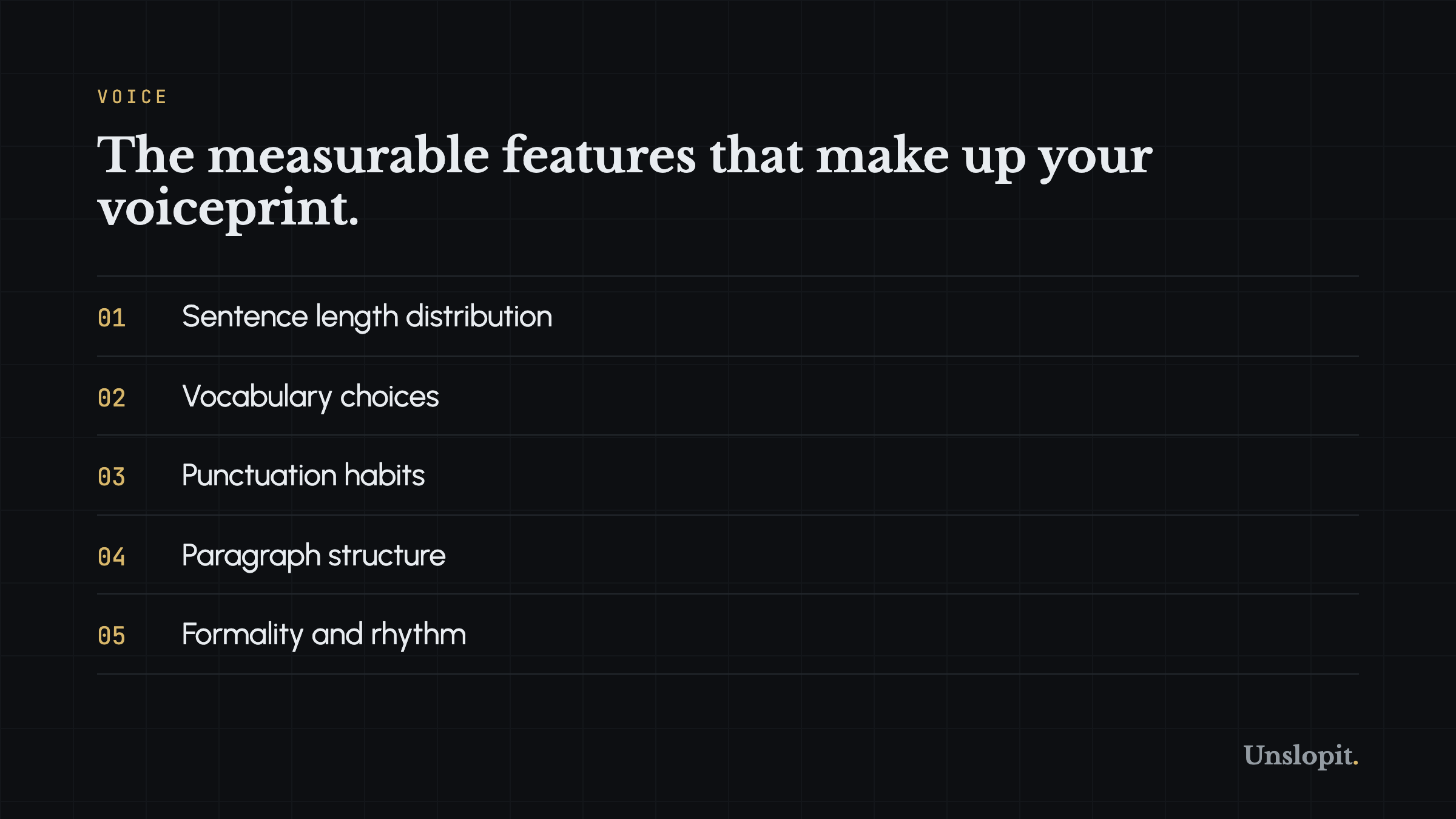
When software builds a voiceprint, it does not "understand" your voice. It breaks your writing into roughly a dozen measurable dimensions and scores each one. Here are the ones that actually matter.
Sentence length distribution
This is the single most revealing metric. Some writers average 12 words per sentence. Others average 28. But the average is less important than the spread. A writer who uses mostly 8-word sentences with the occasional 40-word monster sounds completely different from someone who writes consistently at 22 words. The distribution shape, the variance, the ratio of short to long. A good voiceprint tracks the histogram instead of stopping at the mean.
Vocabulary fingerprint
Every writer has a working vocabulary of roughly 2,000 to 5,000 words they actually use. Your voiceprint maps which tier you operate in. Do you reach for "utilize" or always say "use"? Do you write "however" or do you start sentences with "But"? Do you describe things as "interesting" or is that word absent from your writing entirely? Beyond individual words, there are phrase patterns. I say "the better part of" and "roughly" constantly. You probably have your own tics. The model captures these.
Punctuation habits
Comma frequency. Semicolon usage. Parenthetical frequency versus the aside-with-dashes pattern. Whether you use single quotes or double quotes. Whether you put periods inside or outside quotation marks. All of these are trackable signals. AI writing tends toward very consistent, very "correct" punctuation. Real human writing has quirks. Your voiceprint encodes your specific quirks.
Paragraph structure
Paragraph length is a strong signal. Some writers produce dense 8-sentence blocks. Others rarely write more than two sentences before hitting enter. Some mix freely. The model also tracks how you open paragraphs. Do you lead with a topic sentence, a question, a data point, or a fragment? These patterns are surprisingly consistent within any single writer.
Formality and register
Contraction rate is the easiest measure here. Do you write "I am" or "I'm"? "Cannot" or "can't"? But formality goes deeper. It includes your use of passive voice, your hedging patterns ("sort of," "kind of," "maybe"), and your willingness to use sentence fragments. Some writers never use fragments. Others use them constantly. Both are valid. The voiceprint needs to know which camp you are in.
Rhythm
Rhythm is the hardest dimension to quantify but the most noticeable when it is wrong. It is the composite of all the other dimensions. When you read a paragraph and it just "sounds off," that is rhythm. The model tracks sentence-to-sentence length variation, the pattern of stressed syllables, and the flow from one idea to the next. This is where most generic AI writing fails. It produces flat, uniform rhythm. No peaks and valleys.
How does software actually extract a voiceprint?
The process is straightforward. You paste in a sample of your writing. The software runs it through a pipeline of analyzers.
First, a statistical layer extracts the numeric features. Sentence lengths, word frequencies, punctuation counts, paragraph structure metrics. This produces a structured profile: "Average sentence length: 14.2 words. Contraction rate: 87%. Semicolons per 1,000 words: 1.3. First-person pronoun frequency: high."
Second, a pattern-matching layer identifies your specific phrase preferences and structural habits. This catches things the numeric layer misses: the way you introduce examples, your transitions between paragraphs, your preferred argument structure.
Third, the voiceprint is saved as a structured object that can be injected into AI prompts. When you ask the AI to rewrite something in your voice, the system appends your voiceprint as instructions: "Match these sentence length patterns. Use these vocabulary preferences. Maintain this contraction rate. Avoid these words the user never uses."
This is what Unslopit does with its voiceprint system. You provide a sample of at least 500 characters. It extracts the fingerprint. From then on, every rewrite passes through that saved profile. The voiceprint is the reference. The AI output gets measured against it. When it drifts, it gets corrected.
Why does a saved voiceprint beat re-prompting every time?
Re-prompting is the default approach. You open ChatGPT, you write something like "Rewrite this in my voice. I write conversationally, use short sentences, and avoid jargon." It works for about three exchanges. Then the model's context window pushes your instructions further away. The attention mechanism deprioritizes them. New outputs start drifting back toward the model's default voice.
A saved voiceprint solves this in three ways.
Consistency across sessions
Your voiceprint lives in the tool, not in the chat. Every time you rewrite, the system injects the same profile. It does not degrade. It does not get pushed out of a context window. The first rewrite of the month uses the same voiceprint as the hundredth.
Specificity beats description
Describing your voice in words is lossy. You might say "I write casually." But "casual" means different things to different people. Your voiceprint does not rely on your description. It relies on your actual data. It does not guess what "casual" means. It measures what you actually do and instructs the AI to match that.
No drift
When you re-prompt, you are fighting the model's default behavior. It wants to write like an AI. You are asking it to write like you. Over a long session, its training overwhelms your instructions. A voiceprint applies the same constraints every time. It does not get tired. It does not forget.
What are the limits of a voiceprint?
I need to be direct about this. Voiceprints are not magic. They have real limits, and pretending otherwise sets people up for disappointment.
Garbage in, garbage out
The single biggest limit: the voiceprint is only as good as the sample you feed it. If you paste in an AI-generated paragraph and call it your voice, you have built a profile of AI writing, not of you. If your sample is too short, the model has too little data to extract reliable patterns. If your sample is from a genre you never actually write in (like a formal report when you mostly write casual emails), the voiceprint will be wrong. You need a real, representative sample of your actual writing. Five hundred characters is the bare minimum. A thousand is better.
Voiceprints do not think
A voiceprint captures style. It does not capture judgment. It will make the AI sound like you, but it will not make the AI think like you. The same facts, arguments, and structure that were strong in the draft stay strong. The same weaknesses stay weak. Voice is the wrapper on the content, not the content itself.
Style versus substance
If your draft has no real insight, a voiceprint will not add one. It will make the empty sentences sound like your empty sentences. That is an improvement in authenticity but not in quality. You still need something worth saying.
The cold start problem
If you have never written enough to produce a 500-character sample, you cannot build a voiceprint. There is no shortcut. The tool needs your actual writing. This is genuinely limiting for people who mostly communicate through speech, Slack messages, or bullet points. Voiceprints work best for people who already write at length.
How is this different from "write in my voice" prompts?
The difference is structural. A prompt like "write in a conversational tone" is a vague instruction. The model interprets it through its training data's idea of conversational. That is why every AI "conversational" output sounds the same. Everyone gets the same version of conversational.
A voiceprint says something specific: "This user uses contractions 87% of the time. They average 14 words per sentence with a standard deviation of 8. They never use semicolons. Their most common sentence opener is 'I.' They avoid the words 'however,' 'therefore,' and 'furthermore.' They use sentence fragments in 12% of paragraphs." That is an instruction set the model can actually follow.
That specificity is the entire game. When someone at Unslopit says "rewrite in my voice," they are not asking the model to guess. They are feeding it a measured profile of their actual patterns. The output reflects those patterns because the instructions are concrete enough to execute.
Can a voiceprint be faked or reverse-engineered?
Yes. Easily. Anyone can feed a voiceprint tool someone else's writing and get a profile that mimics that person. This is the same problem as voice cloning with audio. The protection is not technical. It is social. If you use someone else's voiceprint to impersonate them in published work, you are committing fraud. The tool does not prevent this. Your ethics do.
What does this mean for the future of writing?
The thing I find most interesting about voiceprints is what they reveal about AI writing itself. When you measure hundreds of writing samples, a pattern emerges: AI writing is incredibly consistent. Same sentence lengths. Same vocabulary tier. Same rhythm. Same everything. Human writing is messy in ways that are hard to fake.
Voiceprints do not make AI writing indistinguishable from human writing. They make AI writing indistinguishable from one specific human's writing. That is a narrower and more useful goal. The point is not to fool anyone. The point is to get your drafts to the point where your editing takes five minutes instead of forty minutes. The voiceprint closes the gap so the remaining distance is small enough that you can cover it yourself.
I think that is the honest pitch. Not "sound perfectly human." Not "beat the detectors." Just: close the gap enough that your editing is fast, your voice stays yours, and your readers cannot tell where the AI stopped and you started because there is no seam.
How do I get started with a voiceprint?
You need two things. First, a sample of your real writing. Find something you wrote that sounds like you. An email you sent that people responded to. A blog post draft. A long text to a colleague. Paste it in. Five hundred characters minimum. Second, a tool that can extract the voiceprint and apply it. Unslopit does this with its voiceprint system. You paste your sample once. It builds the profile. Every rewrite from then on uses it.
The free Slop Score grader at unslopit.io/score will also tell you, in real numbers, whether a piece of writing matches the anti-slop dimensions. No signup. No card. Paste something in, get the score. If the score is low and you want the voiceprint layer, you know where to find it. If the score is already high, you might not need anything. Either way, you know instead of guessing.
A good voiceprint is the difference between output that could be anyone and output that is identifiably yours. Unslopit builds one from your writing sample and uses it to rewrite AI drafts in your voice, with a score that tells the truth and Fact-Lock that keeps your facts intact. Try it free, three scored rewrites a month, no card. At unslopit.io.