You can spot AI writing from across the room. Not because you are some kind of savant. Because it all sounds the same. The same em dashes. The same buzzwords. The same prefab sentence shapes that no human reaches for on their own. This is AI slop, and once you see the pattern you cannot unsee it.
The fingerprint
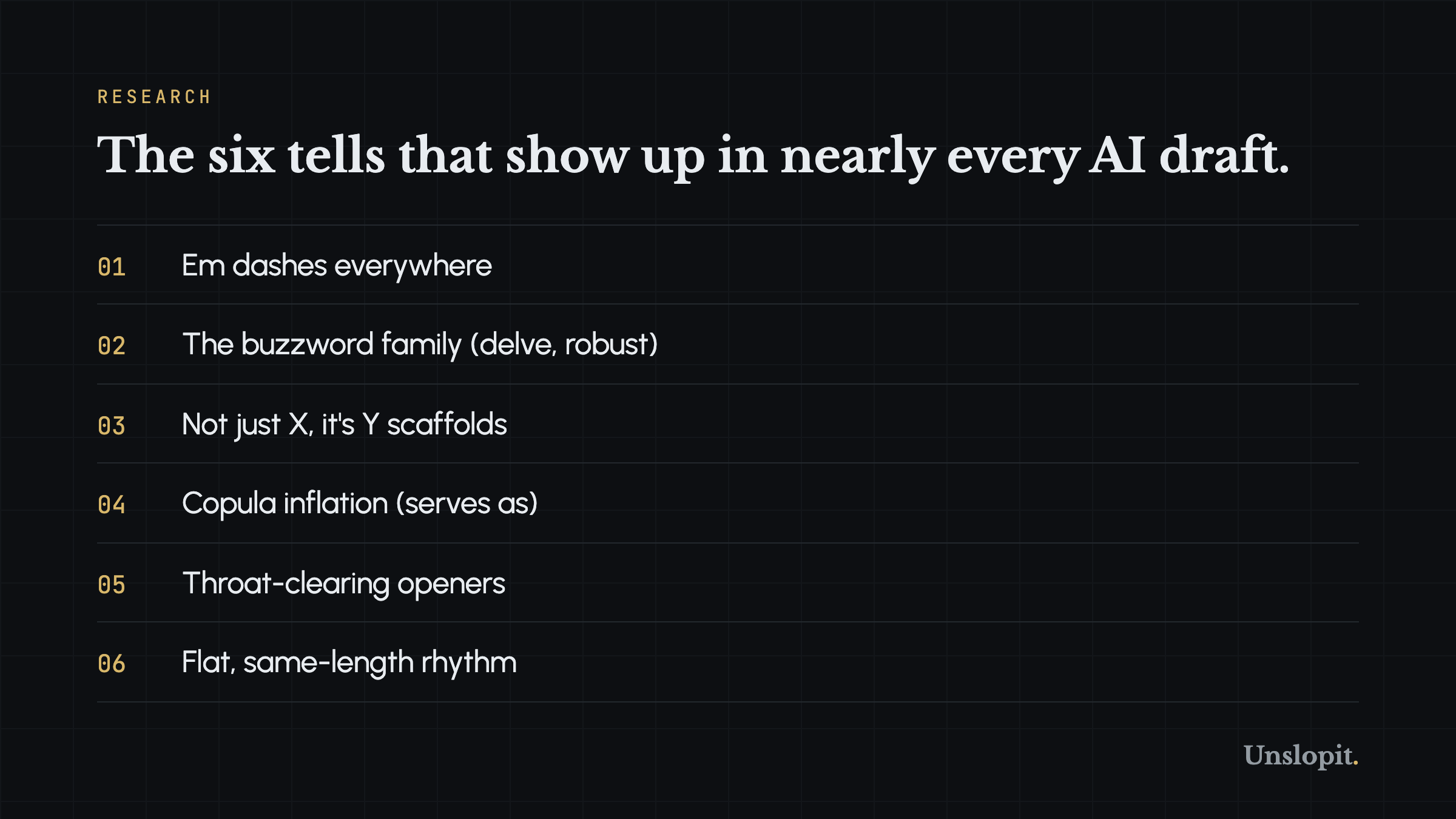
Large language models share training data, architectures, and reinforcement learning pipelines. The result is a set of consistent writing habits that span every major model. They are not subtle. Here are the tells that show up in nearly every AI draft:
1. Em dashes
This is the single most recognizable tell. AI models love the em dash. They use it to create dramatic pauses, to insert asides, and to connect clauses that would be fine with a period. Real humans use em dashes too, but sparingly. AI uses them like punctuation confetti. A 500-word AI draft averaging 4 to 6 em dashes is dead-center normal. A human writer at that length averages 0 to 1.
2. The buzzword family
Delve. Leverage. Robust. Seamless. Transformative. The corporate fog vocabulary that AI models reach for when they want to sound authoritative. These words are not errors. They are the linguistic equivalent of a stock photo, generic and safe and instantly recognizable as not yours. The checker flags over 40 of these and counts how many show up per hundred words.
3. The "not just X, it's Y" scaffold
Prefab sentence shapes that fake depth. "This is not just a tool, it's a paradigm shift." "Marketing isn't just about reach, it's about resonance." These scaffolds give the illusion of insight without containing any. They read like a TED Talk sentence. Sounds smart until you ask what it means.
4. Copula inflation
Where a plain "is" belongs, AI reaches for "serves as" or "stands as." Three words where one would do. The motivation is the same as the scaffold: sound more sophisticated than the thought actually is. Readers pick up on the mismatch between the complexity of the language and the simplicity of the idea.
5. Throat-clearing
"It's important to note." "In today's world." "At the end of the day." These are filler phrases that delay the actual point. AI models use them to pad the opening of paragraphs the way a nervous speaker clears their throat before starting. Humans do this too, but not at the same density. The checker scores throat-clearing as a percentage of total sentences.
6. Robotic rhythm
AI writing tends toward flat, same-length sentences. Humans write bursty. Short sentences. Then longer ones that carry more weight. Then fragments. Then a full sentence that ties it together. The checker measures sentence-length variance. Low variance is a strong AI signal regardless of vocabulary.
Why the detector arms race is a dead end
Most AI humanizers try to beat detectors. They shuffle synonyms, vary sentence starts, and inject intentional typos to lower a classifier score. The problem: detectors evolve. So the humanizers evolve. So the detectors evolve again. The writing gets worse at every step of this arms race, and the reader is the one who loses.
The alternative is simpler. Stop trying to fool a classifier. Instead, learn what the writer actually sounds like and rewrite the draft in that voice. The reader recognizes the voice. The facts stay put. Whether a detector flags it or not is irrelevant because the writing reads as human to the only audience that matters.
How the checker works
The anti-slop checker is deterministic, not model-based. It does not guess. It counts. Each dimension has a tripwire threshold derived from real writing samples across blogs, newsletters, and editorial content. If a dimension trips, the draft goes back for a targeted fix, just the specific tell that triggered the flag, not a full rewrite. Up to two repair passes. Then the final output gets two honest scores: anti-slop from 0 to 20 and voice match from 0 to 100.
What this means for your writing
You do not need to become an AI detection expert. You need to know what your own voice sounds like and notice when it is not there. The checker handles the rest. Paste a draft, paste a sample of your real writing, and compare what comes back. The tells are consistent enough that a deterministic ruleset catches nearly all of them without a single neural network.
That is the whole bet behind Unslopit. Not that AI writing is evil. Not that you should never use a model. Just that the gap between what a model writes and what you sound like is measurable, fixable, and worth fixing before you publish. Run a draft through the free Slop Score grader at unslopit.io/score and see where yours lands.