AI writing sounds robotic because models are trained to predict the most statistically likely next word. That is it. Not the most creative word. Not the most honest word. Not the word you would pick. The word that appears most often in similar contexts across billions of examples. When you chain together thousands of "most likely" choices, you get writing that is technically correct but completely flat. It sounds like everyone because it literally is everyone, averaged.
I see this every day. I run a content studio where I read AI-generated drafts from clients across consulting, SaaS, and creative fields. The same patterns show up regardless of the prompt. Em dashes. "Delve." Perfectly balanced paragraphs of exactly three sentences. A tone that sits somewhere between a LinkedIn thought leader and a hotel welcome email. It is not bad writing. It is anonymous writing. And anonymous writing is the opposite of what gets read.
Here is why it happens and exactly how to fix it. Ten concrete things you can do today.
Why AI Defaults to Flattened, Generic Prose
Language models are trained on enormous corpora of text: websites, books, articles, forums, documentation. During training, the model learns to predict which words are most likely to follow a given sequence. The loss function rewards accuracy, not style. The path of least resistance through that probability space is the middle of the distribution. Safe word choices. Conventional sentence structures. Neutral register.
Then comes RLHF (Reinforcement Learning from Human Feedback). Human raters score model outputs, and the model adjusts toward what raters prefer. The problem: raters tend to reward clarity, structure, and a helpful-professional tone. They punish anything too casual, too sharp, or too weird. The result is a double averaging. First, the statistical averaging of pre-training. Then, the preference averaging of RLHF. You end up with text that nobody hates and nobody remembers.
This is why AI writing has a "voice" despite having no self. It is not a personality. It is a probability distribution wearing a polite smile. The fixes below target the specific statistical tendencies that make the output feel robotic.
10 Ways to Fix Robotic AI Writing
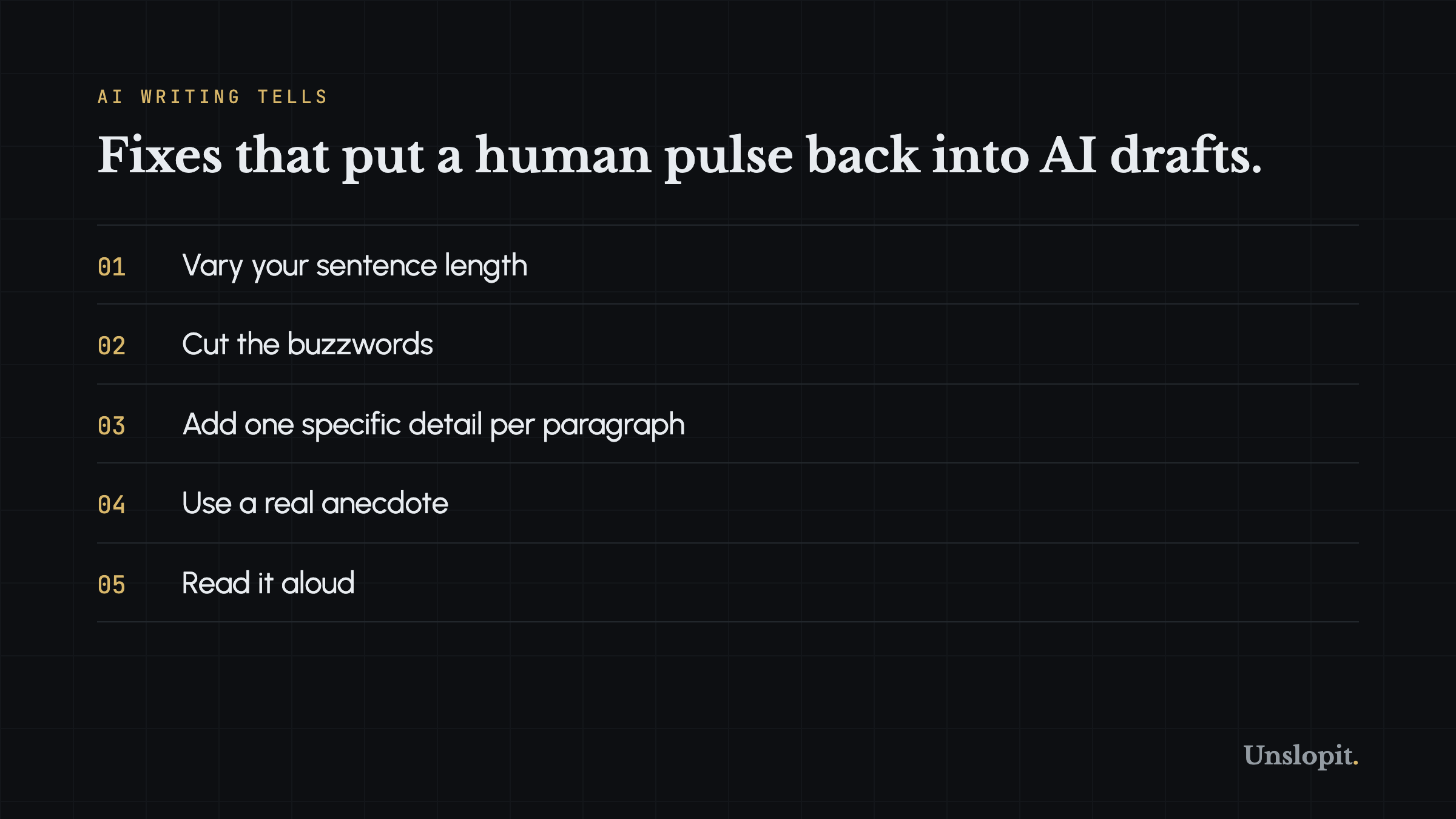
1. Vary Your Sentence Length
AI loves sentences of 16 to 24 words. This is the statistical sweet spot: long enough to sound smart, short enough to stay readable. The problem is that 20 sentences of roughly 20 words each produces a hypnotic, droning rhythm. Human writers vary. Short. Then a longer sentence that unwinds across two clauses and lands on something concrete. Short again. Fragment.
Fix: after generating a draft, count words per sentence on a random sample of 10 sentences. If the range is narrow (all between 14 and 22 words), break some up and combine others. Deliberately inject a 3-word sentence. Then a 35-word sentence. Then another 3-word sentence. The rhythm should feel uneven in a way that holds attention.
2. Cut the Buzzwords
AI writing reaches for certain words constantly. "Delve." "Tapestry." "Testament." "Intricate." "Realm." "Navigate." "Landscape." These words are statistically overrepresented in the RLHF-preferred register, a formal but accessible tone that scored well during human preference training. They became the model's go-to vocabulary because raters consistently preferred text that used them.
Fix: make a personal banned-words list. Run every AI draft through it. Delete every instance. Replace "delve into" with "look at" or "get into." Replace "tapestry" with nothing because you probably did not need that metaphor anyway. Replace "a testament to" with "shows" or "proves." Be ruthless. If the word feels like something you have read in 30 other AI-generated articles this month, cut it.
3. Add Specific Details. Real Ones.
AI writing is vague because specificity requires knowledge the model may not have. Rather than risk a wrong detail, it hedges. "Many companies struggle with content quality" instead of "Last month, a client told me she had thrown out three AI-written campaigns in a single quarter because every page sounded like the same person wrote it." The first sentence is safe and forgettable. The second is specific and credible.
Fix: after generating a draft, go through and add one specific detail per paragraph. A number you know. A real example from your work. A client's actual objection. A tool you actually used. Do not ask the AI to fabricate these. Add them yourself. The AI provides the structure. You provide the proof of life.
4. Use Real Anecdotes
AI cannot tell stories from your life. It can construct plausible-sounding anecdotes, but they have the texture of a standardized test essay. No friction. No surprise. No detail that feels too specific to be made up, because all of it is made up.
Fix: replace AI-generated anecdotes with your own. I replace "a marketing manager at a mid-size firm" with "my client Sarah, who runs a 12-person agency in Austin." I replace "one study found" with "I tested this on 40 of my own drafts and here is what happened." Your experience is the one thing the model cannot replicate. Use it.
5. Break Grammar Rules on Purpose
AI writing is grammatically perfect. And grammatically perfect writing sounds like a textbook. Real people start sentences with "And" and "But." They use fragments. They write run-ons when excited. They drop the subject. "Saw that. Agreed." These are not mistakes. They are signals that a human is on the other end.
Fix: after generating, deliberately break something. Start two consecutive sentences with "And." Add a one-word paragraph. Write a sentence that ends with a preposition because it sounds more natural. The goal is not chaos. It is texture.
6. Read It Aloud
This is the oldest writing advice and it works especially well for AI slop. When you read silently, your brain autocorrects awkward phrasing. When you read aloud, the rhythm problems become physical. You hear the repetition. You stumble on the unnatural word order. You notice that you have used "additionally" three times in two paragraphs.
Fix: read the entire draft aloud before publishing. Mark every sentence where your voice catches or your brain checks out. Rewrite those. If you cannot bring yourself to read something aloud because it feels embarrassing, that feeling is data. Listen to it.
7. Kill the Em Dash Habit
ChatGPT loves em dashes the way a first-year creative writing student loves semicolons. It uses them as a default connector between clauses that do not need connecting. The em dash has become the single most reliable AI tell: if a piece of text uses more than one em dash per 300 words, it was probably written by a language model.
Fix: set a zero-em-dash rule for AI-generated content. Every time you see one, replace it with a period and a new sentence. Or a comma. Or restructure so the connection happens naturally through word order rather than punctuation. This one change alone transforms the feel of an AI draft. It is the fastest, highest-impact edit you can make.
8. Ditch the Scaffold Phrases
AI writing is full of structural scaffolding. "It is important to note." "It is worth mentioning." "When it comes to." "In today's fast-paced world." These phrases add zero information. They exist only because the model learned them as transitions, as padding between actual points.
Fix: delete every scaffold phrase. If a sentence still makes sense without the opening clause, the opening clause was dead weight. "It is important to note that response times vary" becomes "Response times vary." The second version is shorter, stronger, and more credible. Scaffolding signals insecurity. Confident writing does not need it.
9. Stop the Copula Inflation
AI loves to inflate the verb "is" into something fancier. "Serves as." "Stands as." "Represents." "Embodies." "Boasts." These sound like brochure copy from 2007. They add syllables without adding meaning. A button is a button. It does not "serve as a call-to-action mechanism."
Fix: search your draft for "serves as," "stands as," "marks a," "represents," "embodies," "boasts." Replace every instance with "is." If "is" feels too plain, the surrounding sentence needs better details, not a fancier verb.
10. Check the Rhythm with a Tool
Human editors develop an ear for rhythm. Most people using AI to write do not have that ear yet, and the AI definitely does not. So use a deterministic checker that measures what you cannot feel.
Unslopit's anti-slop auditor scores writing on six dimensions: em dashes, buzzword density, scaffold phrases, copula inflation, rhythm/sentence-length variance, and specificity. Each dimension gets flagged, and the output gets a score from 0 to 20. If a draft scores below 18, the report tells you exactly which sections are the problem. This turns a subjective feeling ("this sounds robotic") into an objective checklist you can actually fix.
Why 'Write More Conversationally' Is Bad Advice
You will see a lot of advice telling you to prompt ChatGPT to "write conversationally" or "write like you talk." This produces a different flavor of slop. The model adjusts toward a casual average instead of a formal average. Same problem, different register. You get contractions, sentence fragments, and the word "honestly" used as a filler instead of "additionally" used as a transition. Still not human. Still not you. The casual-average voice is recognizable too. It sounds like a LinkedIn post from someone trying very hard to sound approachable.
The real fix is structural. Edit at the word and sentence level, not the tone level. Tone is an abstraction. Words are concrete. Fix the words and the tone takes care of itself.
What Human Writing Actually Looks Like
Human writing is uneven. It changes pace mid-paragraph. It repeats words because the writer did not notice. It overuses a pet phrase for two months and then drops it. It has personality tics: a friend of mine starts every email with "Hey hey" and nobody else I know does that. These are not flaws to edit out. They are the fingerprints that make writing feel like it came from a person.
The AI slop problem is not that the writing is bad by grammar standards. It is that the writing is too smooth. Too balanced. Too careful. Human communication is full of friction. Lean into that friction instead of polishing it away.
Get a Free Anti-Slop Check
Run your next AI-generated draft through the free Slop Score grader at unslopit.io/score. No signup required. It checks for em dashes, buzzwords, scaffold phrases, copula inflation, rhythm variance, and specificity, then gives you a score from 0 to 20. If you score below 18, the report shows exactly what to fix and where. Try it on a draft you were about to publish. You might realize it needs more work than you thought.