Pick any five LinkedIn posts written with AI assistance. Pick any five AI-generated blog introductions. Pick any five ChatGPT emails. Strip the bylines and the subject lines and lay them side by side. You will struggle to tell the authors apart. Not because the topic is the same. Not because the format demands it. Because the voice is identical. Not similar. Identical.
This is the great flattening. A global convergence toward a single, textureless, optimized-for-no-one writing voice that sounds like everyone and no one at once. It is happening across platforms, industries, and formats. And it is not an accident. It is math.
Why does AI writing all sound the same?
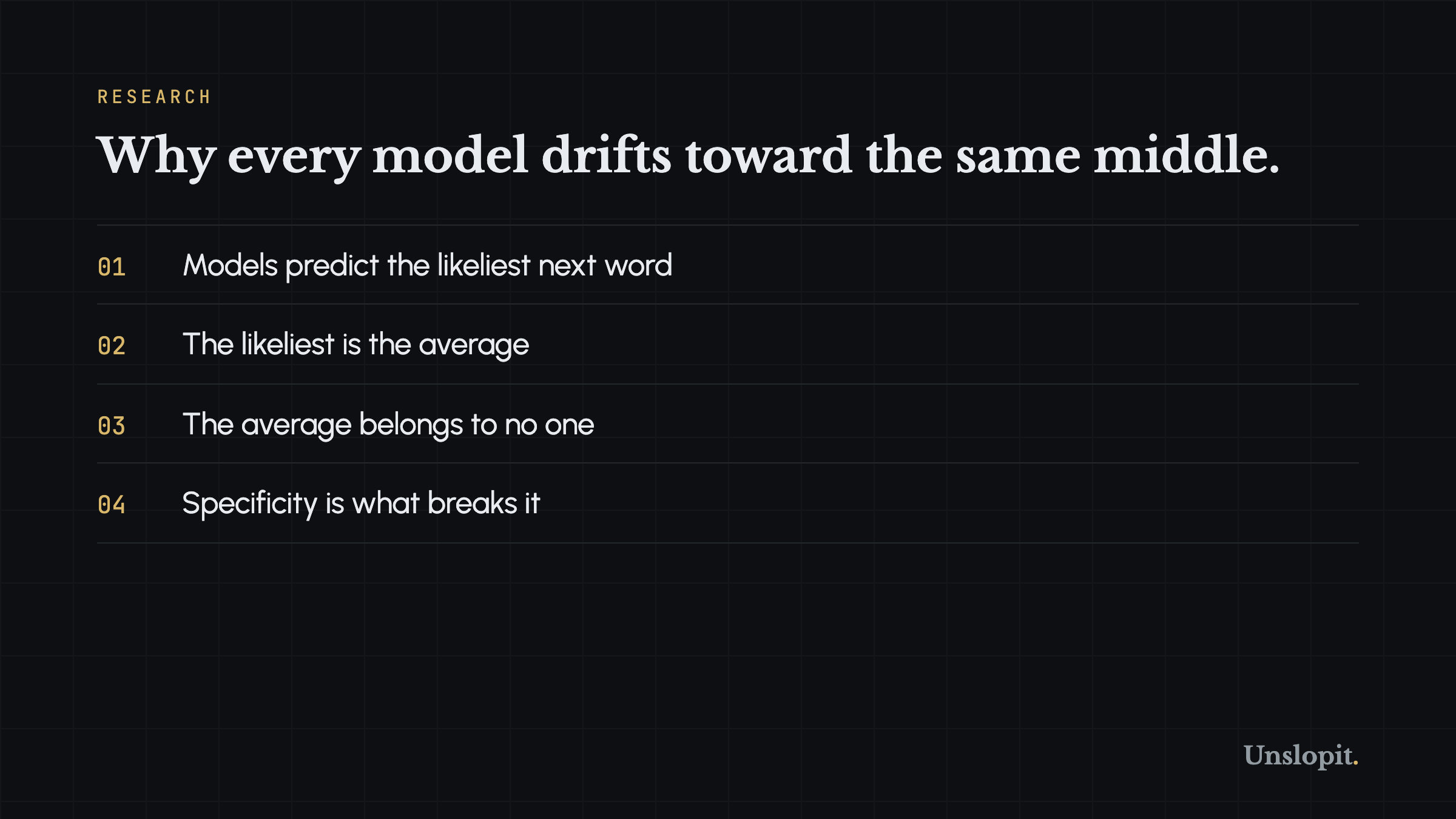
Language models generate text by predicting the most probable next token given the preceding tokens. Probable, not interesting. Probable, not specific. Probable, not true. The model is trained on billions of documents and converges toward the statistical center of that distribution. Every sentence it produces is, in a literal sense, the average of everything it has read.
This would matter less if the training data were wildly diverse and the generation was calibrated for creativity. It is not. The training data is the internet. The internet skews toward certain registers: explainer content, marketing copy, corporate communications, informational articles. These registers share structural habits. They open with context-setting. They use transition phrases to guide the reader. They avoid strong opinions. They stay positive. They summarize at the end.
When a model learns to generate text that fits this distribution, it learns to generate text that fits this register. Not because it is trying to. Because that is what "probable" looks like. The path of least resistance through the probability space leads straight to the center of the bell curve. And the center of the bell curve is bland.
The statistical center problem
Here is a concrete example. Ask a model to write an introduction to an article about remote work. It will almost certainly begin with some version of "The modern workplace has undergone significant changes in recent years, with remote work becoming increasingly prevalent." That sentence is not thoughtful. It is not original. It is not even meaningfully about remote work. It is a prefabricated throat-clearing sequence that appears thousands of times in the training data because thousands of articles opened that way.
The model did not choose that opening. It landed there because the probability distribution made it the safest bet. "The" is a common sentence starter. "Modern" follows "the" frequently in this register. "Workplace" pairs with "modern" regularly. The chain assembles itself from frequency, not from meaning. The result is a sentence nobody would write if they were actually thinking about remote work. They would start with something specific. A statistic. A story. A sharp claim. Something that belongs to them.
This happens at every scale. Word choice converges toward the most common options. Sentence structure converges toward the safest patterns. Argument structure converges toward the outline that appears most often in the training distribution. The output is not bad writing in the sense of grammar errors or incoherence. It is bad writing in the sense that it could have been written by literally anyone. Or no one.
What homogenized writing costs you
The cost shows up in three places. First, reader attention. When every post in a feed reads the same, readers stop reading. They scroll. They skim. They develop a kind of perceptual blindness to the generic register. Your writing, however good the underlying ideas, gets filtered out along with everything else that sounds like it was extruded from a model.
Second, trust. Readers are getting better at pattern-matching AI prose. Not because they are trained detectors. Because the patterns are genuinely repetitive. When someone reads three articles that all use the same structural moves, the same vocabulary clusters, the same tonal register, they do not need a detector to tell them something is off. They feel it. And feeling it erodes trust in the writer, the publication, the brand.
Third, differentiation. The whole point of writing under your own name is that your perspective, your experience, and your voice are different from everyone else's. That difference is your value. If your writing converges to the same voice as everyone else using the same tools, you have surrendered the one thing that made reading you worthwhile.
I see this grief in communities everywhere. Reddit threads where people mourn the death of distinct writing voices. Forums where freelancers describe losing contracts because their work "sounds like AI" even when they wrote every word. Writers building manual word-ban lists, stripping out every "delve" and "tapestry" and "testament" by hand, trying to claw back their own sound. The homogenization is real enough that people are developing countermeasures.
The grief is about more than aesthetics. Writers who built careers on their voice are watching that voice get lost in a sea of same-sounding content. When every blog post about a topic reads identically, the reader stops choosing based on voice because there is no voice to choose between. They choose based on other signals: domain authority, publication brand, social proof. Individual writers become interchangeable. That is a real career risk for anyone who sells words.
I think about this from the reader's side too. I read a lot of industry content. Lately I have noticed a pattern where I read three paragraphs of an article, realize I have absorbed nothing, and scroll up to check the byline. Nine times out of ten, the byline is a real person. But the writing does not belong to them. It belongs to the model. The ideas may be original. The arrangement of words is not. And a reader who cannot find the author in the writing will eventually stop looking.
The specific tells of generic AI prose
The flattened voice has a signature. Once you learn to recognize it, you cannot unsee it. Here are the patterns that give it away:
- The em dash epidemic. AI models overuse em dashes. They lean on them as crutches for rhythm that should come from sentence structure. Real human writers use em dashes occasionally. AI uses them every other paragraph.
- The banned-word cluster. Delve. Tapestry. Testament. Multifaceted. These words appear in AI output at rates wildly disproportionate to actual human writing. They are statistical artifacts of the training data, not words any human picks deliberately.
- The scaffolded structure. "Furthermore..." "It is worth noting that..." "In summary..." These phrases do not add content. They add shape. And AI uses them to create structure where no structural thinking happened. Human writers signal structure through the logic of the argument. AI signals it with signposts.
- The flat rhythm. Human writers vary sentence length naturally. Some sentences are short. Some run longer because the thought demands it. AI tends toward uniform middle-length sentences. Not short. Not long. Just steady. The effect is hypnotic in the bad way.
- The hedged-everywhere tone. AI output qualifies everything. "It may be argued that..." "Research suggests..." "Some experts believe..." Real writers make claims. They take positions. They risk being wrong. AI is too probabilistically cautious to commit.
None of these tells are damning in isolation. A single em dash does not make a text read as AI. But when five or six of these patterns appear together, the cumulative effect is unmistakable. The text reads like it was generated by a process, not written by a person. That is the flattening in action.
What breaks the sameness
The antidote to homogenized writing is not better prompting. You cannot prompt your way out of the statistical center. If the model always trends toward the most probable output, and you want output that is specifically yours, you need something outside the model to pull it toward you.
Three things break the sameness:
- Specificity. Generic writing is generic because it operates at the level of categories and generalizations. Specific writing names things. Instead of "a major tech company," say "Apple." Instead of "recent research," cite the study, the authors, the year, the finding. Specificity is the enemy of homogenization because specifics are low-probability tokens. They do not emerge from the center of the distribution.
- Real experience. The model has never shipped a product, lost a client, won an argument, or changed its mind. It has no experience to draw from. You do. When you include something that actually happened to you, in your actual life, the writing stops being interchangeable. Nobody else has your Friday afternoon where the deploy broke and you fixed it in the parking lot on your phone.
- Your actual voice. Not "casual tone" or "professional tone." Your voice. The one that writes fragments when you are making a point. The one that starts sentences with "And" or "But" because that is how you think. The one that uses words from your industry, your region, your generation. Voice is not a setting on a dropdown. It is a fingerprint. And AI does not have one.
Can AI ever write in a real voice?
Yes, but not by itself. Left to its own devices, a language model will always converge toward the average. The math guarantees it. The only way to break out is to constrain the output toward a specific, non-average target. Your voice, applied as a filter.
This is why I think the future of AI writing is not better models. It is better steering. The model provides the raw material. Your voice provides the shape. The model generates drafts. You generate the final product by running those drafts through your voice and verifying that the facts held. The machine does the heavy lifting. You do the part that makes it yours.
Tools that build voiceprints from your actual writing are the closest thing we have to a solution. They do not ask the model to imitate you. They extract your patterns deterministically and apply them as a filter. The model writes a draft. Your voiceprint rewrites it. The result is not a compromise between AI efficiency and human authenticity. It is AI efficiency delivering raw material, and your voice making it yours. The final product carries your fingerprints. That is what readers recognize.
The alternative is the great flattening continuing until everything reads like everything else. That is not a future I want to read in. I doubt you do either. Grab your next draft and run it through the grader at unslopit.io/score. See where you stand. Then make it yours. Because the only writing that survives the flattening is the writing that could only come from one person. Make sure that person is you.