ChatGPT defaults to em dashes for two reasons, both straightforward once you see them. First, its training data is packed with formal writing where connective dashes signal sophistication. Second, the RLHF feedback loop that made ChatGPT polite and helpful also rewarded punctuation patterns that look "complete" to human raters. The dash became a proxy for polish. Every time a human evaluator preferred the version with crisp parenthetical asides, the model logged that preference. Multiply by millions of ratings and you get the dash epidemic we are all living through.
The result is that nearly every ChatGPT draft arrives littered with them. I run an AI voice editor called Unslopit and I read AI-generated drafts all day. The em dash is the single most reliable tell I see. Before I look at word choice or rhythm or any other signal, I can scan a page for those long horizontal strokes and predict the source with near certainty. Reddit threads with thousands of upvotes have turned the em dash into the poster child of AI slop. The conversation has gotten loud enough that real people who have used em dashes naturally for years now worry their writing looks fake.
Why ChatGPT Specifically Loves the Em Dash
The training data story is the biggest piece of the puzzle. ChatGPT was trained on a massive corpus of internet text, books, articles, and academic papers. Formal writing in English has used em dashes for centuries. Jane Austen used them. Charles Dickens used them. Modern journalism uses them for asides and breaks. When you train a language model on that much formal prose, it learns that competent writers connect thoughts with dashes. It learns the pattern so thoroughly that it over-applies it.
Then came RLHF. After the base model was trained, OpenAI hired human raters to score outputs and steer the model toward helpful, safe, well-structured responses. Raters rewarded text that felt thorough and organized. A paragraph with a parenthetical aside connected by an em dash often reads as more considered than one that just runs on with commas. The model learned: dash equals quality signal. Over thousands of rating cycles, that connection hardened into a default behavior. ChatGPT now reaches for the em dash the way a nervous public speaker reaches for "um".
There is a structural piece too. LLMs generate token by token, predicting the next most likely word given everything that came before. After a complete clause, the model faces a branching moment. It can end the sentence. It can use a comma. Or it can reach for a connective punctuation mark that lets it keep going while signaling a shift in thought. The em dash is the most versatile option in that position. It does not commit to the tight logical relationship demanded by a semicolon. It does not finalize with a period. It keeps the door open. For a model optimizing for fluency and continuity, that flexibility is hard to resist.
This is not just a ChatGPT problem. Claude does it. Gemini does it. Every major LLM reaches for the em dash because they were all trained on overlapping corpora of formal English and they all use similar architectural approaches to token prediction. The dash is not a ChatGPT quirk. It is a language model quirk. The specific frequency may vary between models (Claude tends to be slightly more restrained, Gemini slightly less), but the pattern holds across the board. If you read enough AI output from any source, you start to notice the same connective punctuation rhythm regardless of which model produced it.
How the Community Figured This Out
The em dash tell was not discovered by researchers or detector companies. It was discovered by readers. In early 2023, people on Reddit and Twitter started noticing that AI-generated text had a distinct visual texture. Someone posted a ChatGPT draft side by side with a human draft and asked why the AI version felt different. The top comment pointed to the dashes. Within weeks, r/ChatGPT and r/ArtificialIntelligence had threads with thousands of comments cataloging the tell. By mid-2023, the em dash had become shorthand. 'Check the dashes' was the first piece of advice anyone gave for spotting AI text. No detector needed. Just your eyes. The pattern was that consistent.
The Collateral Damage: Real Writers Caught in the Crossfire
Here is the part nobody talks about enough. The war on em dashes is hitting actual humans. I have heard from freelance writers who lost contracts because a client ran their work through an AI detector, saw the dashes, and fired them. These are people who learned to use em dashes from Strunk and White. People who wrote dissertations with them. People whose natural style includes parenthetical asides because that is how they think. Now they are scared to use a punctuation mark they have deployed for decades.
That is genuinely messed up. A punctuation mark does not belong to AI. It belongs to the English language. The problem is not that em dashes exist. The problem is that ChatGPT sprinkles them into every sentence like confetti at a parade. Humans use them occasionally for effect. ChatGPT uses them as connective tissue between every other clause. The density is the tell, not the dash itself. One or two em dashes in a thousand-word piece is a writer. Twelve is a bot.
I want to be clear about this because the em dash conversation has gotten toxic in some corners of Reddit. People are building regex scripts to purge every instance. Professors are telling students to never use them. The overcorrection is real. If you use em dashes naturally, keep using them. Just do not use seventeen of them in a single email. The distinction matters.
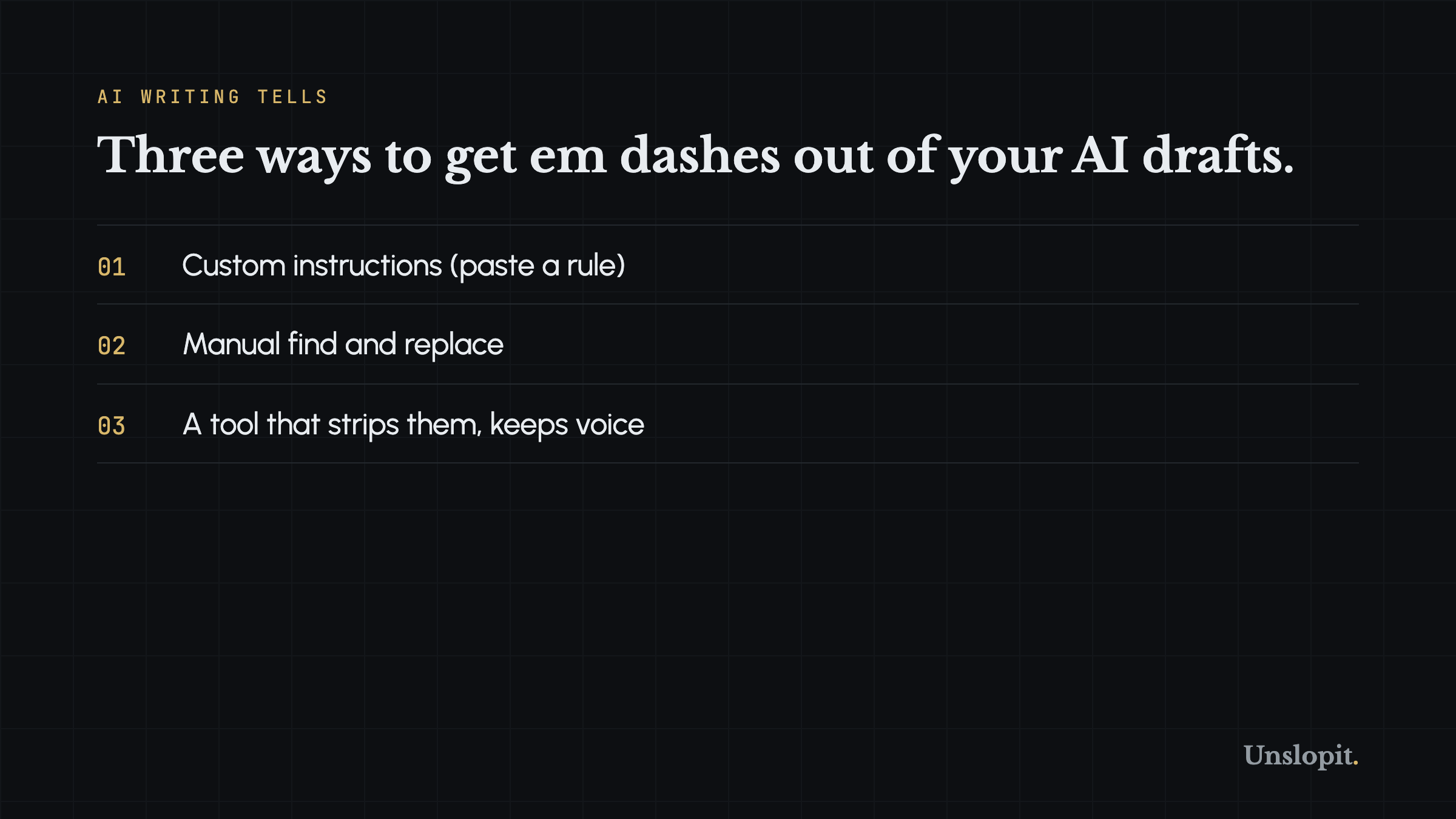
Three Concrete Ways to Stop ChatGPT From Using Em Dashes
If you want ChatGPT to stop flooding your drafts with dashes, you have three practical options. I have tested all of them. They work.
Fix 1: Custom Instructions That Actually Work
Most people try to tell ChatGPT "use fewer em dashes" and it ignores them. You need a specific, unambiguous instruction in your Custom Instructions. Here is the exact text I recommend pasting into your ChatGPT settings under "What would you like ChatGPT to know about you":
Never use em dashes, en dashes, or double hyphens used as dashes in your responses. Use periods, commas, parentheses, or restructure sentences instead. No exceptions.
— Paste this in ChatGPT Custom Instructions
This works because it names the prohibition explicitly, lists the banned characters, gives approved alternatives, and closes with "no exceptions." Vague requests like "sound more natural" will not override the model's deeply trained punctuation habits. You have to be this blunt. I have seen this single instruction cut dash frequency by roughly 90% across multiple ChatGPT versions.
Fix 2: Manual Find-and-Replace Takes 30 Seconds
If you already have a draft full of dashes from ChatGPT, do not rewrite it from scratch. Copy the text into any editor. Search for the em dash character. Replace it with a period or a comma depending on the sentence structure. Then read back through and fix any punctuation collisions (you might end up with double periods or weird comma splices). This takes about 30 seconds for a typical 500-word email and costs nothing.
The main downside: find-and-replace is blunt. It can not tell the difference between a dash that should become a period and one that should become a comma. You will need to read the result and smooth a few spots. But for quick cleanup before hitting send, it gets the job done.
Fix 3: A Tool That Strips Them While Keeping Your Voice
This is the option for people who use ChatGPT as a drafting engine and need clean output at scale. My company Unslopit has an anti-slop auditor that scans AI drafts and flags every em dash along with dozens of other tells. It rewrites the text in your actual voice (you give it a 500+ character writing sample and it builds a voiceprint). The em dashes get stripped in the rewrite, not by dumb deletion but by restructuring the sentences so the flow holds up. The auditor scores the output on 20 anti-slop dimensions and gives you a number you can actually check.
There is a free Slop Score grader at unslopit.io/score. Paste any draft and it tells you how many dashes, buzzwords, and scaffolds are in there. No signup required. If you want the rewrite, the free tier gives you 3 scored rewrites a month.
How to Check Your Own Em Dash Density Right Now
You do not need special tools to measure your dash problem. Open any recent draft you wrote with AI assistance. Count the em dashes. Divide by the word count and multiply by 100. That is your dashes-per-100-words rate. Anything above 1.0 is in the danger zone. Most human writing sits between 0.0 and 0.3. ChatGPT drafts routinely hit 1.5 to 3.0. I have seen drafts with 4.0. That is a dash every 25 words. At that density, the text reads like Morse code.
The density number matters more than the raw count because it scales with document length. One dash in a 50-word email is high density. Three dashes in a 2,000-word essay is fine. The ratio is what your reader's eye picks up on, even if they can not articulate why the text feels off. They sense the rhythmic sameness. Every paragraph pauses the same way. Every aside connects with the same stroke. That uniformity is the real giveaway.
But Wait. Should I Actually Stop Using Em Dashes?
Not necessarily. If you are a human who uses em dashes because you like how they read, keep them. One dash per page is not an AI tell. The problem emerges at scale. The tell is density, not existence. The tell is that every paragraph has one. The tell is that sentences keep pausing in the exact same way.
What I tell users of Unslopit is this: do not let AI's bad habits steal a punctuation mark from you. Em dashes are useful. They create pauses that commas can not match. They let you shift tone mid-sentence. They are part of the language. The goal is not to purge them from existence. The goal is to sound like you and not like a model that learned punctuation from a million JSTOR articles.
If you want to know exactly how many dashes your drafts contain and what your anti-slop score looks like, run your next piece through the free grader at unslopit.io/score. It takes 10 seconds and gives you a number you can track over time. No card, no signup. Just paste and see.